

TL;DR
- Cross platform app development frameworks let you build iOS and Android apps using shared code.
- Flutter is ideal for UI-heavy and fast-iterating apps.
- React Native works best for teams with strong React and JavaScript expertise.
- Kotlin Multiplatform excels when native performance and long-term scalability matter.
- .NET MAUI is suited for Microsoft-centric and enterprise environments.
- Ionic fits content-driven and web-first mobile apps.
- The best framework depends on performance needs, team skills, and product roadmap.
Cross platform app development has moved from a cost-saving option to a strategic decision.
In 2026, mobile apps are no longer just front-end tools. Mobile apps now work as growth engines, data hubs, and AI-powered touch points.
And while building one, businesses now want faster releases, consistent user experiences, and AI-ready architectures.
Instead of building separate apps for iOS and Android, you can now use cross platform app development frameworks to create one code base that works everywhere.
In this article, we will help you choose the best cross platform app development frameworks, based on real-world usage, performance, ecosystem maturity, and future readiness.
On a side note, app development framework selection becomes significantly easier when guided by real-world build and scale experience.
Evangelist Apps partners with startups and enterprises to architect, build, and scale cross platform mobile apps across Flutter, React Native, and Kotlin Multiplatform.
We have already delivered solutions to brands like British Airways, Hastens, Dux, UBS, British Gas and more.
Contact us for building the cross platform app for your business too!
What Is Cross Platform App Development?
Cross platform app development is the practice of building mobile applications that run on multiple platforms using shared logic, shared components, or a shared architecture.
Rather than duplicating effort for iOS and Android, you reuse core code, business logic, API integrations, data handling and core workflows.
Only platform-specific elements are customized when needed.
A premier example of a cross-platform mobile app is the popular social media platform Instagram.

It uses React Native to share a large percentage of its code across both iOS and Android ensuring consistent features and design
Benefits of Building Cross Platform Mobile Apps
Cross platform apps allow you to:
- Reduce development time
- Lower long-term maintenance cost
- Keep feature parity across platforms
- Respond faster to market changes
What are cross platform app development frameworks?
Cross platform app development frameworks are software platforms that enable this shared development model.
They provide:
- Shared business logic layers
- Cross platform UI rendering or native UI bindings
- Access to device features like camera, GPS, and storage
- Tooling for testing, debugging, and deployment
- Access to device APIs
These frameworks form the backbone of modern cross platform mobile app development.
Why Are Businesses Shifting to Cross Platform Mobile App Development?
According to Statista, over 70% of mobile developers now rely on cross platform or hybrid frameworks for at least part of their mobile strategy.
More businesses are now developing cross platform mobile apps because of the following reasons –
- Faster time to market – You release features faster by working on one core codebase.
- Lower total cost of ownership – Shared development and maintenance reduce long-term costs.
- Consistent user experience – Design systems and logic remain aligned across platforms.
- Better AI and cloud integration – Modern frameworks integrate smoothly with AI APIs, analytics, and cloud backends.
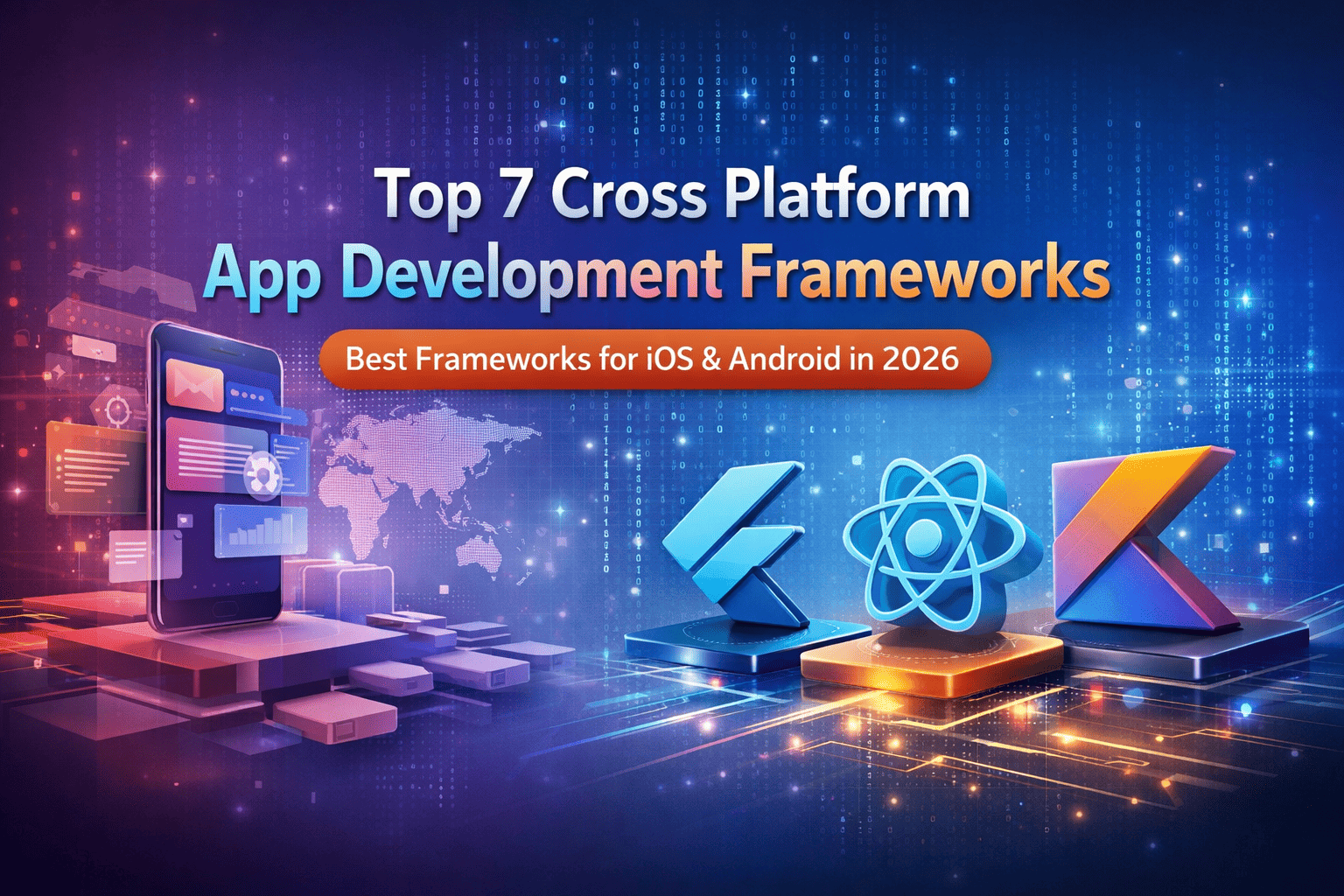
7 Best Cross Platform App Development Frameworks for App Developers
Let’s find out the best frameworks for cross platform app development with practical, deep & use-case based breakdown for the developers & tech leaders.
Each app development framework is evaluated not just on features, but on how it behaves in real production environments.
#1. Flutter
Flutter is a UI-centric cross platform framework that uses a single codebase and a custom rendering engine to deliver consistent experiences across platforms.
Unlike other app development frameworks that rely heavily on native UI components, Flutter controls every pixel on the screen. This gives teams full ownership over design, animation, and performance behavior.
Flutter is widely adopted for modern consumer apps where visual identity, speed, and iteration matter.
Key features of Flutter for cross platform app development
- Single codebase across platforms – Write once and deploy to iOS, Android, web, desktop, and embedded devices.
- Custom rendering engine – Flutter draws UI directly using its own engine, ensuring consistent look and feel regardless of platform or OS version.
- Hot reload for rapid iteration – Developers can see UI and logic changes instantly, reducing feedback loops during development.
- Strong animation and gesture system- Ideal for complex transitions, micro-interactions, and custom design systems.
- Clean architecture support – Works well with scalable patterns like BLoC, MVVM, and clean architecture.
- Easy backend and AI integration – Well-suited for apps integrating APIs, real-time data, recommendations, and AI-powered features.
Practical use cases of Flutter
- Consumer apps with strong branding – Marketplaces, fintech apps, travel apps, and lifestyle products that require visual differentiation.
- Fast MVPs and startup products – Teams can move from prototype to production quickly without sacrificing UI quality.
- Apps with complex UI logic – Dashboards, interactive onboarding flows, and animation-heavy experiences.
- Cross-platform consistency at scale – Ideal when maintaining identical UI behavior across iOS and Android is critical.
Popular apps built with Flutter
- Google Ads
- BMW App

- Alibaba Xianyu
Why choose Flutter: If visual consistency, fast iteration, and design control are top priorities, Flutter remains one of the best cross platform mobile app development frameworks for 2026.
_______________
#2. React Native
React Native enables cross platform app development using JavaScript while rendering real native UI components on each platform.
Instead of drawing its own UI, React Native acts as a bridge between JavaScript logic and native components, allowing apps to feel truly native while sharing most of the codebase.
It is especially popular among teams already using React for web development.
Key features of React Native as app development framework
- Native UI rendering – Uses platform-specific UI components, ensuring familiar behavior for users.
- JavaScript and React ecosystem – Leverages one of the largest developer ecosystems in the world.
- Code reuse with web applications – Shared logic and patterns between React web and mobile apps.
- Fast refresh for productivity – Instant updates during development without full rebuilds.
- Strong third-party integrations – Mature ecosystem for analytics, payments, authentication, and device APIs.
Practical use cases of React Native
- Business and enterprise applications – CRM apps, internal tools, dashboards, and workflow automation apps.
- Apps requiring frequent updates – Ideal for products that release features weekly or bi-weekly.
- Teams with React expertise – Reduces learning curve and hiring friction.
- Feature-rich consumer apps – Where native UX matters but speed of delivery is equally important.
Popular apps built with React Native
- Facebook
- Instagram
- Shopify Mobile
Why choose React Native: React Native works best when you want native user experience combined with faster delivery in cross platform mobile app development.
_____________
#3. Kotlin Multiplatform
Kotlin Multiplatform takes a fundamentally different approach to cross platform development.
Instead of sharing UI, it focuses on sharing business logic, while each platform keeps its native UI. This results in apps that feel fully native but still benefit from shared logic, data handling, and domain rules.
It is often chosen for long-lived, high-performance, and security-sensitive products.
Key features of Kotlin for cross platform app development
- Shared business logic layer – Core logic such as networking, data processing, and validation is reused.
- Native UI per platform – Full control over iOS and Android UI using native frameworks.
- High performance and stability – No UI abstraction layer, resulting in native speed and behavior.
- Strong type safety – Reduces runtime errors and improves long-term maintainability.
- Incremental adoption – Can be introduced into existing native apps without full rewrites.
Practical use cases of React Native
- Fintech and banking apps – Where security, performance, and correctness are critical.
- Enterprise-grade products – Apps with long roadmaps and complex business rules.
- Apps with shared logic but different UI needs – Platform-specific UX with consistent behavior underneath.
- Products migrating from native apps – Gradual adoption without disrupting existing codebases.
Popular apps using Kotlin Multiplatform
- Netflix (shared business logic components)
- McDonald’s
- VMware mobile products
Why choose Kotlin Multiplatform:If performance, architecture, and long-term scalability matter more than UI reuse, Kotlin Multiplatform is a strong strategic choice.
________
#4. .NET MAUI
.NET MAUI is Microsoft’s modern cross platform framework that allows developers to build apps using C# and .NET with a single project structure.
It is the successor to Xamarin and is designed for organizations already invested in the Microsoft ecosystem.
Key features of .NET MAUI
- Single project for multiple platforms – One codebase targeting iOS, Android, Windows, and macOS.
- Native UI abstraction – UI components map to native controls on each platform.
- Deep Microsoft ecosystem integration – Works seamlessly with Azure, Active Directory, and enterprise tooling.
- Strong tooling and debugging – Visual Studio provides robust development and testing support.
- Enterprise-grade security – Well-suited for compliance-driven environments.
Practical use cases of .NET MAUI
- Internal enterprise applications – Admin panels, reporting tools, and operational apps.
- B2B and line-of-business products – Apps that integrate deeply with backend systems.
- Organizations using C# and .NET – Enables teams to reuse skills and backend logic.
Popular apps built with .NET-based frameworks
- Alaska Airlines internal tools
- NBC Sports apps
- Siemens enterprise applications
Why choose .NET MAUI:.NET MAUI is best for enterprises seeking predictable delivery within the Microsoft ecosystem.
__________
#5. Unity (for specialized use cases)
Unity is not a general mobile app development framework, but it plays an important role in graphics-intensive cross platform applications.
Key features of Unity
- High-performance 2D and 3D rendering
- Cross-platform deployment
- Strong AR and VR capabilities
Practical use cases
- Mobile games
- AR/VR experiences
- Simulation and training apps
#6. Ionic with Capacitor
Ionic is a web-first cross platform framework that packages web applications into mobile apps using native bridges.
Instead of rethinking UI for mobile, Ionic allows teams to reuse existing web assets and deliver them as mobile apps.
Key features of Ionic framework
- Web technology stack – Uses HTML, CSS, and JavaScript.
- Single codebase for web and mobile – Ideal for teams maintaining both web and mobile products.
- Fast development cycles – Minimal setup and quick iterations.
- Capacitor native bridge – Access to device features like camera, storage, and notifications.
- Cost-effective delivery – Lower development and maintenance overhead.
Practical use cases of Ionic
- Content-driven applications – News, media, catalogs, and documentation apps.
- MVPs and proof-of-concepts – When speed and budget matter more than native performance.
- Web-to-mobile expansion – Converting existing web apps into mobile experiences.
Popular apps built with Ionic
- MarketWatch

- Sworkit
- JustWatch
Why choose Ionic:Ionic is suitable when speed, cost efficiency, and web reuse are higher priorities than native-level performance.
________
#7. Xamarin (legacy but relevant for migrations)
Xamarin is no longer the primary choice for new projects, but it remains relevant for organizations maintaining or migrating legacy applications.
Key features of Xamarin
- C# shared logic across platforms
- Native API access
- Mature enterprise adoption
Practical use cases of Xamarin
- Maintaining existing Xamarin apps
- Gradual migration to .NET MAUI without disruption
How to Choose the Right Cross Platform Mobile App Development Framework?
Choosing a framework should always start from real product use cases.
Because a wrong app development framework may slow delivery, increase technical debt, or limit future features.
Use the following hands-on, scenario-based criteria to choose the right cross platform app development framework for your business.
Use‑case based app development framework selection guide
| Decision factor | Practical scenario | Requirements | Recommended Framework |
| Type of app | Consumer apps (fintech, marketplaces, social) | Needs smooth UI, fast iteration, frequent releases | Flutter, React Native |
| Enterprise apps (dashboards, internal tools) | Needs stability, security, long-term support | Kotlin Multiplatform, .NET MAUI | |
| Content-driven apps (media, catalogs) | Speed and cost efficiency matter most | Ionic, React Native | |
| Performance needs | Real-time data, heavy animations, video, AR | Requires native-level performance | Kotlin Multiplatform |
| Forms, dashboards, CRUD workflows | Near-native performance is sufficient | Flutter, React Native | |
| UI complexity | Custom animations, branded design systems | Requires full rendering control | Flutter |
| Platform-native look and feel | Needs native UI components | React Native | |
| Full native UI ownership | Separate UI per platform | Kotlin Multiplatform | |
| Team skills | JavaScript / React developers | Faster onboarding, easier hiring | React Native, Ionic |
| Android / Kotlin teams | Shared logic with native control | Kotlin Multiplatform | |
| C# / .NET teams | Best tooling alignment | .NET MAUI | |
| Long-term scalability | Long-lived enterprise products | Maintainability over speed | Kotlin Multiplatform |
| Fast-growing consumer products | Rapid feature delivery | Flutter, React Native | |
| AI feature plans | Recommendations, search, chatbots | Needs strong API and SDK integration | Flutter, React Native |
| Release velocity | Weekly or bi-weekly releases | Fast iteration and hot reload | Flutter, React Native |
| Controlled, stable releases | Predictable lifecycle | Kotlin Multiplatform |
Quick decision shortcuts –
1. Faster MVP & UI speed → Flutter
2. React-based team and native UX → React Native
3. Native performance & clean architecture → Kotlin Multiplatform
4. Microsoft ecosystem alignment → .NET MAUI
5. Web-first or content apps → Ionic
This table-driven approach helps you choose the best cross platform mobile app development framework without guesswork.
Ready to Build Your High‑impact Cross Platform Mobile App?
Evangelist Apps helps you turn the right cross platform app development framework into real business results.
We design and build scalable cross platform mobile apps that work for both iOS and Android apps using a shared codebase without compromising performance, security, or user experience.
Our approach is use‑case driven.
We align frameworks like Flutter, React Native, or Kotlin Multiplatform with your project goals, growth plans, and technical constraints.
This ensures faster launches, lower long‑term costs, and cleaner scalability.
Also, we integrate AI‑ready architecture, analytics, and performance optimization so your app is built for modern, data‑driven use cases from day one.
From launch to continuous improvement, Evangelist Apps acts as a reliable cross platform app development partner.
Explore our case studies to see how we’ve built cross‑platform mobile apps at scale for other businesses.
Book a free call with our app development expert to discuss your product goals, framework strategy, and roadmap and get practical guidance tailored to your business.
F.A.Q: Cross Platform App Development Frameworks
Q. What are cross platform app development frameworks?
Cross platform app development frameworks are tools that let you build one application and deploy it on multiple platforms, mainly iOS and Android, using a shared codebase. Instead of creating separate native apps, you write common logic once and reuse it across platforms. This reduces development time, lowers costs, and makes long-term maintenance easier while still delivering near-native performance when implemented correctly.
Q. Which is the best cross platform mobile app development framework in 2026?
There is no single best framework for every use case. In 2026, Flutter is widely used for UI‑heavy apps, React Native is popular for fast MVPs and content-driven apps, and Kotlin Multiplatform is preferred when strong native performance and gradual migration from native code are required. The best choice depends on your app complexity, performance needs, team skills, and long-term product roadmap.
Q. Is cross platform app development suitable for enterprise-scale applications?
Yes, cross platform app development can work well for enterprise applications when the architecture is designed correctly. Many enterprise apps use cross platform frameworks for shared business logic while keeping platform-specific modules for performance-critical features. This hybrid approach allows enterprises to scale faster, maintain consistency, and reduce technical debt over time.
Q. How does cross platform mobile app development impact app performance?
Modern cross platform frameworks deliver performance that is close to native for most use cases. Performance depends more on architecture, state management, and how native APIs are used than on the framework itself. For compute-heavy or hardware-intensive features, native modules can be integrated to ensure smooth performance without sacrificing the benefits of a shared codebase.
Q. When should I avoid cross platform app development?
Cross platform development may not be ideal if your app relies heavily on platform-specific UI patterns, advanced hardware features, or real-time graphics such as high-end games. In these cases, full native development can provide finer control. However, many products still combine cross platform foundations with native extensions to balance speed and performance.
Q. How much does cross platform mobile app development typically cost?
The cost varies based on app complexity, features, integrations, and ongoing support needs. In general, cross platform development is more cost-effective than building separate native apps because it reduces duplicate effort. You save on development, testing, and long-term maintenance, especially when updates and new features are released frequently.
Q. How long does it take to build a cross platform mobile app?
A typical cross platform app can be built faster than two separate native apps. MVPs are often delivered in a few months, while larger products may take longer depending on scope and integrations. Clear requirements, the right framework choice, and an experienced development team significantly reduce delivery timelines.
Q. Can cross platform apps scale as the user base grows?
Yes, scalability depends more on backend architecture, API design, and infrastructure than on the front-end framework. Cross platform apps built with clean architecture, modular code, and performance monitoring can scale to millions of users without issues. Planning for scalability early is key.
Q. Do I need a specialized team for cross platform app development services?
While many developers can learn cross platform frameworks, delivering production-ready apps requires experience with architecture, native integrations, testing, and deployment. Working with a team (like Evangelist Apps) that specializes in cross platform mobile app development services helps avoid common pitfalls and ensures the app is built for performance, security, and long-term success.
Q. What are the best cross-platform app development frameworks?
The best framework depends on your app and team. Flutter is strong for UI-heavy products, React Native suits React teams and fast releases, Kotlin Multiplatform fits native-performance priorities, and Ionic works well for web-first apps
Q. How do I choose the right cross-platform framework for iPhone and Android?
Compare performance, UI control, team skills, and long-term maintainability. The best choice is the one that gives you speed today without creating a migration problem later.