

AI in finance is not new.
Banks, insurers, asset managers and fintech companies have been using machine learning, predictive models and algorithmic systems for years.
Fraud scoring, credit risk models and algorithmic trading all pre-date today’s generative AI boom.
What has changed is the range of tasks AI can support.
Large language models, generative AI, speech analysis and intelligent automation can now work with unstructured information such as documents, calls, emails and customer conversations.
This is opening up new use cases across operations, compliance, customer service, fraud prevention and product development.
At Evangelist Apps, a leading UK-based AI consulting and development company working closely with financial services organisations, we’ve seen this evolution first-hand across banking, fintech and regulated enterprise environments.
If you’re exploring how to build or integrate AI into your organisation, you can book a free consultation with our team here.
The important question for financial services leaders is how AI can produce useful results without creating unacceptable operational, regulatory or security risks.
This guide looks at where AI is already being used, where expectations are ahead of reality & what UK & global financial services organisations should consider before putting AI into production.
7 Areas where AI is already delivering results in finance
The strongest AI use cases tend to have 3 main characteristics:
- Large volumes of data,
- Repetitive analysis, and
- a clear business outcome that can be measured.
Area #1) Fraud detection and transaction monitoring
AI fraud detection in finance is one of the clearest practical use cases.
Traditional fraud systems often depend heavily on predefined rules. Machine learning models can assess relationships between many signals and identify patterns that may be difficult to capture through rules alone.
These can include unusual transaction behaviour, changes in account activity, device signals and abnormal sequences of events.
This does not mean AI can identify every fraudulent transaction. Fraud patterns change, data can be incomplete, and false positives still create operational costs.
The useful role for AI is often to improve detection, prioritisation and investigation rather than remove human review completely.
The same principle applies to transaction monitoring and wider financial crime controls. AI can help investigators surface unusual cases and focus attention where risk appears higher.
Area #2 Credit risk assessment and underwriting
AI can support credit assessment by analysing larger and more varied datasets.
For lenders, this may mean combining conventional credit information with transaction patterns, application data and other permitted signals. The potential benefit is faster assessment and better risk segmentation.
The risk is that broader data does not automatically mean fairer decisions.
A model can reproduce historical bias, rely on weak proxies or perform differently across customer groups.
For this reason, AI-based underwriting needs regular testing, documented decision logic and clear escalation routes when a decision requires human review.
Area #3 Customer service and operations
Customer service is another area where AI in financial services is already practical.
Conversational AI can answer routine questions, locate information and route more complex cases to the right team.
Generative AI can also help employees summarise case histories, draft responses and retrieve information from internal knowledge bases.
The most sensible deployments often keep a human in control of decisions that affect customers materially.
Document processing is also becoming more useful.
AI can extract information from forms, statements and other documents, reducing manual administration and moving information into downstream workflows for review.
Area #4 Regulatory compliance and reporting
Compliance teams work with large volumes of policies, reports, customer records, regulatory material and internal documentation.
AI can help compare documents, identify exceptions, summarise material changes and surface transactions or cases for investigation. Generative AI can also assist with first drafts of internal reports and summaries.
The important distinction is between assistance and final accountability.
A model can help a compliance professional find relevant information faster. It should not automatically become the sole authority for a regulatory interpretation, formal filing or high-risk decision without appropriate controls.
Area #5 Anti-money laundering
AML is closely related to transaction monitoring but deserves separate attention because of the operational burden created by false positives.
AI and machine learning can help identify unusual relationships across transactions, accounts and customer behaviour.
The goal is not simply to flag more activity.
A useful system should help investigators identify more relevant cases while reducing avoidable investigation work.
This is where model performance needs to be judged against operational outcomes. A lower false positive rate sounds attractive, but not if it also increases missed alerts.
Financial services organisations need to measure both sides of that equation.
Area #6 Personalised financial products
AI can support more personalised customer experiences across banking, lending, insurance and wealth management.
Examples include product recommendations, next-best-action suggestions, spending insights and customer segmentation.
The opportunity is significant, but financial personalisation carries additional responsibility.
A recommendation engine needs to consider fairness, transparency, customer circumstances and the difference between general information and regulated advice.
The rise of consumer-facing AI makes this even more important.
The FCA reported in July 2026 that almost one in five UK consumers may use AI for financial guidance, showing that customer expectations are changing alongside institutional adoption.
Area #7 Voice and identity verification
AI is also changing how financial organisations think about identity and authenticity.
Synthetic voice, deepfakes and AI-assisted conversations create new fraud risks. At the same time, AI-based speech and video analysis can provide new signals for verification.
This is particularly relevant in environments where financial decisions depend on expert conversations, due diligence interviews or other high-value interactions.
VeritasIQ is an example of this emerging category.
It analyses audio, video, transcripts and behavioural signals to identify potential AI-assisted consultations, synthetic voices, deepfake manipulation and inconsistencies in expert responses.
Interested to see the product in action?
Book a FREE demo of VeritasIQ here.
Areas where AI in finance is still overhyped
Not every financial problem needs a large language model, and not every process should be automated.
Fully autonomous trading is often presented as a natural end point for AI in finance.
In practice, financial markets are affected by changing conditions, incomplete information and complex feedback loops. Human oversight, model risk controls and trading governance remain important.
The same applies to the idea of replacing financial advisers entirely with AI.
AI can support research, preparation and customer interactions, but financial advice involves suitability, accountability and customer-specific judgement.
There is also a growing tendency to add AI to products simply because the technology is available.
That approach can create unnecessary risk, cost and complexity.
The better question is simple: what specific decision, workflow or customer problem will improve because AI is involved?
The regulatory landscape for AI banking in the UK
For UK banks and other financial services organisations, AI governance sits within several existing regulatory and legal frameworks.
The FCA’s approach is currently principles-based.
Firms are expected to manage AI in line with their wider regulatory responsibilities, including governance, customer outcomes and accountability.
The FCA has also highlighted cybersecurity as the biggest perceived AI risk among firms.
The PRA’s existing expectations around model risk are also relevant where AI forms part of material modelling or risk processes.
Its supervisory approach emphasises identifying, managing and controlling model risk rather than treating a model as a black box that can operate without oversight.
Data protection is another major consideration.
The ICO’s guidance covers fairness, transparency, security, data minimisation and the governance implications of AI systems that process personal data. Its guidance is currently being reviewed following changes made by the Data (Use and Access) Act.
The Data (Use and Access) Act also changes the UK’s approach to solely automated decision-making. Organisations have greater scope to make certain significant automated decisions, but safeguards include giving people information about significant decisions, allowing representations and providing routes to human intervention.
For firms with EU operations or customers, the EU AI Act also matters.
Its transparency obligations under Article 50 began applying on 2 August 2026, including requirements around informing people when they interact with certain AI systems and addressing certain AI-generated or manipulated content. Whether and how the wider Act applies depends on the organisation, system and market involved.
This is a high-level overview, not legal advice. Financial services organisations should assess their own regulatory, privacy, outsourcing and operational resilience obligations before deploying AI.
6 Key considerations before adopting AI in financial services
The technology is only one part of a successful AI programme.
1) Start with data quality and governance
A sophisticated model cannot compensate for unreliable data.
Before selecting a model, establish what data is available, who owns it, how it is collected, whether it can legally be used for the intended purpose, and how quality will be monitored.
2) Build explainability and audit trails into the design
Financial organisations need to understand what a system did, what information influenced its output and what happened afterwards.
That does not mean every model must produce a simple explanation of every calculation. It does mean organisations should be able to document the system, its purpose, controls, performance and decision process.
3) Test for bias
Bias testing should not be an afterthought.
For lending, underwriting, fraud detection and customer segmentation, organisations should test whether model performance differs between relevant customer groups and investigate material differences.
4) Expect legacy integration
Many financial services organisations are working with technology estates built over decades.
An AI system therefore needs to work with existing APIs, data platforms, customer systems and operational processes. The challenge is rarely just “build the model”. It is connecting that model safely to everything around it.
5) Decide whether to build, buy or partner
There is no universal answer.
- A standard capability may be easier to buy.
- A strategically important workflow may justify custom development.
- A hybrid model may be appropriate where an organisation needs specialist engineering but wants to use established foundation models.
The decision should consider data sensitivity, integration requirements, model control, total cost of ownership and internal capability.
6) Treat security and data residency as design decisions
Before sending financial or personal data into an AI service, teams need to know where that data is processed, what is retained, which model provider is involved, and what contractual and technical controls apply.
For regulated environments, security reviews should happen before production deployment, not after the pilot succeeds.
Want to explore what AI could do in your organisation?
Book a free consultation with our AI team & get a complete roadmap for your AI development & integration.
Use case spotlight: AI in compliance & due diligence
AI in compliance finance is increasingly moving beyond simple document automation.
In due diligence and expert-based research, AI can help verify identities, analyse interview transcripts, detect unusual voice characteristics and identify inconsistencies between an individual’s stated expertise and the information presented during an engagement.
The aim is not to let a model decide whether an expert is trustworthy.
It is to give compliance and operations teams additional evidence they can investigate.
VeritasIQ is designed around this problem. It analyses audio, video and transcript signals to detect synthetic voices, deepfake manipulation and potential AI-assisted responses during expert calls.
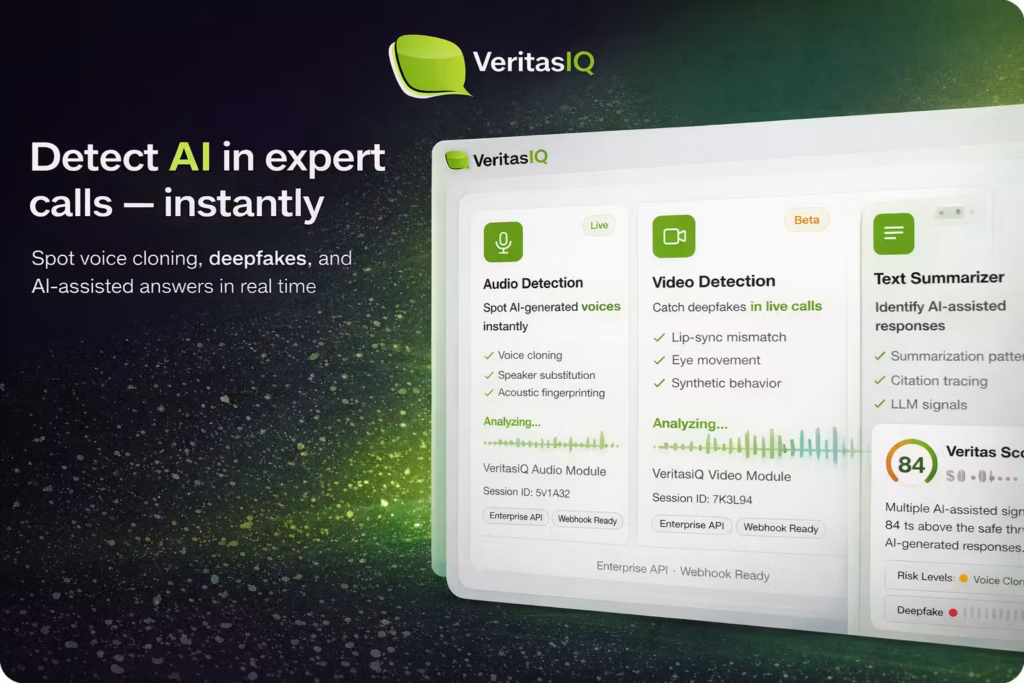
Its workflow produces a consolidated authenticity score and compliance alerts that can support human review.
This makes it relevant to organisations where expert integrity, due diligence and information quality matter to financial decision-making.
How Evangelist Apps works with financial services organisations
Evangelist Apps is a UK-based engineering partner with 18 years of proven experience delivering secure, enterprise-grade software for some of the most recognised names in financial services and fintech.
The team has built and shipped production systems for organisations including UBS, Virgin Money, Third Bridge & others helping them modernise customer experiences, strengthen security, and scale digital operations.
This track record matters because financial services organisations rarely need “new AI tools in isolation”.
They need AI that can safely integrate into complex, regulated environments existing banking systems, legacy infrastructure, compliance workflows, and strict data governance frameworks.
Evangelist Apps specialises in exactly this intersection: combining financial-grade software engineering with modern AI capability to deliver systems that are production-ready, secure, and regulator-aware from day one.
For financial institutions, fintechs, and regulated organisations exploring how AI can be safely introduced into their systems, Evangelist Apps offers a practical starting point grounded in real delivery experience.
Book a free consultation with Evangelist Apps today
Get a practical AI roadmap for your organisation and identify where AI can deliver measurable value in your existing systems.
You can also take a quick look at our past projects here.
What responsible AI adoption looks like in 2026 & beyond
For financial services organisations, responsible AI is becoming less about making broad statements and more about building practical controls into delivery.
A sensible programme usually starts with –
- a defined business problem,
- a measurable outcome and
- a limited pilot.
The organisation then evaluates accuracy, operational impact, security, customer impact and governance requirements before expanding the use case.
This approach also makes it easier to decide where AI should not be used.
The FCA’s 2026 work reinforces that AI is likely to reshape firm operations, customer journeys, competition and fraud or cyber risk.
That suggests the organisations best placed to benefit will not necessarily be those deploying the most AI. They will be those that know where AI adds value and where human judgement must remain central.
Final thoughts on AI in finance
AI in finance is moving from experimentation into everyday operational use.
Fraud detection, compliance support, document processing, customer service, risk assessment and financial personalisation all offer practical opportunities.
But financial services are different from many other industries.
A system can be technically impressive and still be unsuitable if its data is weak, its outputs cannot be reviewed, its integration is insecure or its decisions create unacceptable customer risk.
For UK banks, insurers, asset managers and fintech companies, the strongest AI strategies are likely to be the ones that combine useful technology with strong governance, clear accountability and sensible human oversight.
That is the difference between adding AI to a financial product and building an AI capability that an organisation can actually trust.
Get in touch with us to discuss AI for your financial services organisation
Frequently asked questions
Q. Can smaller fintech companies use AI without a large data science team?
Yes. Smaller fintechs can start with focused use cases using managed models, specialist platforms or external engineering support. The key is to define a narrow business problem and put governance around the system from the start.
Q. Does generative AI have a role in core banking systems?
It can, but usually as a supporting layer rather than a direct replacement for core transaction processing. Common applications include employee assistants, document analysis, knowledge retrieval, case summarisation and workflow support.
Q. What should a bank measure after an AI pilot?
Metrics should reflect the business problem. Depending on the use case, this may include processing time, false positive rates, investigation effort, customer outcomes, accuracy, escalation rates, security incidents and cost per case.
Q. How can financial firms reduce the risk of AI hallucinations?
Use controlled data sources, retrieval-based systems where appropriate, output validation, confidence thresholds and human review for higher-risk tasks. Generative AI should not be treated as an authoritative source simply because its response sounds convincing.
Q. Is AI suitable for insurance as well as banking?
Yes. Insurers can apply AI to areas such as claims processing, underwriting support, fraud detection, customer service, document analysis and risk assessment. The same requirements around data quality, fairness, security and governance still apply.
Q. Should AI models be built internally or hosted by an external provider?
It depends on the use case. Internal or private deployments can provide greater control over data and architecture, while external providers can reduce development effort. Financial organisations should assess security, data handling, integration, performance, cost and vendor dependency before choosing an approach.
Q. How does AI affect financial services outsourcing?
AI changes the skills required from technology partners. Organisations increasingly need partners that can connect models to existing applications, data and workflows while working within security, governance and operational constraints.