

Artificial Intelligence is no longer an experiment for tech teams.
In 2026, AI is a core business capability.
If you are a CTO, product leader, or founder, your focus has shifted from “Should we use AI?” to “Where does AI create real business advantage?”
This article breaks down the most important AI trends in 2026, explained in a practical and implementation‑focused way.
You will understand what is changing, why it matters, and how to act on it especially if you are building digital products, platforms, or enterprise systems.
The goal is simple: help you make better AI decisions that deliver speed, efficiency, and measurable ROI.
So, let’s get started.
What Are AI Trends in 2026?
AI trends in 2026 reflect 3 clear shifts:
- From experimentation to execution
- From generic models to business‑specific systems
- From tools to embedded intelligence
AI is now expected to improve margins, accelerate delivery, reduce operational friction, and unlock new product capabilities.
Why AI Trends Matter for Tech and Product Leaders?
If you lead technology or product teams, catching up with the AI trends in 2026 directly impact:
- Product roadmaps
- Engineering velocity
- Cost structures
- Data strategy
- Competitive positioning
Ignoring these trends increases technical debt, operational risk, and time‑to‑market delays.
Understanding them helps you invest wisely and avoid AI hype traps.
To put this shift into perspective, global investment in AI is accelerating rapidly.
Worldwide spending on artificial intelligence is projected to reach approximately USD 2.52 trillion in 2026, showing how strongly enterprises are backing AI initiatives that deliver real business value.
So missing these 2026 AI trends can pose serious challenges for enterprises.
Top 7 AI Trends in 2026 You Must Watch.
These AI trends represent clear patterns in how real products, platforms, and enterprises are being built and scaled.
These trends show where AI is delivering measurable outcomes today and where long-term competitive advantage is being created.
For CTOs, founders, and product leaders, these trends answer practical questions such as:
- Where should AI be embedded in the product roadmap?
- Which AI investments reduce cost and time-to-market?
- What type of AI architecture will scale safely in production?
- How do teams move from pilots to reliable AI systems?
The trends below focus on execution over experimentation.
Each one reflects how mature teams are applying AI to solve operational bottlenecks, improve customer experience, and unlock new revenue opportunities.
If you are building or modernizing digital products in 2026, these are the AI trends you cannot ignore.
Trend #1: Agentic AI Is Redefining Software Systems
Agentic AI is one of the most important AI trends in 2026 because it changes how software behaves, not just what it outputs.
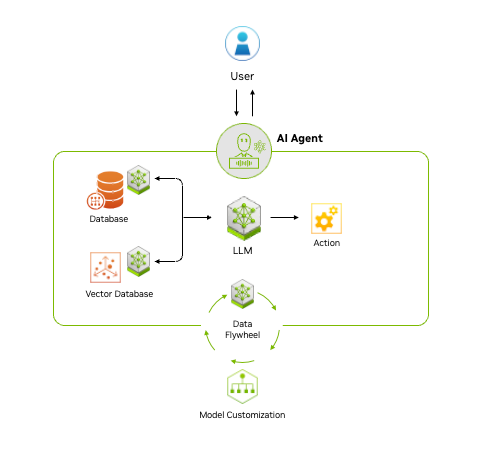
Picture credit: NVIDIA
Agentic AI systems can plan, decide, and act across multiple steps to achieve a goal. Instead of waiting for one instruction at a time, these systems understand intent, break work into steps, and complete tasks end to end.
Unlike traditional AI that reacts to prompts, agentic AI:
- Understands a goal, not just a command
- Breaks the goal into smaller tasks
- Selects the right tools, APIs, or data sources
- Executes actions in the correct order
- Checks results and adjusts when needed
Why Agentic AI Matters in Real Products
In practical terms, agentic AI turns software into active participants in your business.
- Your systems no longer wait for manual input
- Repetitive coordination work disappears
- Operational tasks run continuously in the background
This is why many teams describe agentic AI as creating digital workers, not features.
Practical Examples of AI Agent Implementation for Different Use-cases
- Customer support: An AI agent reads a ticket, checks order data, processes a refund, updates CRM, and closes the ticket without human handoffs.
- DevOps and reliability: An agent detects a performance issue, analyzes logs, rolls back a deployment, and alerts the team with context.
- Revenue operations: An agent updates pipeline data, flags deal risks, sends follow-ups, and adjusts forecasts.
What Teams Must Design Carefully
Agentic AI only works well when supported by:
- Clear orchestration logic
- Guardrails and approval checkpoints
- Full observability and audit logs
Without these, agentic systems can become unpredictable.
In 2026, strong agent design is a core engineering skill.
___________
Trend #2: Vertical AI Is Replacing Generic AI
Generic AI models are powerful, but they lack business context. In 2026, that gap becomes a serious limitation.
Vertical AI focuses on specific industries and domains, such as healthcare, fintech, SaaS, retail, or manufacturing. These systems are trained and configured to understand industry workflows, data structures, and rules.
Why Vertical AI Delivers Better Results
Vertical AI systems:
- Use industry-specific data
- Understand domain terminology
- Follow regulatory and compliance rules
- Match real operational workflows
This leads to higher accuracy and faster adoption.
A Practical Example of How Vertical AI Helps
A generic AI can summarize text and do the basic stuff.
On the other hand, a vertical AI for healthcare can:
- Understand clinical notes
- Follow patient privacy rules
- Support diagnostic workflows
- Integrate with hospital systems
That difference directly impacts trust and usability.
Why Vertical AI Matters for Product Companies
In 2026, vertical AI becomes a competitive moat.
If your product understands your customer’s industry better than competitors, switching costs increase and value becomes clearer.
_________
Trend #3: Embedded AI for Modern Products
One of the biggest AI industry trends in 2026 is that AI disappears from the interface but becomes central to the experience.
This concept is called “Embedded AI”.
Embedded AI means intelligence is built directly into workflows, not added as a separate chatbot or feature.
Users do not “use AI.” They simply get better outcomes.
What Embedded AI Looks Like in Practice
- Search that understands intent, not keywords
- Dashboards that explain trends, not just show charts
- Forms that auto-fill based on context
- Systems that recommend the next best action
Why Embedded AI Works
- No learning curve for users
- Faster task completion
- Higher feature adoption
This trend improves user experience, retention, and product stickiness.
For SaaS and platform teams, embedded AI is now a baseline expectation, not a differentiator.
This expectation is driven by adoption at scale.
Recent industry data shows that around 78% of companies globally are already using AI in at least one business function, which means users increasingly expect intelligent behavior to be built directly into the tools they use every day.
_____________
Trend #4: Multimodal AI Is Becoming the Standard
In the real world, information is not just text.
Multimodal AI processes text, images, audio, and video together, allowing systems to understand richer context.
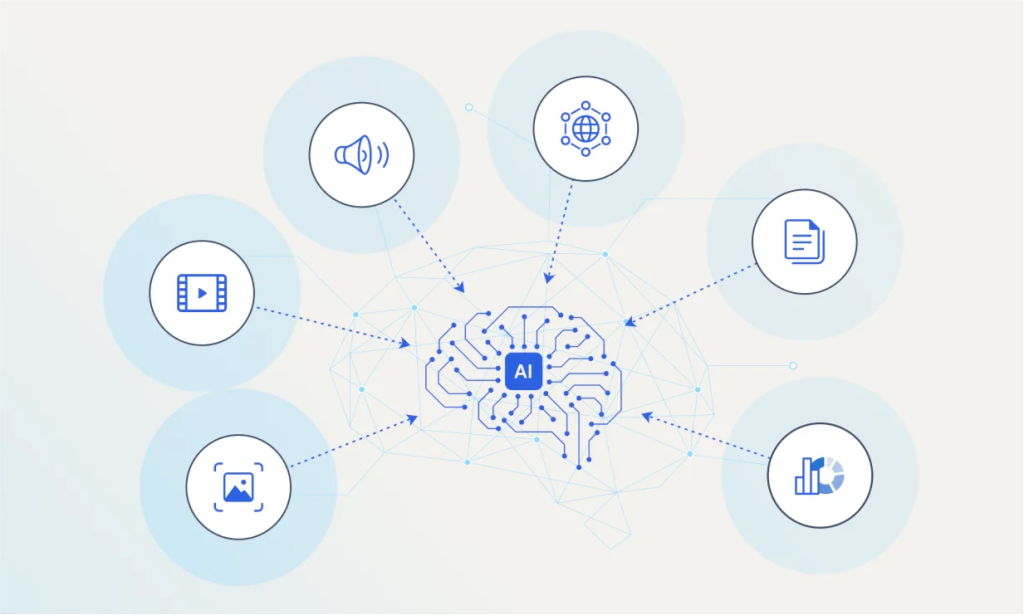
Pic credit: Appen
In 2026, products built on a single data type feel incomplete.
Why Multimodal AI Matters for Businesses
- It mirrors how humans communicate
- It reduces friction in complex tasks
- It improves accessibility and usability
Real-world Business Use Cases
- Video analytics: Understanding both visuals and spoken words
- Voice-enabled tools: Combining speech with on-screen context
- Quality inspection: Analyzing images with historical data
Multimodal AI enables more natural and accurate decision-making inside products.
This trend is closely tied to the rapid growth of generative AI capabilities.
Enterprise spending on generative AI technologies is projected to reach approximately USD 644 billion, reflecting strong demand for AI systems that can understand and generate content across multiple formats such as text, images, audio, and video.
So, as a tech leader, you better not miss it!
___________
Trend #5: AI Agents Are Changing Team Productivity
AI agents are no longer personal assistants.
In 2026, they are becoming team-level productivity systems. (You might have already used one such as Claude Code, Clawdbot etc.)
Instead of helping one person at a time, AI agents now support entire workflows.
What AI Agents Do Well
- Prepare and summarize reports
- Extract insights from large datasets
- Monitor KPIs continuously
- Trigger actions across tools
The Real Productivity Shift
The biggest gains do not come from better prompts.
They come from system-level automation, where AI is connected to internal tools like CRM systems, ERP, analytics, and ticketing systems.
This reduces coordination overhead and decision latency across teams.
___________
Trends #6: AI Governance Is a Core Engineering Requirement Now
As AI systems take on more responsibility and corporations adopt more AI into their daily workflows, governance becomes a technical necessity.
In 2026, AI governance is built directly into architecture.
By 2026, both the European Union and the United States have introduced legal frameworks that directly impact how AI systems are designed, deployed, and governed.
In the European Union, AI systems are now legally regulated under a risk-based legal model.

Picture credit: EU AI Act
Certain harmful applications are restricted outright, and compliance obligations are being enforced in phases through 2026.
In the United States, AI regulation remains decentralized. Instead of one federal AI law, oversight is spread across states and industry regulators.
Rules focus on transparency, consumer protection, automated decision disclosure, and responsible use of high-impact AI systems, especially in sensitive domains.
For product teams and CTOs, this means AI governance must be built into the system design, not added later.
Where and how your AI product is deployed now directly affects compliance, risk exposure, and long-term scalability.
AI Core Governance Components
- Model monitoring and performance tracking
- Bias and drift detection
- Clear audit trails
- Explainable outputs
- Human-in-the-loop controls
Why AI Governance Matters
Without governance:
- AI decisions become opaque
- Compliance risks increase
- User trust declines
Responsible AI is now a product quality metric.
Teams that design governance early move faster and face fewer risks later.
_________
Trend #7: Edge & Hybrid AI Improving Performance
Cloud-based AI works well for many use cases, but it is not always ideal. (at least for the commercial use-cases)
Edge and hybrid AI bring intelligence closer to where data is generated.
Hybrid LLMs are beautifully explained here, check it out!
Benefits of Hybrid AI
- Lower latency
- Better privacy
- Reduced cloud costs
Why this trend is growing
- Lower latency for real-time decisions
- Better data privacy and control
- Reduced cloud processing costs
Practical Use Cases of Hybrid & Edge AI
- IoT and sensor-based systems
- Real-time monitoring platforms
- On-device AI for mobile and wearables
For regulated industries and performance-critical products, edge and hybrid AI are becoming essential architectural choices.
Embedded AI examples using Hybrid & Edge AI
- Search that understands intent
- Dashboards that explain insights
- Forms that auto‑complete intelligently
- Systems that predict next actions
Adopting this trend can help businesses improve UX, retention & feature stickiness.
What Is the Future of AI Beyond 2026?
The future of AI is shaped by:
- Autonomous systems
- Domain‑specific intelligence
- Human‑AI collaboration
- Strong governance frameworks
AI will become invisible infrastructure, quietly powering decisions across products and operations.
If you focus on practical use cases, strong architecture, and responsible deployment, AI becomes a powerful growth lever.
The winners in 2026 are not the companies using the most AI but the ones using it wisely.
Companies that treat AI as a strategic capability not a feature will lead.
How Evangelist Apps Helps You Build Practical AI Systems
Evangelist Apps works with startups and enterprises to design, build, and scale AI‑powered applications.
Our focus is practical, production‑ready AI.
With multiple real‑world AI implementations across SaaS, enterprise platforms, and regulated environments, Evangelist Apps brings proven delivery experience.
Our AI and App Development Capabilities
- AI strategy and architecture
- Custom AI model integration
- Agent‑based systems
- AI‑powered mobile and web apps
- Data engineering and MLOps
- Responsible AI implementation
Check our case studies to see the clients we have worked with and the solutions we have built for them.
book a free call with us to discuss your use case.
We help you align AI initiatives with business outcomes, engineering realities, and long‑term scalability.
F.A.Qs
Q. What are the top AI trends in 2026?
The top AI trends in 2026 include agentic AI, vertical AI, embedded AI, multimodal AI, AI agents for team productivity, builtin AI governance, and edge or hybrid AI architectures. These trends focus on production‑ready systems that deliver measurable business outcomes.
Q. How will AI trends impact businesses in 2026?
AI trends in 2026 impact businesses by reducing operational costs, improving decision speed, increasing automation across workflows, and enabling smarter products. Companies that align AI with core workflows gain faster time‑to‑market and stronger competitive advantage.
Q. What is agentic AI in simple terms?
Agentic AI is a type of AI that can plan tasks, take actions, and adjust its behavior to reach a goal with minimal human input. Unlike traditional AI, it works across multiple steps instead of responding to a single prompt.
Q. Why is vertical AI more effective than generic AI?
Vertical AI is more effective because it is trained and designed for a specific industry. It understands domain data, workflows, and rules, which leads to higher accuracy, better compliance, and faster user adoption compared to generic AI models.
Q. What does embedded AI mean in software products?
Embedded AI means AI is built directly into product workflows instead of existing as a separate feature. Users experience smarter behavior such as recommendations or insights without needing to interact with AI explicitly.
Q. How do AI agents improve team productivity?
AI agents improve team productivity by automating repetitive tasks, monitoring systems continuously, summarizing information, and triggering actions across tools. This reduces manual coordination and allows teams to focus on higher‑value work.
Q. Why is AI governance important in 2026?
AI governance is important because AI systems increasingly influence decisions. Governance ensures transparency, fairness, compliance, and reliability by adding monitoring, explainability, and human oversight into AI systems.
Q. What is the difference between edge AI and cloud AI?
Cloud AI processes data centrally, while edge AI runs closer to where data is generated. Edge and hybrid AI reduce latency, improve privacy, and lower cloud costs, making them ideal for real‑time and regulated use cases.
Q. How should companies start adopting AI trends safely?
Companies should start by identifying high‑impact use cases, running small pilots, embedding governance early, and scaling gradually. A clear AI architecture and experienced implementation support reduce long‑term risk.
Q. How does Evangelist Apps help companies adopt AI?
Evangelist Apps helps companies design and build scalable, secure, and production‑ready AI systems. The focus is on aligning AI with real product goals, engineering constraints, and long‑term business value rather than experimentation alone.