

TL;DR
- AGI means artificial general intelligence.
- Today’s AI is not AGI. Current systems are powerful, but they still work best inside predefined limits and special-purpose use cases.
- Commercial availability will lag the breakthrough. Even if AGI arrives, productization will still depend on safety, trust, regulation, cost, and real-world reliability.
AGI stands for artificial general intelligence.
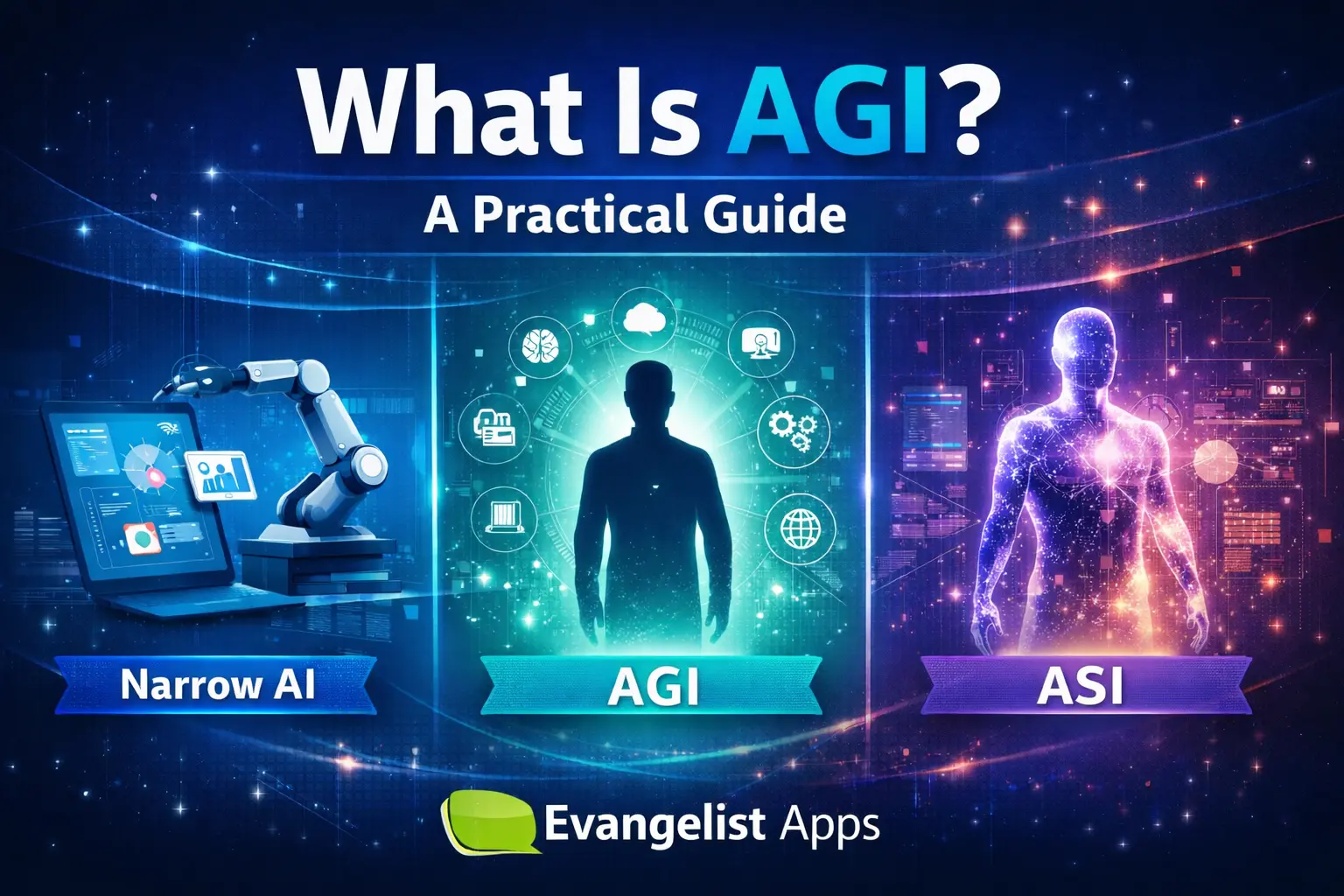
In plain English, it is the idea of an AI system that can learn, reason, and adapt across many different tasks the way a human can. That is very different from the AI most people use today, which is still mostly narrow, task-specific, and limited by training boundaries.
As of now, true AGI does not exist.
But will they make it? That’s the BIG question.
This is why AGI is such a big topic: it represents a shift from task-based automation to true machine intelligence that can solve problems across domains.
What Does AGI Stand For?
AGI stands for artificial general intelligence. The phrase describes a machine intelligence that is broader than today’s narrow AI. It is meant to be flexible, transferable, and capable of handling unfamiliar tasks without task-specific retraining.
What Is AGI in Simple Terms?
A simple way to think about AGI is this: if today’s AI is a very strong specialist, AGI would be a generalist.
A specialist AI can do one thing well, such as generate text, classify images, recommend products, or summarize documents.
AGI would be expected to do all of those kinds of tasks, but also learn new domains, reason in context, and adapt when the situation changes.
That broader ability is what makes AGI different from the AI tools available now.
What Is the Difference Between AI and AGI?
This is one of the most common questions, and the answer matters.
AI today
Current the AI we know is mostly narrow AI. It is built for specific tasks such as image recognition, chat, or filtering email. These systems operate within predefined limits and are optimized for particular use cases.
AGI
AGI is the proposed next step. It would be able to learn from new situations, move across domains, and solve tasks it was not explicitly trained for. It represents broad, flexible, transferable intelligence that does not require task-specific programming.
The practical difference
The difference will be operational.
If an AI tool can help you write a draft email, summarize a call, or generate code, that is useful AI.
If the same system can reliably reason about unfamiliar business problems, plan a strategy, learn a new tool on its own, and complete complex work across departments with human-level consistency, that starts to resemble AGI.
Today’s AI tools are impressive, but they are still not there (at least the time I am writing this piece on!)
What Is AGI and ASI?
AGI is usually discussed as a midpoint.
ASI stands for artificial superintelligence.
ASI refers to a theoretical form of AI that would surpass human intelligence in reasoning, creativity, and emotional intelligence. In other words, AGI would aim to match human-level general ability, while ASI would go beyond it.
That is why AGI and ASI are often mentioned together.
If AGI were ever built, some expect it could become a stepping stone to ASI. Others argue that this jump is not automatic and may require new breakthroughs, not just bigger models.
When Can We Have AGI?
There is no consensus.
Some estimates suggest AGI could arrive within five to ten years, while others believe it could take decades or even longer. These wide-ranging views highlight how uncertain the timeline still is.
Understanding AGI timelines becomes clearer when you hear directly from the people building it.
In this interview, leading AI company Open AI‘s founder Sam Altman shares his perspectives on how close we are to AGI. (Watch this if you haven’t already!)
A practical reading is this: the AGI timeline is still a forecast, not a schedule.
However, not everyone believes AGI is a distant milestone.
Nvidia CEO Jensen Huang recently made headlines by stating that, by certain definitions, we have already achieved AGI.
Huang argues that if the benchmark for AGI is the ability of AI to pass a broad battery of human tests from legal bar exams to medical certifications then that capability is already within our grasp.
This perspective shifts the debate from when it will happen to how we define it.
While some see AGI as a future “super-intelligence,” leaders like Huang suggest that the functional reality of general intelligence is already beginning to operate within the industry.
What Should Businesses Do With That Uncertainty?
Do not wait for AGI to start using AI.
The right move is to build for the AI that exists now: copilots, assistants, workflow automation, retrieval systems, and domain-specific agents.
That is where the value is today.
Stanford’s 2025 AI Index Report found that 78% of organizations reported using AI in 2024, up from 55% the year before which is already a top-notch move.
Is AGI Impossible to Achieve?
That’s a brewing question online.
And it’s really difficult to answer at this point of time.
A careful answer is better than an absolute one.
AGI is not proven impossible.
But some researchers and critics argue that the way people talk about AGI is too vague, too benchmark-driven, or too optimistic about current model scaling.
Today’s systems are still specialized and do not generalize like humans do. They also struggle with deeper understanding, reasoning consistency, and real-world adaptability.
There is also a deeper issue.
Some research suggests that under strict definitions, a system may not be able to be both fully safe and fully autonomous at the same time.
That does not mean AGI can never exist in practice. It does mean that the more power and autonomy you add, the harder it becomes to guarantee safety.
The Most Practical Reasons Skeptics Push Back
- Current AI still struggles with reliable generalization outside its training domain.
- Human-level common sense is still hard to replicate.
- There is no universally accepted AGI test.
- Safety, trust, and broad autonomy may pull in different directions.
So the better framing is this: AGI may not be impossible in principle, but it is still unresolved in practice, definition, measurement, and deployment.
When Will AGI Be Commercially Available?
Not today.
No widely accepted AGI product exists in the market right now. AGI is still a theoretical concept rather than a commercial reality.
Even after a technical breakthrough, commercial availability would likely take time.
Real products need reliability, liability controls, auditability, cost efficiency, compliance, and strong human oversight. That is why the first commercially successful wave is more likely to be AGI-adjacent systems such as copilots, domain agents, and workflow automation tools.
What AGI Means for Business Right Now
The smartest business move is not to wait for AGI. It is to prepare for stronger AI.
That means:
- Choose one high-value process to automate.
- Keep a human in the loop for quality and risk.
- Use AI where the cost of error is manageable.
- Build data and governance foundations now.
- Treat AGI as a strategic horizon, not a dependency.
This is where practical execution matters.
Teams that want to move from AI curiosity to production systems should work with builders who understand strategy, product, and engineering together.
Evangelist Apps is a strong example of an AI development partner that can help businesses turn current AI into useful products, custom assistants, and workflow automations without chasing hype.
Book a 15-min FREE consulting call with us for a detailed AI roadmap, integration, costs and other factors.
A Simple Rule to Follow
If a use case is valuable today with narrow AI, build it today.
Do not wait for AGI to solve a problem that is already solvable with the tools we have.
Open AI founder Sam Altman already heard saying –
We are now confident we know how to build AGI
At the same time, there are also views that while progress is strong, there are still missing pieces and uncertainty around timelines.
That contrast is the real story: confidence is rising, but certainty is not.
F.A.Q
Q. What is AGI?
AGI stands for artificial general intelligence. It refers to a theoretical AI system that can learn, reason, and adapt across many tasks at a human-like level.
Q. What does AGI stand for?
AGI stands for artificial general intelligence.
Q. What is AGI vs AI?
AI is the broad field, and today’s AI is mostly narrow and task-specific. AGI would be a much broader system that can generalize across domains and learn new tasks more like a human.
Q. What is AGI and ASI?
AGI is human-level general intelligence in theory. ASI, or artificial superintelligence, would go beyond human intelligence across reasoning, creativity, and other domains.
Q. When can we have AGI?
No one knows for sure. Current estimates range from a few years to decades or longer, and some researchers think it may never happen.
Q. Why is AGI impossible?
It is not proven impossible. But some experts argue that current AI methods do not yet solve generalization, grounding, common sense, or strict safety-and-trust requirements at AGI level.
Q. When will AGI be commercially available?
There is no confirmed date. Since true AGI does not exist yet, any commercial availability would depend on both a technical breakthrough and the ability to deploy it safely and reliably.
Q. How far are we from AGI?
AGI is still a theoretical goal with no clear timeline. Current AI systems are highly capable but remain task-specific. Most experts estimate we are years to decades away, depending on breakthroughs in reasoning, learning, and real-world adaptability.