Many AI applications rely solely on the knowledge embedded within a language model during training.
While this works well for general questions, it becomes a challenge when businesses need AI to answer questions using company-specific documents, policies, customer records, or product information.
RAG solves this problem by allowing an AI system to search relevant content before generating a response. Instead of relying only on what the model “remembers,” it retrieves information from trusted sources such as internal knowledge bases, PDFs, databases, SharePoint, CRM systems, or websites.
For organisations, this means AI can provide answers that are not only fluent but also relevant, traceable, and based on the latest available information. Whether it’s an internal employee assistant, customer support chatbot, legal knowledge portal, or enterprise search solution, RAG significantly improves reliability while reducing the chances of incorrect or outdated responses.
As more businesses adopt AI, RAG has become one of the most important building blocks for enterprise-grade generative AI solutions.
How RAG Works
At its core, Retrieval-Augmented Generation combines two capabilities: information retrieval and natural language generation.
When a user asks a question, the AI system does not immediately generate an answer. Instead, it first searches a connected knowledge source to identify the most relevant documents or pieces of information related to the query.
The retrieved information is then provided as additional context to the language model.
Using this context, the model generates a response that is based on the retrieved data rather than relying solely on its pre-trained knowledge.
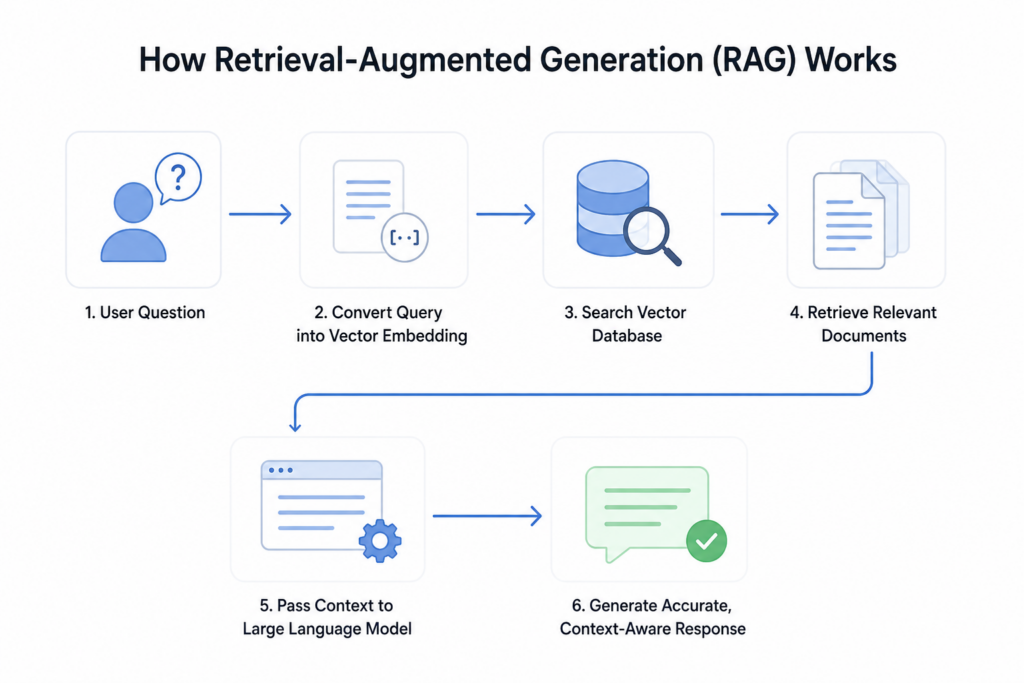
A typical RAG workflow includes the following steps:
A user submits a question.
The question is converted into a mathematical representation known as an embedding.
The embedding is compared against a vector database to find similar content.
The most relevant documents are retrieved.
The retrieved content is passed to the language model.
The language model generates a contextual, human-readable response.
This process typically happens within seconds, allowing users to receive responses that are both conversational and supported by relevant business information.
What Are the Benefits of RAG
Improves Accuracy
By retrieving relevant information before generating a response, RAG reduces the likelihood of incorrect or fabricated answers.
Uses Business-Specific Knowledge
RAG enables AI systems to understand and respond using company documents, technical manuals, contracts, policies, and other proprietary information without retraining the language model.
Keeps Information Current
Instead of waiting for a language model to be retrained, businesses can simply update their knowledge repository. The AI automatically accesses the latest information during retrieval.
Reduces AI Hallucinations
Because responses are grounded in retrieved content, RAG helps minimise unsupported or misleading answers, making AI more trustworthy for business applications.
Scales Across Multiple Data Sources
RAG can connect to document libraries, cloud storage, enterprise databases, CRM platforms, ERP systems, websites, and APIs, creating a unified AI knowledge experience.
Cost-Effective
Rather than fine-tuning a language model every time business information changes, organisations can update their documents while continuing to use the same AI model.
Real-World Business Example of RAG Usage
Imagine a manufacturing company with thousands of product manuals, maintenance guides, safety procedures, and technical specifications stored across multiple systems.
Without RAG, an AI assistant may provide generic answers based on publicly available knowledge, which could be incomplete or outdated.
With RAG, the assistant searches the company’s latest documentation whenever an engineer asks a question such as:
“What is the recommended maintenance schedule for Model X hydraulic pumps?”
Instead of guessing, the AI retrieves the relevant maintenance manual, identifies the correct section, and generates a concise answer based on the company’s own documentation.
This enables employees to access trusted information faster while reducing the need to manually search through lengthy documents.
How Evangelist Apps Uses RAG
At Evangelist Apps, we build intelligent AI solutions that deliver practical business value rather than generic chatbot experiences.
We use Retrieval-Augmented Generation to develop enterprise AI assistants, knowledge management platforms, customer support solutions, document search systems, and internal productivity tools. By connecting AI models with trusted business data, we help organisations generate responses that are accurate, relevant, and aligned with their latest information.
Our RAG implementations can integrate with platforms such as Microsoft SharePoint, Dynamics 365, cloud storage, CRM systems, APIs, and custom databases, allowing businesses to unlock the full value of their existing knowledge without extensive model retraining.
Whether you’re building an AI-powered customer portal or an internal knowledge assistant, RAG provides the foundation for reliable, context-aware AI experiences.
Summarize with AI
Share:
Transform your
business! Build a
powerful mobile app
now!
Why Over 500 Clients Choose Evangelist Apps
Why Organizations Trust Us
25+ Years of Expertise. |
Global Reach |
Agile. Transparent. Fast
Our Recognized Certifications & Partnerships
About to leave?
Share your requirements with us, and we’ll provide you with a detailed estimate on cost and timeline