

You probably already know this but I will repeat again.
Choosing the wrong software development methodology will make your team struggle with delays, scope creep, and technical debt.
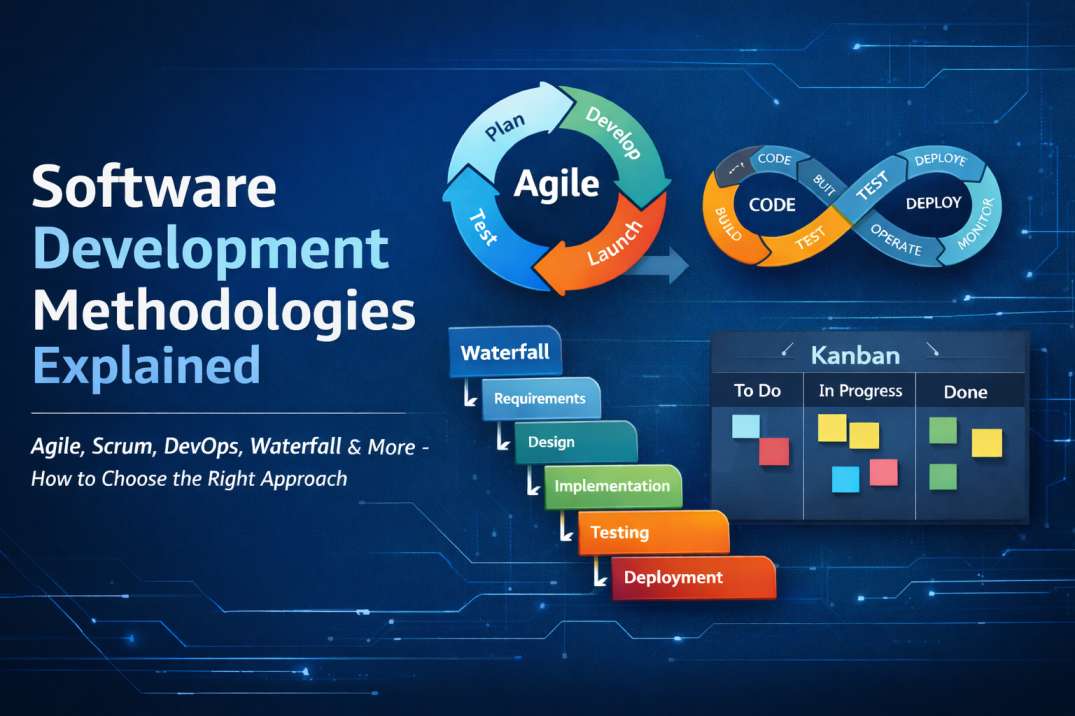
In the new age of AI-driven development, software teams must balance speed, security, compliance, AI integration, and continuous delivery.
So selecting the best software development methodology is now more of a strategic business choice.
If you are looking for questions like –
- What is the best software development methodology?
- What is agile methodology in software development?
- Which methodology fits startups vs enterprises?
This comprehensive guide will help you compare the types of software development methodologies, understand their real-world applications, and choose the best methodology for software development for your team.
So let’s get started.
TL;DR
- A software development methodology defines how software is planned, built, tested, and delivered.
- In 2026, Agile + DevOps is the most widely adopted approach for product companies.
- Scrum works best for structured sprint-based teams.
- Kanban fits continuous delivery and support teams.
- Waterfall / V-Model are ideal for regulated, fixed-scope systems.
- Spiral suits high-risk enterprise builds.
- RAD and Low-Code accelerate MVPs and internal tools.
- The best software development methodology depends on risk, compliance, speed, and business goals (not trends).
Best Software Development Methodologies (Compared)
Here are the 10 best methodologies for software development that work for small to large organizations.
- Scrum
- Kanban
- Agile
- DevOps
- Waterfall
- V-Model
- Spiral
- RAD
- Lean
- Low-code
They have been compared below.
Comparison of the best software development methodologies
| Methodology | Best For | Flexibility | Documentation Level | Speed | Risk Control | Ideal Industry |
| Agile | Product development | High | Medium | High | Medium | SaaS, Startups |
| Scrum | Sprint-based teams | High | Medium | High | Medium | Tech companies |
| Kanban | Continuous workflows | High | Low | High | Low | DevOps, Support |
| DevOps | Frequent releases | High | Medium | Very High | Medium | Cloud/SaaS |
| Waterfall | Fixed scope projects | Low | High | Low | Medium | Government |
| V-Model | Safety-critical systems | Low | Very High | Low | High | Healthcare, Aerospace |
| Spiral | High-risk enterprise builds | Medium | High | Medium | Very High | Large enterprises |
| RAD | Rapid MVPs | High | Low | Very High | Low | Startups |
| Lean | Efficiency-focused teams | Medium | Medium | High | Medium | Product orgs |
| Low-Code | Business automation | High | Low | Very High | Low | SMBs, internal apps |
For more details on these different methodologies, pls check the detailed section.
What Is a Software Development Methodology?
A software development methodology is a structured framework that defines how software is planned, designed, developed, tested, and maintained.
It aligns with the software development life cycle methodology (SDLC) and ensures:
- Clear communication
- Risk management
- Predictable delivery
- Quality assurance
- Resource optimization
With distributed teams, AI-assisted development, and rising cybersecurity demands, structured execution separates high-performing teams from chaotic ones.
What Is the Best Software Development Methodology in 2026?
There is no universal answer.
The best methodology for software development depends on your situation.
If You Are a Startup
> Choose Agile + DevOps.
If You Are Building a Regulated System
> Choose Waterfall or V-Model.
If You Need Continuous Delivery
> Choose Kanban + DevOps.
If You Need Fast Prototyping
> Choose RAD or Low-Code.
Most successful organizations use hybrid approaches.
10 Best Software Development Methodologies for Tech Teams
Below are the most important types of software development methodologies in 2026.
#1. Agile Methodology
As the name suggests, Agile is an iterative development approach where software is delivered in small, incremental releases. Requirements evolve through collaboration and feedback.
How Agile Works Operationally
Agile teams:
- Break work into user stories (1–4 weeks)
- Prioritize based on business value
- Deliver small increments frequently
- Collect stakeholder feedback
- Adjust roadmap continuously
Instead of long-term fixed plans, Agile emphasizes short cycles and learning.
Agile Process Example
A SaaS startup building a project management platform:
- Month 1: Release core task management
- Month 2: Add collaboration tools based on user feedback
- Month 3: Introduce analytics dashboard
- Month 4: Optimize performance after real usage insights
✅ When to Use Agile Methodology
- Requirements are likely to evolve.
- Product-market fit is still being validated.
- Speed to market matters.
- Customer feedback directly influences feature decisions.
- Cross-functional collaboration is strong.
❌ When to Avoid Agile Methodology
- Scope must be fixed upfront.
- Regulatory documentation is required before development.
- Budget and timelines must remain strictly unchanged.
- Organization resists iterative change.
Strengths & Weaknesses of Agile
| Strengths | Practical Insight | Weaknesses | Practical Risk |
| Rapid adaptability | Allows product pivoting mid-development | Cost predictability is lower | Budget forecasting becomes complex |
| Faster early value delivery | Early releases generate ROI sooner | Scope creep risk | Without discipline, backlog expands uncontrollably |
| Continuous customer involvement | Higher product-market alignment | Heavy reliance on product owner | Poor prioritization derails progress |
| Improved team morale | Teams feel ownership | Documentation may be lighter | Harder compliance auditing |
Agile Is Suitable for
- SaaS startups validating product-market fit
- AI-driven applications requiring experimentation
- Mobile applications with frequent feature releases
- E-commerce platforms adapting to user behavior
- Digital transformation initiatives
_________________
#2. Scrum Methodology
Scrum is a structured Agile framework that introduces defined roles, ceremonies, and timeboxed sprints.
It brings predictability and discipline to Agile while maintaining flexibility. Scrum emphasizes accountability, transparency, and measurable progress through sprint cycles.
Scrum works best when teams need both adaptability and structured governance.
How Scrum Works Operationally
- Product backlog prioritized.
- Sprint planning selects backlog items.
- Sprint begins (2–4 weeks).
- Daily standup ensures alignment.
- Sprint review presents working increment.
- Sprint retrospective improves process.
- Repeat cycle.
Operational success depends on:
- Accurate estimation
- Strong Product Owner authority
- Commitment protection during sprints
Scrum Process Example
A fintech platform team plans a two-week sprint to implement multi-factor authentication. During sprint planning, tasks are estimated and committed. Daily standups track progress. At sprint end, the feature is demoed to compliance stakeholders before release. Feedback informs the next sprint backlog.
✅ When to Use Scrum
Use Scrum when:
- You have a dedicated Product Owner.
- Work can be broken into sprint-sized increments.
- Stakeholders want consistent delivery cadence.
- Teams are stable and cross-functional.
- Progress transparency is important for leadership.
Scrum is ideal for mid-sized product teams building feature-based systems.
❌ When to Avoid Scrum
Avoid Scrum when:
- Work is operationally reactive (e.g., support tickets).
- Interruptions frequently disrupt sprint commitments.
- Team size is too large (over 10 without scaling structure).
- Deliverables cannot be completed within sprint timeframes.
Scrum loses effectiveness if sprint discipline is compromised.
Strengths & Weaknesses of Scrum
| Strengths | Practical Insight | Weaknesses | Practical Risk |
| Predictable sprint cycles | Leadership sees progress biweekly | Rigid sprint boundaries | Mid-sprint changes disrupt velocity |
| Strong team accountability | Clear ownership roles | Role dependency | Weak Product Owner harms prioritization |
| Transparency | Regular demos reduce surprises | Ceremony overhead | Too many meetings reduce productivity |
| Continuous improvement | Retrospective refines process | Scaling complexity | Requires frameworks like SAFe for large orgs |
Scrum Is Suitable for
- Fintech applications
- Feature-driven SaaS products
- Mid-sized product teams
- Enterprise digital modules
- Agile governance environments
______________
#3. Kanban Methodology
Kanban is a continuous flow methodology that focuses on visualizing work, limiting work-in-progress (WIP), and improving efficiency.
Unlike Scrum, Kanban does not use time-boxed sprints. Instead, it optimizes throughput and minimizes bottlenecks.
Kanban is process-optimization driven.
How Kanban Works Operationally
- Visualize workflow stages.
- Set WIP limits.
- Track cycle time metrics.
- Identify bottlenecks.
- Continuously optimize throughput.
- Deliver features when completed (no sprint boundary).
Kanban requires metric discipline for real optimization.
Kanban Process Example
An infrastructure team tracks deployment tasks on a Kanban board. By limiting “In Progress” to five tasks at a time, engineers finish work faster rather than juggling multiple incomplete items. Cycle time drops by 30%.
✅ When to Use Kanban
Use Kanban when:
- Work volume is unpredictable.
- Continuous delivery is required.
- You aim to improve operational efficiency.
- You want minimal process overhead.
- Teams resist heavy frameworks.
Kanban works exceptionally well for DevOps and maintenance teams.
❌ When to Avoid Kanban
Avoid Kanban when:
- Stakeholders require sprint-based milestones.
- Fixed delivery timelines are contractual.
- Long-term forecasting is mandatory.
- Team discipline is low (board becomes cluttered).
Strengths & Weaknesses of Kanban
| Strengths | Practical Insight | Weaknesses | Practical Risk |
| High flexibility | Work flows naturally | No fixed deadlines | Harder stakeholder reporting |
| Reduces multitasking | Improves focus | Less predictability | Long-term planning is difficult |
| Easy adoption | Minimal role restructuring | Requires strong tracking | Without metrics, stagnation occurs |
| Improves efficiency | Bottlenecks become visible | May lack urgency | Tasks linger without time pressure |
Kanban Is Suitable for
- DevOps teams
- IT operations
- Maintenance projects
- Infrastructure management
- Continuous improvement initiatives
____________
#4. DevOps Methodology
DevOps is not only a methodology but a cultural and operational movement integrating development and operations to automate, accelerate, and stabilize software delivery. It reduces friction between coding and deployment.
DevOps prioritizes automation and system reliability.
How DevOps Works Operationally
- Continuous Integration (CI).
- Automated testing.
- Continuous Deployment (CD).
- Infrastructure as Code.
- Monitoring and logging integration.
- Feedback loop to development.
DevOps requires engineering maturity and investment in tooling.
DevOps Process Example
Developers push new code to Git. Automated CI pipelines run tests instantly. If successful, code deploys to staging. Monitoring tools track performance. Any anomaly triggers rollback and alert systems.
✅ When to Use DevOps
Use DevOps when:
- You deploy frequently.
- Downtime directly impacts revenue.
- Infrastructure is cloud-native.
- Microservices architecture exists.
- Automation tooling is available.
❌ When to Avoid DevOps
Avoid DevOps when:
- Deployment frequency is quarterly or lower.
- Infrastructure is legacy-based.
- Cultural silos are deeply entrenched.
- Automation expertise is missing.
Strengths & Weaknesses of DevOps
| Strengths | Practical Insight | Weaknesses | Practical Risk |
| Faster releases | Competitive advantage | High initial setup cost | Toolchain complexity |
| Improved reliability | Reduced production errors | Cultural resistance | Team misalignment |
| Automation reduces manual errors | Scales easily | Requires skilled engineers | Security misconfigurations |
| Continuous monitoring | Faster issue resolution | Steep learning curve | DevOps burnout risk |
DevOps Is Suitable for
- SaaS companies
- Cloud-native platforms
- Microservices systems
- High-growth startups
- Enterprise digital ecosystems
____________
#5. Waterfall Methodology
Waterfall is a linear, sequential methodology where each development phase is completed and approved before moving to the next.
It prioritizes documentation, predictability, and formal governance.
Waterfall emphasizes planning over adaptability.
How Waterfall Works Operationally
- Requirements gathering.
- System design.
- Full development.
- System-wide testing.
- Deployment.
- Maintenance.
Each phase requires approval before progression.
Waterfall Process Example
A government system first documents complete requirements. Design is finalized and approved. Development follows exactly as planned. Testing is conducted only after coding finishes. Deployment occurs after full validation.
✅ When to Use Waterfall
Use Waterfall when:
- Requirements are stable.
- Regulatory compliance is mandatory.
- Scope must be contractually fixed.
- The budget and timeline are predetermined.
- Change frequency is low.
❌ When to Avoid Waterfall
Avoid Waterfall when:
- Innovation is required.
- User feedback should shape development.
- The market changes rapidly.
- Scope ambiguity exists.
Strengths & Weaknesses of Waterfall
| Strengths | Practical Insight | Weaknesses | Practical Risk |
| Strong predictability | Easier cost estimation | Inflexible to change | Expensive late-stage changes |
| Comprehensive documentation | Audit-ready | Late testing feedback | Defects discovered late |
| Clear stakeholder alignment | Formal governance | Slow iteration | Reduced innovation |
| Structured management | Suitable for contracts | Risk of requirement misinterpretation | High rework cost |
Waterfall Is Suitable For
- Government systems
- Defense projects
- Banking core systems
- Enterprise ERP implementations
- Compliance-heavy environments
_________
#6. V-Model (Verification & Validation Model)
The V-Model is an extension of the Waterfall methodology that emphasizes parallel verification and validation activities for every development phase.
Each development stage has a corresponding testing phase, forming a “V” structure. It is designed for environments where quality assurance, traceability, and compliance are critical.
Unlike Agile, the V-Model prioritizes defect prevention over rapid iteration.
How V-Model Works Operationally
- Requirements specification.
- System design.
- Architectural design.
- Module design.
- Coding.
- Unit testing (validates module design).
- Integration testing (validates architecture).
- System testing (validates system design).
- Acceptance testing (validates requirements).
Every development output must map directly to a test artifact.
V-Model Process Example
A medical device software team defines system requirements. Alongside this, they create system-level test cases. When architecture design is completed, integration test plans are prepared. Once coding finishes, testing begins at unit, integration, system, and acceptance levels each mapped directly to earlier design documentation.
✅ When to Use V-Model
Use V-Model when:
- Software must comply with strict regulatory standards (FDA, ISO, aerospace compliance).
- System failure could cause financial loss, safety risks, or legal liability.
- Requirements are well-defined and stable.
- Traceability between requirement and test case is mandatory.
- Audit readiness is a continuous requirement.
The V-Model is particularly suited for safety-critical industries.
❌ When to Avoid V-Model
Avoid V-Model when:
- Requirements evolve frequently.
- You are building consumer-facing applications.
- Speed to market is more important than formal validation.
- Iterative prototyping is required.
Strengths & Weaknesses of V-Model
| Strengths | Practical Insight | Weaknesses | Practical Risk |
| Strong validation structure | Reduces defect escape rate | Inflexible to change | Change management overhead |
| High traceability | Audit-friendly | High documentation burden | Slower innovation |
| Risk reduction | Early test planning improves quality | Late visibility to stakeholders | User feedback delayed |
| Ideal for compliance | Mandatory in regulated industries | Expensive to modify scope | Rework complexity |
V-Model Is Suitable for
- Medical device software
- Aerospace and defense systems
- Automotive embedded systems
- Banking core transaction engines
- Government-critical infrastructure
__________
#7. Spiral Model
The Spiral Model is a risk-driven software development methodology combining iterative development with systematic risk assessment.
Each cycle (or “spiral”) includes planning, risk analysis, engineering, and evaluation. It is particularly effective for large, complex, and high-uncertainty projects.
Spiral prioritizes risk mitigation before full-scale investment.
How Spiral Works Operationally
Each spiral cycle includes:
- Objective definition.
- Risk identification and analysis.
- Prototype development.
- Evaluation by stakeholders.
- Planning the next iteration.
Risk analysis is the defining operational characteristic.
Spiral Model Example Process
An enterprise AI platform begins with a small prototype to validate algorithm feasibility. Risk analysis identifies scalability challenges. A second spiral addresses infrastructure scaling risks. Each iteration progressively builds the system while reducing uncertainty.
✅ When to Use Spiral Model
Use Spiral when:
- The project is large and complex.
- Technical feasibility is uncertain.
- Significant financial investment is involved.
- Risk management is critical.
- Multiple stakeholders require controlled progress.
Spiral is ideal for R&D-intensive initiatives.
❌ When to Avoid Spiral Model
Avoid Spiral when:
- The project size is small.
- The budget is constrained.
- Risk is low and requirements are stable.
- Rapid MVP launch is required.
Strengths & Weaknesses of Spiral
| Strengths | Practical Insight | Weaknesses | Practical Risk |
| Strong risk mitigation | Reduces costly failures | High management complexity | Requires experienced leadership |
| Flexible iteration | Allows progressive refinement | Expensive | Budget can escalate |
| Early validation of feasibility | Reduces uncertainty | Not suitable for small projects | Overengineering risk |
| Suitable for innovation | Balances planning and iteration | Time-consuming | Slower early delivery |
Spiral Is Suitable for
- AI and machine learning platforms
- Enterprise system overhauls
- R&D-heavy technology initiatives
- Large digital transformation programs
- High-investment enterprise platforms
___________
#8. Rapid Application Development (RAD)
Rapid Application Development (RAD) is a user-centric methodology focused on fast prototyping and iterative refinement. Instead of extensive upfront planning, RAD prioritizes quick builds and user feedback.
RAD emphasizes speed and flexibility over formal structure.
How RAD Works Operationally
- Requirements planning workshop.
- Rapid prototype development.
- User testing and feedback.
- Iterative refinement.
- Final deployment.
User involvement is continuous and intensive.
RAD Process Example
A startup developing a marketplace app builds a basic prototype in three weeks. Early users test the UI and suggest improvements. The team iterates weekly, refining functionality until a viable product is ready for launch.
✅ When to Use RAD
Use RAD when:
- Speed to market is critical.
- UI/UX feedback drives product success.
- Business requirements are evolving.
- The budget is moderate but the timeline is tight.
- Stakeholders are available for continuous input.
RAD works well in startup and early-stage product environments.
❌ When to Avoid RAD
Avoid RAD when:
- System complexity is high.
- Strong architectural foundations are required early.
- Regulatory compliance demands heavy documentation.
- Scalability must be guaranteed from day one.
Strengths & Weaknesses of RAD
| Strengths | Practical Insight | Weaknesses | Practical Risk |
| Fast development cycles | Ideal for MVP validation | Architectural shortcuts | Technical debt risk |
| High user involvement | Better UX alignment | Scalability challenges | Performance issues later |
| Flexible requirement handling | Quick pivots possible | Less documentation | Harder maintenance later |
| Reduced time-to-market | Competitive advantage | Dependency on stakeholder feedback | Misaligned expectations |
RAD Is Suitable for
- Startup MVP development
- Mobile application design
- UI/UX-focused platforms
- Internal business tools
- Prototype validation projects
_________
#9. Lean Software Development
Lean Software Development is derived from Lean manufacturing principles. It focuses on eliminating waste, optimizing value delivery, and improving flow efficiency. Lean prioritizes continuous improvement and data-driven optimization.
Lean is about maximizing value while minimizing waste.
How Lean Works Operationally
- Identify value from customer perspective.
- Map value stream.
- Eliminate waste (delays, rework, excess features).
- Improve flow efficiency.
- Establish continuous improvement cycles.
Lean relies heavily on performance metrics.
Lean Software Development Process Example
A SaaS company identifies delays in QA handoffs. By automating regression testing and reducing approval layers, release cycle time drops by 40%. Continuous measurement helps refine performance metrics.
✅ When to Use Lean
Use Lean when:
- Operational efficiency is a priority.
- You want to reduce cycle time.
- Process bottlenecks are visible.
- Organization supports continuous improvement culture.
- Data-driven decision making is mature.
Lean works best in scaling product organizations.
❌ When to Avoid Lean
Avoid Lean when:
- The team lacks measurement discipline.
- Culture resists process transparency.
- Organization is early-stage and chaotic.
- Leadership does not support continuous improvement.
Strengths & Weaknesses of Lean Software Development
| Strengths | Practical Insight | Weaknesses | Practical Risk |
| Improved efficiency | Reduced time-to-market | Requires cultural maturity | Resistance to change |
| Cost optimization | Waste elimination improves margins | Heavy reliance on metrics | Poor data leads to wrong decisions |
| Scalable processes | Prevents bloated workflows | Implementation complexity | Change fatigue |
| Continuous improvement | Sustainable growth | Less structured for early startups | Execution inconsistency |
Lean Is Suitable for
- Scaling SaaS companies
- Enterprise digital teams
- Process-driven organizations
- Mature product teams
- Operational efficiency initiatives
________
#10. Low-Code / No-Code Development
Low-Code/No-Code platforms allow software development using visual interfaces and pre-built components instead of extensive manual coding.
They significantly reduce development time and enable business users to participate in application building.
This methodology prioritizes speed and accessibility.
Low-Code Software Development Process Example
An HR department builds an internal leave management tool using a low-code platform. Workflow automation and reporting dashboards are configured visually without writing custom backend code.
How Low-Code Development Works Operationally
- Drag-and-drop UI creation.
- Pre-built logic workflows.
- API-based integrations.
- Rapid deployment.
- Ongoing configuration adjustments.
✅ When to Use Low-Code Software Development
Use Low-Code when:
- Internal tools are needed quickly.
- Development resources are limited.
- MVP validation is required.
- Business automation is the primary goal.
- Customization needs are moderate.
❌ When to Avoid Low-Code Software Development
Avoid Low-Code when:
- System scalability is critical.
- Deep customization is required.
- Vendor lock-in is unacceptable.
- Complex integrations are necessary.
Strengths & Weaknesses of Low-Code
| Strengths | Practical Insight | Weaknesses | Practical Risk |
| Fast deployment | Reduced development time | Limited customization | Platform constraints |
| Lower technical barrier | Business user empowerment | Vendor lock-in risk | Migration difficulty |
| Reduced cost for simple apps | Efficient internal tools | Scalability concerns | Performance bottlenecks |
| Rapid experimentation | Good for MVP | Security dependency on platform | Compliance limitations |
Low-Code/No-Code Is Suitable for
- Internal workflow automation
- Business dashboards
- Department-level applications
- MVP experiments
- Small to mid-scale tools
How to Choose the Right Software Development Methodology?
After going through the long list of different software development processes, you might be already wondering what is the right methodology for your business/team.
There is no universal best software development methodology.
The right choice depends on requirement stability, risk level, speed, team maturity, and system complexity.
Below is a single decision matrix covering all five dimensions.
| Business Factor | Scenario | Recommended Methodology | Why It Fits |
| Requirement Stability | Fixed, clearly defined | Waterfall, V-Model | Structured phases reduce ambiguity |
| Mostly stable with minor change | Scrum | Iterative but controlled delivery | |
| Frequently evolving | Agile | Adapts quickly to feedback | |
| Experimental / uncertain | Spiral, RAD | Risk-driven and prototype-focused | |
| Risk & Compliance | Safety-critical / regulated | V-Model | Strong validation & traceability |
| High financial exposure | Spiral | Risk analysis at every iteration | |
| Moderate enterprise risk | Scrum | Controlled sprint reviews | |
| Low regulatory burden | Agile, Kanban | Faster adaptation, less documentation | |
| Speed to Market | Immediate MVP needed | RAD, Agile | Rapid prototyping & iteration |
| Continuous release model | Agile + DevOps | CI/CD automation enables fast deployment | |
| Predictable milestone delivery | Scrum | Time-boxed sprints create cadence | |
| Fixed contract timeline | Waterfall | Predictable budgeting & planning | |
| Team Maturity | Highly collaborative, experienced | Agile + DevOps | Requires strong ownership & automation |
| Medium discipline | Scrum | Structured ceremonies add accountability | |
| Process-heavy organization | Waterfall | Formal governance alignment | |
| Operational support team | Kanban | Flow-based work management | |
| System Complexity | Simple internal tool | Low-Code | Fast build with minimal engineering |
| SaaS product platform | Agile + DevOps | Scalable, iterative delivery | |
| Enterprise transformation | Spiral | Progressive risk mitigation | |
| Embedded / hardware-integrated | V-Model | Validation-driven lifecycle |
Final recommendations for tech teams
Very few organizations practically can actually adopt a single software development process.
Most high-performing organizations combine:
- Agile for development
- DevOps for deployment
- Lean for process efficiency
- V-Model practices for compliance validation
There is no single “best methodology for software development.” There is only the best-fit methodology for your business context.
Custom Software Development at Evangelist Apps
Choosing the right methodology is only the first step.
Executing it correctly is what drives results.
Evangelist Apps, one of UK’s leading AI solutions & software development partner, delivers custom software development solutions tailored to:
- Startup MVP launches
- SaaS product scaling
- Enterprise digital transformation
- AI-powered application development
- Secure, cloud-native architecture builds
We use the Agile methodology to deliver solutions that meet –
- Business objectives
- Regulatory exposure
- System architecture complexity
- Long-term scalability goals
- Deployment frequency requirements
What This Means for Clients
- Faster time-to-market without sacrificing quality
- Reduced rework through structured validation
- Scalable cloud-native systems
- Secure-by-design architecture
- Sustainable engineering processes
Whether you’re building an MVP or modernizing an enterprise platform, the goal is not to “follow Agile” or “apply Waterfall.”
The goal is to build software that scales, performs, and supports long-term growth.
That is the core philosophy behind custom software development at Evangelist Apps.
Book a FREE 30-min call with Evangelist Apps to discuss your software development needs.
F.A.Qs
Q. What is a software development methodology?
A structured framework that guides how software is built, tested, and delivered.
Q. What is agile methodology in software development?
Agile methodology software development is an iterative approach focused on collaboration, adaptability, and incremental releases.
Q. What is the best agile methodology for software development?
Scrum is the most widely adopted for sprint-based teams. Kanban suits continuous workflows.
Q. What is the best software development methodology?
It depends on project size, risk, compliance, and delivery speed requirements.
Q. How do companies choose a methodology?
They evaluate risk, compliance, budget model, team maturity, and business goals.
Q. What are the most effective software development methodologies for automotive projects?
For automotive projects, V-Model is often the best fit because it links each development phase to testing and supports traceability, compliance, and safety. Use Spiral for high-risk R&D, and Agile/DevOps only for non-safety-critical modules