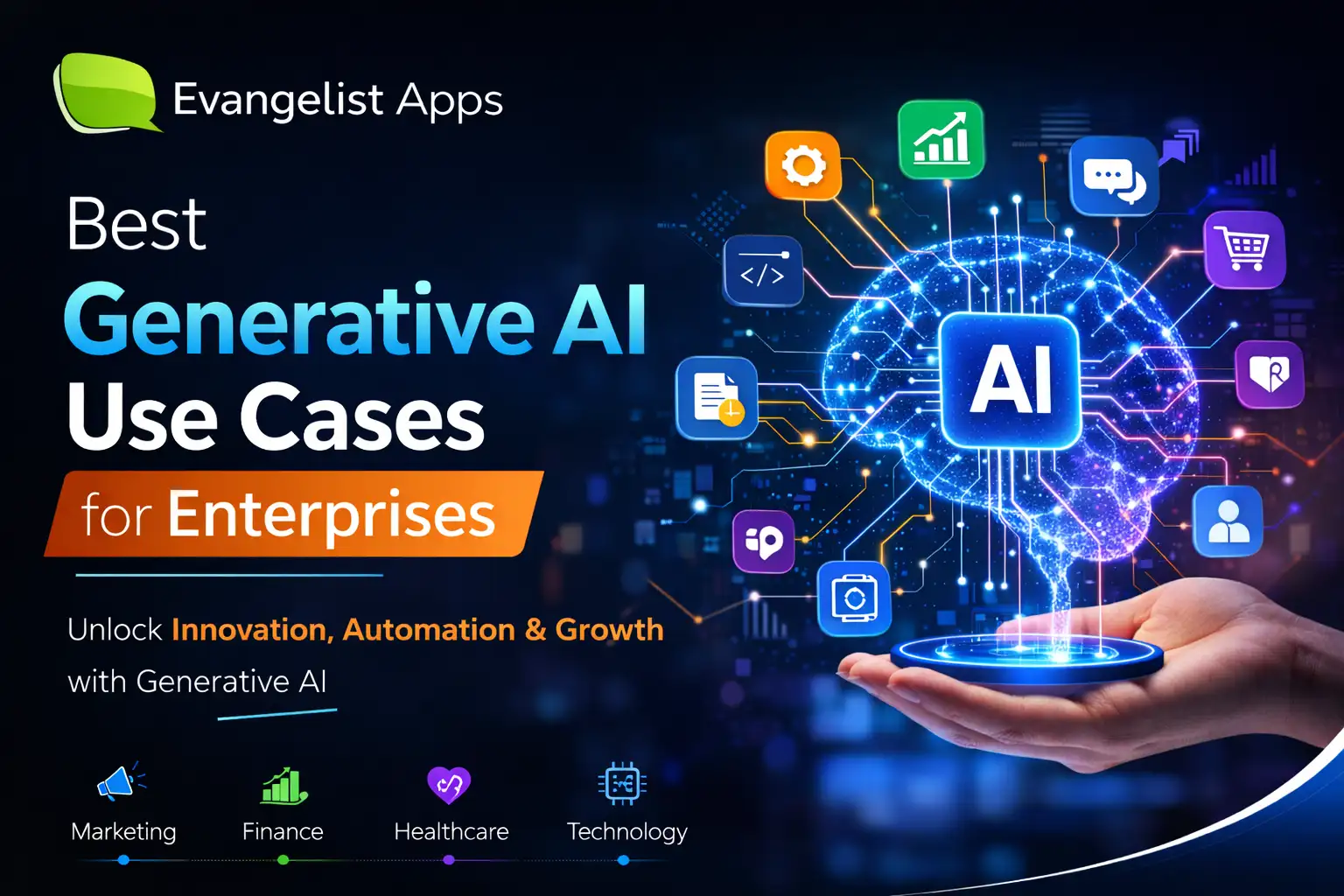


TL;DR – The most impactful generative AI enterprise use cases include AI-powered marketing content, intelligent customer assistants, code generation, knowledge management, synthetic data generation, and product design optimization.
Enterprises today are under constant pressure to innovate faster, operate more efficiently, and deliver better customer experiences.
At the same time, enterprise teams are overwhelmed with growing volumes of data, repetitive workflows, and rising expectations for speed and personalization.
And generative AI is closing that gap in leaps and bounds.
Unlike traditional AI systems that primarily analyze data, generative AI can create content, generate insights, design products, write code, and simulate business scenarios.
As a result, organizations across industries are actively looking for generative AI use cases to automate complex workflows and accelerate innovation.
The adoption momentum is already significant.
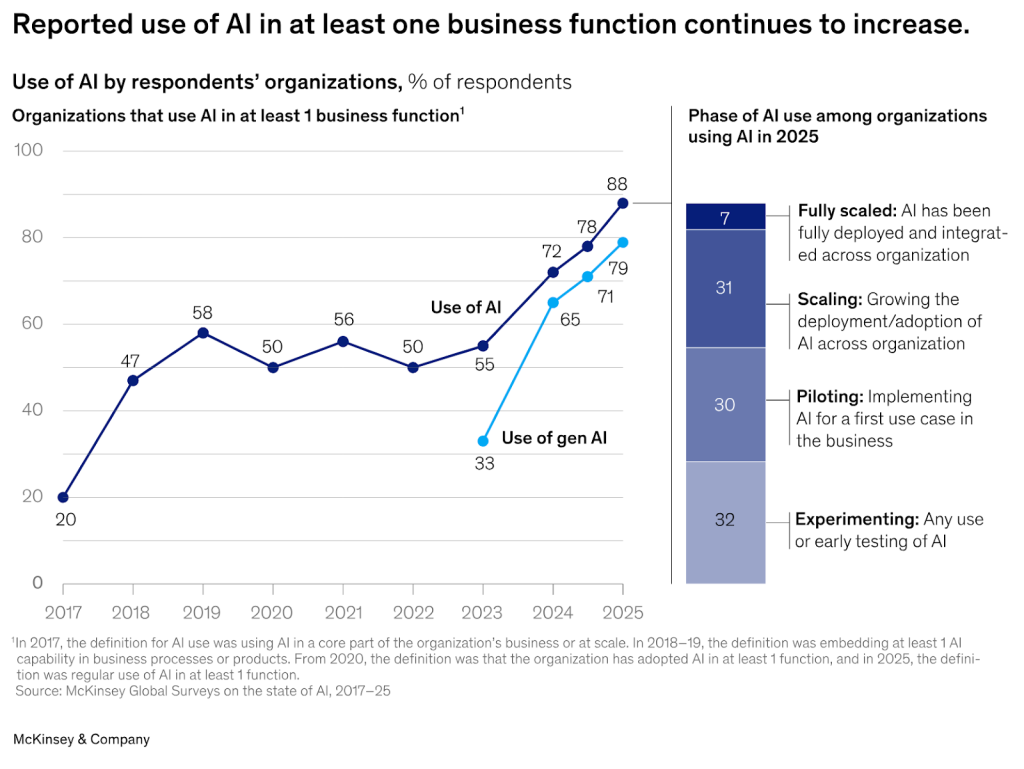
A 2025 global survey by McKinsey found that 65% of organizations are already using generative AI regularly in at least one business function, doubling from the previous year.
But despite this rapid adoption, many enterprise teams are still struggling with a fundamental question:
Which generative AI enterprise use cases actually deliver measurable business value?
In this guide, we’ll explore the most practical generative AI business use cases for enterprises.
We will also outline how to evaluate and prioritise them, and try to provide a practical implementation roadmap for teams ready to move forward.
Top Generative AI Use Cases for Enterprise Adoption
Here’s a quick overview of the highest-impact generative AI business use cases, mapped by function and ROI signal.
| Use Case | Primary Owner | ROI Signal |
| Automated content creation | Marketing | Reduced cost per asset, faster publish cycles |
| Customer communications and virtual assistants | CX / Operations | CSAT uplift, deflection rate |
| Design and creative assistance | Product / Marketing | Reduced agency spend, faster prototyping |
| Synthetic data and data augmentation | Data Science / IT | Training cost reduction, compliance |
| Code generation and developer productivity | Engineering | Dev velocity, bug reduction |
| Forecasting and scenario simulation | Strategy / Supply Chain | Forecast accuracy, margin improvement |
| Knowledge management and document automation | Legal / HR / Compliance | Hours saved per document, error rate |
| Product innovation and design prototyping | Product / R&D | Time-to-concept reduction |
| Training, upskilling and simulated role-plays | HR / L&D | Time-to-competency |
| Fraud detection and security testing | Security / Risk | False positive rate, detection speed |
| Knowledge worker augmentation | All functions | Research synthesis speed, output quality |
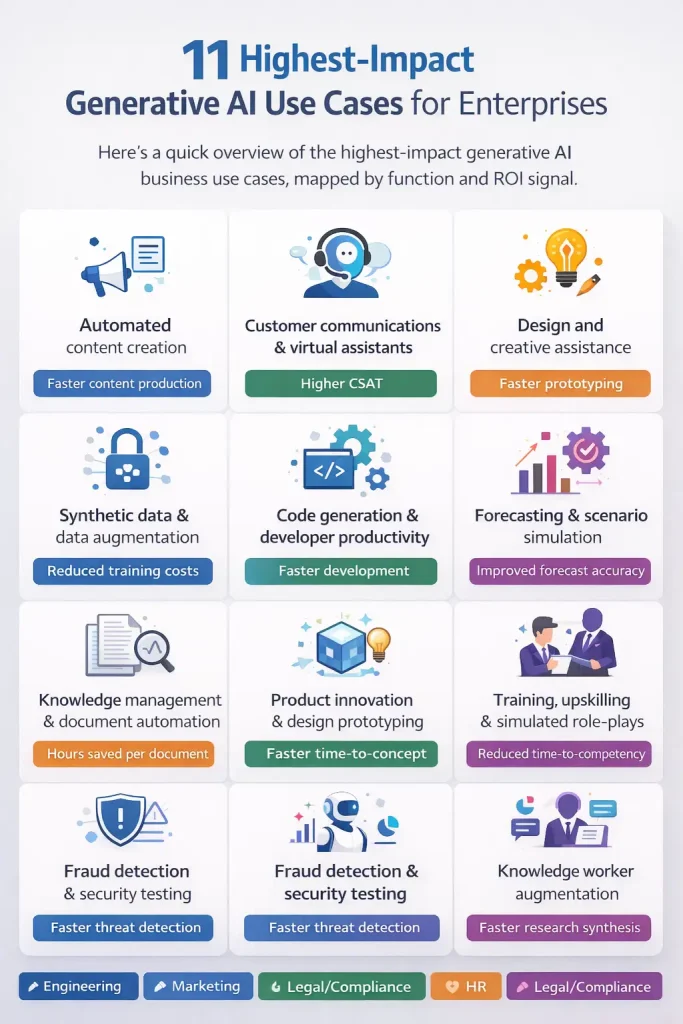
Now let’s understand each one of these gen AI use cases in detail.
Use case #1) AI-Powered Content Creation & Marketing Automation
One of the most common generative AI business use cases is automated content generation.
Content teams in large organisations consistently face pressure to produce more assets across more channels.
And this pressure grows without proportional headcount growth.
Generative AI addresses this directly.
It produces ad copy, product descriptions, email subject lines, blog drafts, and social media variants at scale.
Marketing/Content teams can use generative AI to produce high-quality written and visual content faster than ever before.
McKinsey research finds that generative AI can reduce the time required for content creation tasks by 60 to 70%, representing one of the largest productivity gains across any enterprise function
And the business impact extends beyond volume.
Consistent brand voice, rapid A/B testing of messaging variants, and multilingual content adaptation all become operationally feasible.
Business impact of this use-case
- Faster content production
- Improved SEO scale
- Personalized marketing campaigns
- Reduced marketing costs
- Automated marketing workflows
When integrated with CRM platforms and marketing automation tools, generative AI can even create personalized messaging for individual customer segments, significantly improving engagement rates.
Implementation works best when editorial guardrails are applied from the start.
Human review at key sign-off stages, plagiarism detection, and brand tone governance are non-negotiable for enterprise deployments.
Content automation is among the highest-adoption use cases.
The reason is straightforward. The feedback loop between input and measurable output is short.
______
Use case #2) Intelligent Customer Support and Virtual Assistants
Automated customer-facing interactions represent one of the most commercially significant generative AI enterprise use cases.
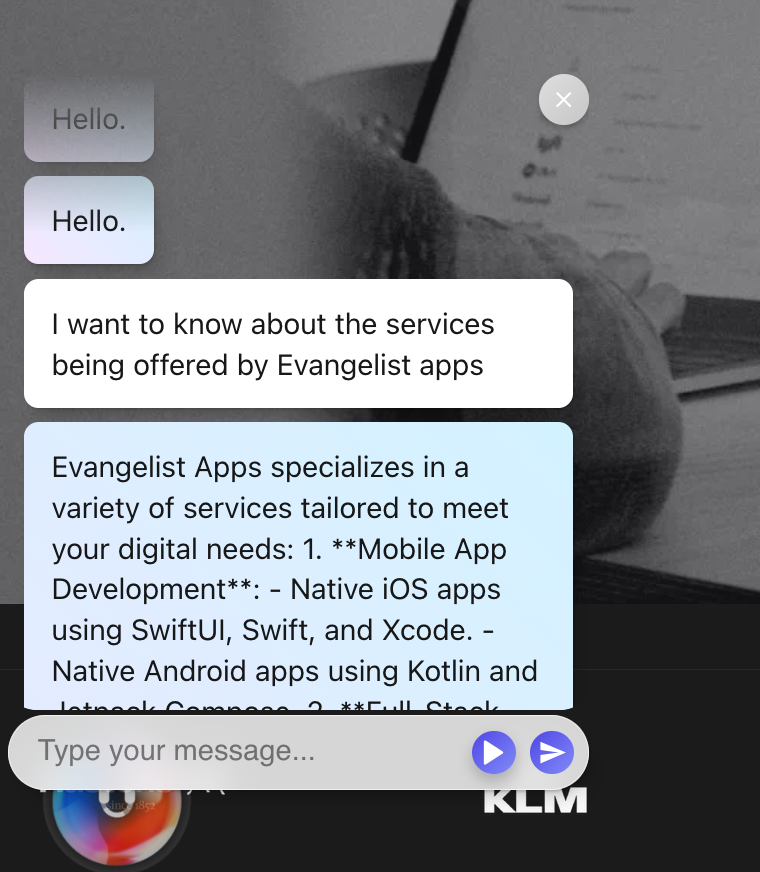
For context, we have built such a LLM powered chatbot assistant for quick customer support for our website Evangelist Apps. (Check the image below)
Modern AI-powered assistants can:
- Answer complex customer queries
- Generate contextual responses
- Draft support tickets and knowledge articles
- Provide troubleshooting suggestions
- Assist human agents in real time
These LLM-powered assistants can also generate personalised emails across voice, chat, and mobile channels.
Many enterprises also integrate generative AI with their knowledge base systems so responses are grounded in verified internal information.
Key performance indicators for this use case include customer satisfaction (CSAT), first-contact resolution rate, and deflection rate.
Enterprise benefits of this use-case include
- Reduced support response time
- Higher customer satisfaction (CSAT)
- Lower operational costs
- 24/7 customer support availability
Enterprise teams implementing AI chatbot development services typically target a 30 to 50 percent reduction in Tier 1 support volume.
This is often achieved within the first production quarter.
_________
Use Case #3) Design, Creative Assistance and Generative Media
Generative AI models (like ChatGPT, Gemini, Grok, Claude etc.) are now capable of producing images, video storyboards, UI mockups, and creative variants are changing the economics of design.
For context, I created the infographic image used in this article using ChatGPT.
Rather than replacing design teams, these tools can help in rapid ideation and faster brief-to-concept cycles.
They also lower the cost of exploratory work.
Enterprise implementations should establish clear processes for image rights, model provenance, and brand review.
The most effective pattern follows three stages.
- Step 1 – AI-assisted ideation.
- Step 2 – human refinement.
- Step 3 – final brand sign-off before any asset enters production.
___________
Use Case #4) Synthetic Data and Data Augmentation for AI Model Training
Regulated industries, including financial services, healthcare, and insurance, often cannot use real customer data to train machine learning models.
Generative AI solves this problem by creating synthetic datasets that replicate real-world patterns without exposing sensitive information.
The synthetic data helps enterprises to experiment with advanced AI systems while maintaining strict compliance with privacy regulations.
Enterprise teams use synthetic data for:
- Machine learning model training
- Fraud detection testing
- Healthcare research
- Autonomous system simulations
- Risk modeling
And it is particularly impactful for industries where rare-event simulation is essential.
This includes fraud scenarios and equipment failures, where model robustness depends on exposure to events that rarely appear in real data.
________
Use case #5) Software Development and Code Generation
Generative AI has become a major productivity accelerator for software engineering teams.
AI copilots integrated into development environments are now part of standard engineering workflows at many enterprise organisations.
These tools accelerate boilerplate code generation, test suite creation, API integration, and documentation.
Some of such tools are Lovable.dev, Microsoft copilot, Claude Code, Cursor, Bolt, Replit (Check them out!)
Developers now use AI-powered coding assistants to:
- Generate boilerplate code
- Write functions and APIs
- Suggest bug fixes
- Create unit tests
- Refactor legacy code
- Generate documentation
By automating repetitive development tasks, engineers can focus more on architecture and complex problem solving.
Business outcomes
- Faster development cycles
- Reduced technical debt
- Improved code quality
- Higher engineering productivity
But be careful of governance here.
Code review processes, security scanning, and software composition analysis (SCA) should be applied to all AI-generated code before it enters staging or production pipelines.
Benefit metrics to track include sprint velocity, code review cycle time, and post-release defect rates.
This ensures productivity gains do not come at the cost of reliability or security.
_________
Use case #6) AI-Driven Financial Forecasting and Scenario Simulation
Finance teams can use generative AI to model complex economic scenarios and generate predictive insights.
Generative AI models (like Perplexity, Claude,ChatGPT) can simulate complex operational scenarios for supply chain planning, demand forecasting, and pricing strategy.
Rather than relying solely on historical data, scenario simulation allows planning teams to test assumptions under conditions that have not yet occurred.
Most impactful use cases are:
- Revenue forecasting
- Demand prediction
- Budget planning
- Risk analysis
- Pricing optimization
The practical approach here is to run generative scenario pilots alongside traditional forecasting tools.
This is particularly valuable for industries with volatile markets such as retail, logistics, and financial services.
Evaluate performance against a defined set of business outcomes.
This controlled comparison builds stakeholder confidence and provides a clear ROI benchmark.
__________
Use case #7) Knowledge Management and Enterprise Search
Enterprises often struggle with fragmented information stored across documents, internal tools, and databases.
Legal, compliance, and HR teams often manage high volumes of structured and unstructured documents.
Generative AI can auto-summarise contracts, meeting transcripts, policy documents, and regulatory filings. It can also generate first drafts of standard documents such as employment agreements, compliance notices, and internal reports.
Using Gen AI tools enterprise teams can build AI-powered knowledge systems that can:
- Summarize documents
- Extract key insights from reports
- Answer employee questions
- Generate meeting summaries
- Create executive briefing
Instead of manually searching through large documents, employees can simply ask questions and receive summarized answers.
Evangelist Apps has direct experience applying AI to knowledge-intensive workflows.
In a legal document intelligence engagement, we used generative AI to extract structured insights from large volumes of unstructured legal text.
This reduced manual review time significantly.
We have also done it for an accounting platform, where we automated document processing, reduced processing overhead and improved their data accuracy. (check the case study for more details)
For document automation to work at scale, the AI system should be connected to an enterprise knowledge graph or retrieval layer.
This ensures outputs reflect current policies and approved source material.
_________
Use Case #8: Product Innovation and Design Prototyping
Generative AI is transforming product design across industries including manufacturing, automotive, consumer electronics, and architecture.
Iterating on physical or digital prototypes carries significant cost in these environments.
Generative AI accelerates concepting by producing multiple design candidates based on defined parameters.
Design teams can use AI models to:
- Generate product prototypes
- Explore design variations
- Optimize materials and structures
- Create 3D concepts
- Simulate performance scenarios
Teams that integrate generative prototyping into their product development lifecycle typically report faster time-to-concept.
They also report more diverse design exploration than is feasible with manual processes alone.
_________
Use Case #9: Employee Training and Workforce Upskilling
Organizations are using generative AI to create personalized training experiences for employees.
Personalized learning content, scenario-based assessments, and simulated customer interactions are all well-suited to generative AI.
HR and learning teams can use these capabilities to create tailored training modules at scale. They can also test competency in a safe environment.
Here are some of the great examples under this use case:
- AI-generated training modules
- Interactive simulations
- Role-play scenarios
- Custom learning pathways
- Automated training assessments
Measurement should focus on time-to-competency and knowledge retention rates at 30 and 90 days.
Performance correlation between simulation assessment scores and live job performance is also a valuable metric to track.
____________
Use Case #10: Security Testing and Fraud Detection
Cybersecurity teams are adopting generative AI to simulate cyber threats and test security systems.
Generative AI models can now generate:
- Synthetic attack scenarios
- Malware variations
- Fraud patterns
- Security vulnerabilities
By simulating real-world attack patterns, enterprises can proactively strengthen their security infrastructure.
Governance requirements for this use case include audit trails, reproducibility of test scenarios, and documentation that satisfies regulatory review.
One specific and growing fraud vector is AI-assisted deception in knowledge-intensive contexts where experts use AI-generated voice, scripted answers, or fabricated documents during calls and vetting processes.
VeritasIQ, built by Evangelist Apps, addresses this directly.
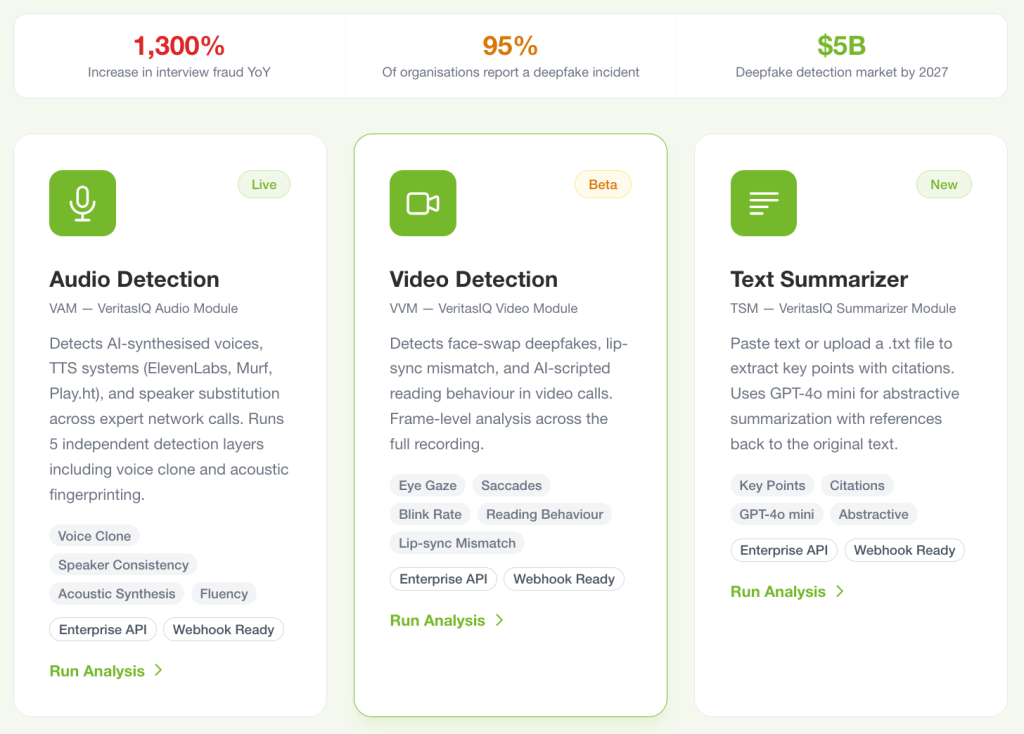
It detects AI-generated voice, screen-reading behaviour, and AI-written documents across audio, video, and text in seconds.
No installation required.
Designed for expert network operators who need authenticity signals before a high-stakes decision is made.
__________
Use Case #11) Knowledge Worker Augmentation
Analysts, researchers, and strategy teams spend significant time synthesising information from multiple sources.
Generative AI tools that produce executive summaries, extract themes from research, and generate slide-ready outputs reduce cognitive load.
Generative AI can automate much of this process by:
- Summarizing large datasets
- Generating executive dashboards
- Creating presentation slides
- Writing performance reports
They allow knowledge workers to focus on interpretation and decision-making rather than information assembly.
4 Challenges Enterprises Face When Implementing Generative AI
While the opportunities are enormous, deploying generative AI at enterprise scale requires careful planning.
Challenge #1) Data Privacy and Security
Organizations must ensure sensitive information is protected when training or using generative models.
Best practices include:
- Data anonymization
- Access controls
- Secure model hosting
- Synthetic data pipelines
Challenge #2) AI Hallucinations and Accuracy
Generative AI models sometimes produce incorrect or fabricated information.
Enterprises can mitigate this risk through:
- Retrieval-augmented generation (RAG)
- Knowledge grounding
- Human review workflows
- Output validation systems
Challenge #3) Governance and Compliance
Regulated industries must ensure AI usage follows legal and ethical standards.
Important governance elements include:
- AI usage policies
- Audit trails
- Explainability frameworks
- Risk management controls
Challenge #4) Cost and Infrastructure Planning
Large generative models can be resource intensive. Organizations must plan for:
- Cloud infrastructure costs
- Model inference usage
- Data pipelines
- Monitoring systems
Strategic architecture planning helps keep costs under control while maintaining performance.
How to Evaluate and Select the Right Generative AI Use Cases
Here’s a five-step framework that provides a practical decision tool.
- Step 1) Business Impact. Quantify the value of the problem being solved. Attach a revenue, cost, or risk metric to the target outcome.
- Step 2) Data Readiness. Assess whether the data required to build or fine-tune the model exists, is accessible, and meets quality standards.
- Step 3) Technical Complexity. Evaluate whether the use case requires custom model development, fine-tuning, prompt engineering, or integration with existing systems.
- Step 4) Compliance Risk. Identify regulatory, legal, and ethical constraints that apply to the use case in your industry and geography.
- Step 5) Time-to-Value. Estimate realistic timelines from proof-of-concept to production. Account for data preparation, testing, and change management.
Score each use case across these five dimensions.
How to Implementation Generative AI for Enterprises (Roadmap)
Here’s a full roadmap to implement different generative AI use cases for businesses.
Phase 0) Opportunity Discovery and Use Case Prioritisation
Run structured workshops with business and technology stakeholders.
The goal is to identify candidate use cases and map them to measurable KPIs.
Build a prioritised shortlist using the evaluation framework above.
The typical deliverable is a scored use case register with executive alignment on the top 3 to 5 candidates.
Phase 1) Proof of Concept (4 to 8 Weeks)
Design a minimum viable experiment with a defined dataset, evaluation metrics, and success gates.
The goal is not to build production-ready software.
The goal is to validate that the model approach is technically sound and the business hypothesis holds.
Measure against the KPIs defined in Phase 0 before proceeding.
Phase 2) Productionisation via MLOps
Move validated pilots into production using CI/CD pipelines for model deployment.
Set up monitoring dashboards for latency and error rates.
Implement drift detection to trigger retraining when model performance degrades.
This phase requires investment in ModelOps infrastructure and clear ownership between data science and engineering teams.
Phase 3) Scale and Governance
Extend successful production models across business units.
Introduce multi-model orchestration where required. Implement enterprise-wide AI governance policies.
Cost controls, audit logging, and regular model performance reviews become standing operational practices at this stage.
How Evangelist Apps Supports Enterprise Generative AI Development
Evangelist Apps is a leading UK-based technology partner with over 25 years of experience in enterprise software, AI solution, and mobile platform development.
We deliver end-to-end generative AI development services across discovery, engineering, and production.
Our work spans across financial services, expert networks, luxury retail, and professional services & some other industries.
Our generative AI solution approach focuses on:
- Business-first AI strategy
- Rapid experimentation and iteration
- Scalable enterprise architectures
- Responsible AI governance
If your organization is exploring generative AI business use cases, our team can help you identify the best opportunities and implement solutions that deliver measurable ROI.
The generative AI development services offered by Evangelist Apps cover the full delivery lifecycle:
- Strategy and use case discovery workshops aligned to top-line and cost metrics
- Proof-of-concept development with clear KPI-driven success gates
- MLOps and production engineering including secure deployment, monitoring, and drift detection
- Data strategy and synthetic data pipelines for privacy-first training environments
- Integration and automation connecting AI outputs to CRM, ERP, and operational workflows
- Governance and compliance support including policy templates, audit trails, and model risk documentation
To explore how these capabilities map to your organisation’s priorities, book a free 30-minute discovery call with the Evangelist Apps team.
F.A.Qs: Generative AI Use Cases for Enterprises
Q. What are the most common generative AI use cases in enterprises?
The most common generative AI use cases include content creation, customer support automation, software development assistance, knowledge management, synthetic data generation, financial forecasting, and product design optimization.
Q. How are businesses using generative AI today?
Businesses use generative AI to automate content creation, enhance customer support, accelerate software development, generate insights from data, simulate scenarios for planning, and improve employee productivity.
Q. Which industries benefit the most from generative AI?
Industries benefiting the most include finance, healthcare, retail, manufacturing, media, and technology. However, nearly every sector can leverage generative AI to improve efficiency and innovation.
Q. What are the biggest challenges of implementing generative AI?
Major challenges include data privacy concerns, AI hallucinations, infrastructure costs, governance requirements, and integration with existing enterprise systems.
Q. How long does it take to implement a generative AI solution?
A typical generative AI proof-of-concept can take 4–8 weeks, while full enterprise deployment may take several months depending on complexity and integration requirements.
Q. Do enterprises need custom generative AI models?
Not always. Many organizations start with existing foundation models and customize them using techniques such as fine-tuning, prompt engineering, and retrieval-augmented generation.
Q. What product should you use for your generative AI enterprise use cases?
There is no single best product; use a custom enterprise generative AI solution built around your use case, with RAG, human review, secure deployment, and workflow integration. Evangelist Apps offers end-to-end generative AI development services to design and implement that stack.
Q. How can enterprises use generative AI in daily workflows?
Start with repeatable tasks such as document search, support, drafting, and summarization. The strongest deployments are narrow, measurable, and tied to a specific workflow.