
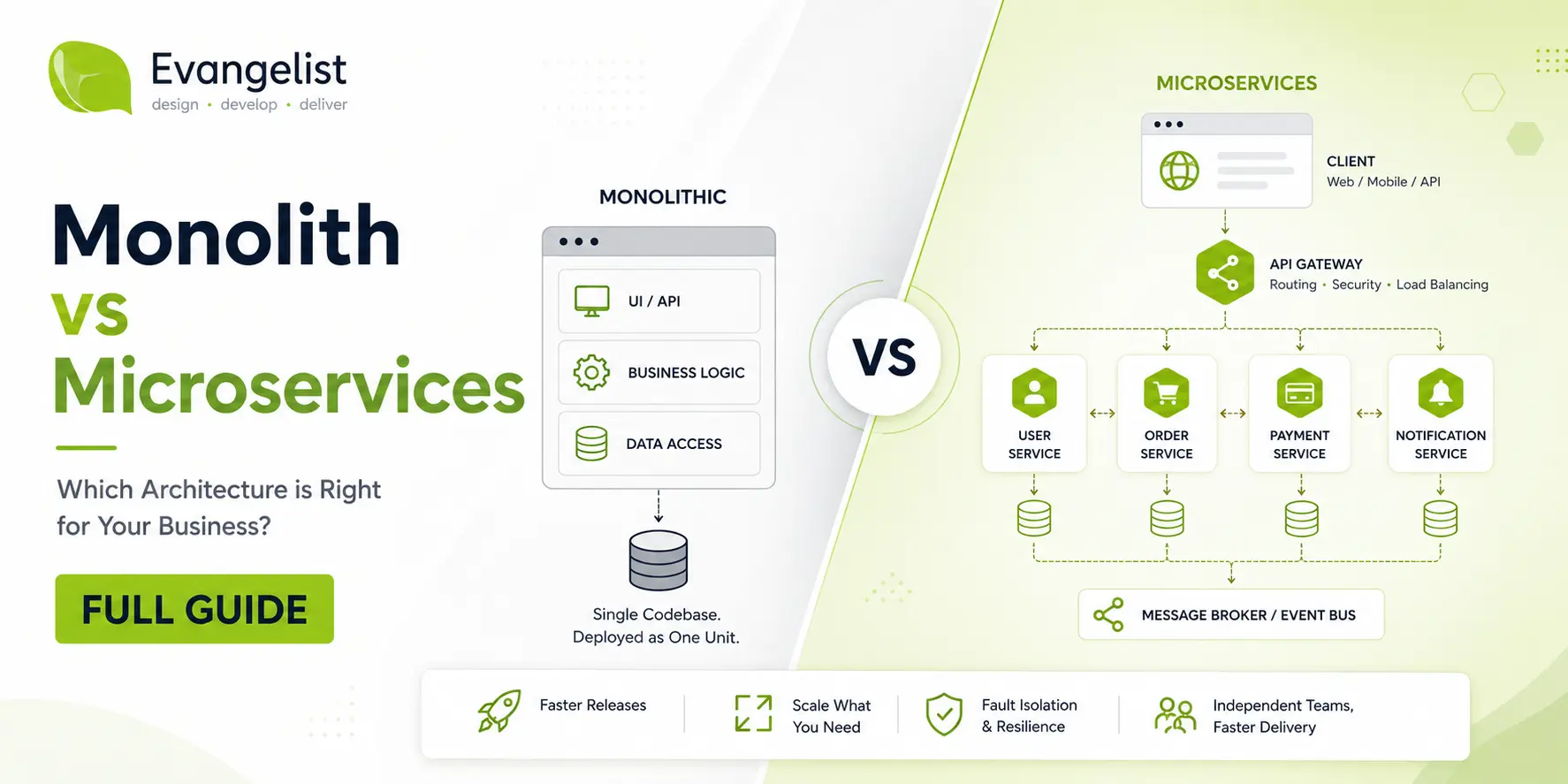


The monolith vs microservices architecture decision is not about choosing between “old” and “modern” technology.
It is more of a business and engineering decision that affects development speed, operating costs, scalability, reliability and how your teams work.
For startups, a well-structured monolith can help a small team build and test an idea quickly.
For larger organisations, microservices can make sense when multiple teams need independent releases, selective scaling and clearer ownership.
This guide explains the practical differences between the two approaches, including the often-overlooked modular monolith, so you can choose an architecture based on your business needs.
Evangelist Apps, one of the UK’s leading product engineering teams, helps businesses with microservices architecture consulting, design, development, integration, testing and migration.
Its microservices services also cover legacy modernisation where a phased move from a monolith is appropriate.
So, if you need a helping hand, book a FREE consultation call with us today.
TL;DR: Monolithic vs Microservices Architecture – What to choose?
- A monolith runs as one deployable application and is usually simpler to build, test and operate.
- Microservices split an application into independently deployable services built around business capabilities.
- A modular monolith keeps one deployment while creating strong internal boundaries, making it a useful middle option.
- Startups often benefit from a monolith when the product, team and requirements are still changing.
- Microservices become more useful when multiple teams, independent releases, uneven scaling or fault isolation justify the added operational complexity.
What is monolithic architecture?
A monolithic architecture packages the main application functionality into one deployable unit. The user interface or API layer, business logic and data access may be separated into internal layers, but the application is released as a whole.
A monolith is not automatically poorly designed.
A well-structured monolith can have clear modules, strong testing, sensible dependencies and clean interfaces. Problems usually appear when those boundaries disappear and unrelated parts of the application become tightly coupled.
How monolithic architecture works
A typical application might contain:
- Web or mobile API
- Authentication
- Business logic
- Payment processing
- Order management
- Data access
- Database
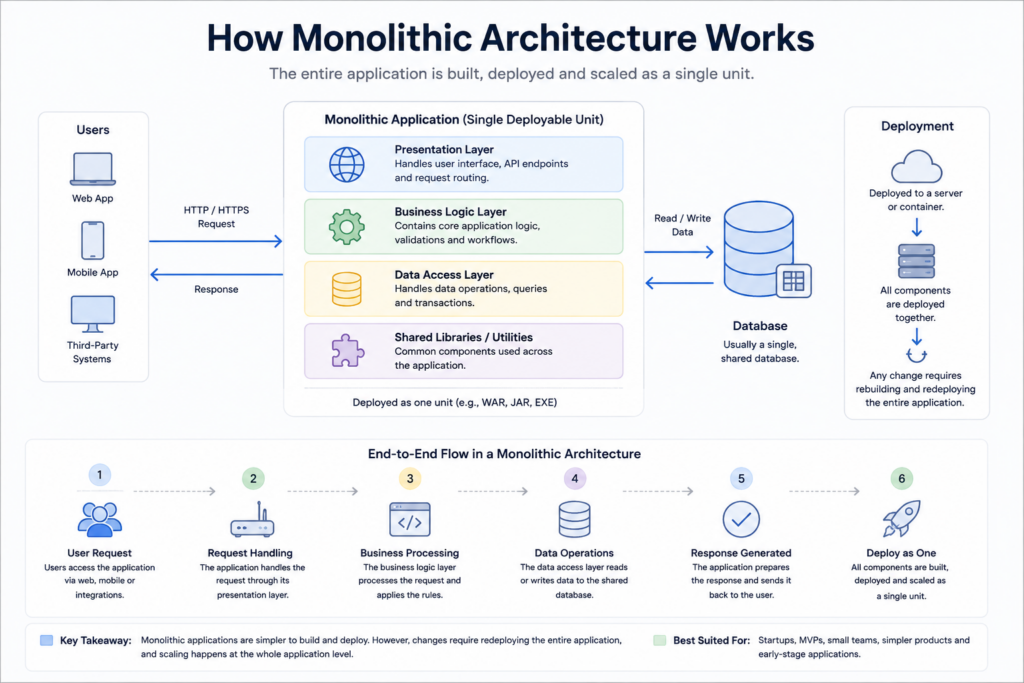
A change to one part generally goes through the same build and deployment pipeline as the rest of the application.
Strengths and limitations of Monolithic architecture
| Strengths | Limitations |
| Simple deployment | Entire application may need redeployment |
| Easier local development | Large codebases can become difficult to understand |
| Straightforward debugging | Selective scaling is harder |
| Lower operational overhead | One failure can affect more functionality |
| Easier for small teams | Releases can become tightly coupled |
A monolith can also run in the cloud and scale horizontally. It is not limited to a single server.
What is Microservices architecture?
Microservices architecture divides an application into independently deployable services organised around business capabilities.
For example, an ecommerce platform might have separate services for:
- Customer accounts
- Catalogue
- Orders
- Payments
- Notifications
How Microservice architecture works
Services communicate through APIs, messaging or event streams. Each service can have its own deployment lifecycle and, where appropriate, its own data store.
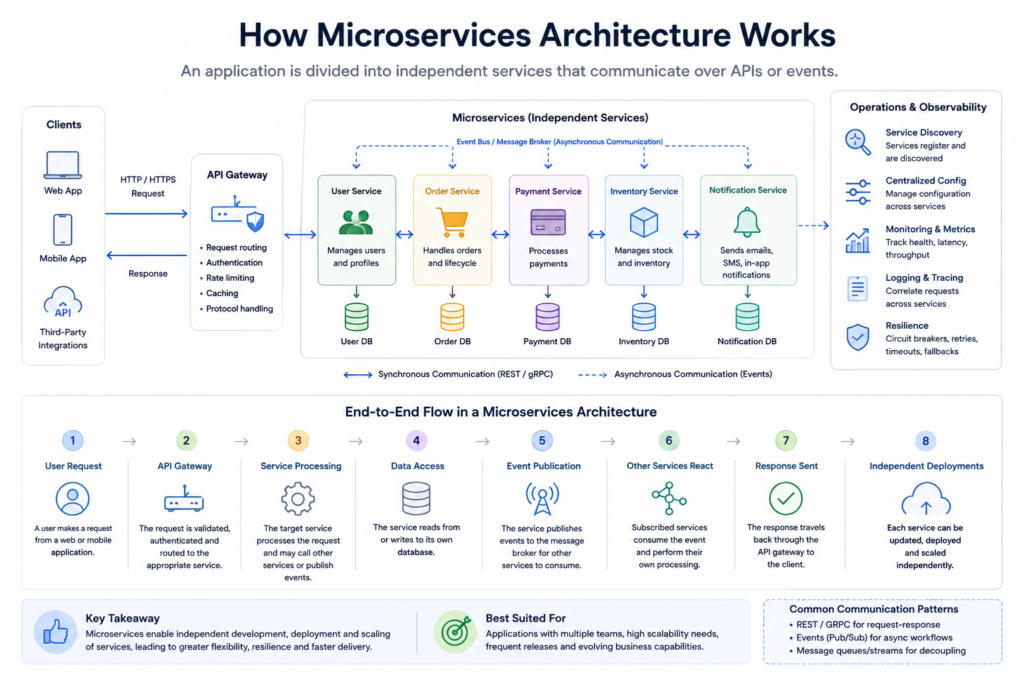
The important point is that “micro” does not mean every service must be tiny.
Service boundaries should reflect business responsibilities and the team’s ability to build, deploy and operate them independently.
What changes with microservices?
Microservices can give teams more independence, but they also create a distributed system.
You now need to manage:
- Network communication
- API contracts
- Service discovery or routing
- Distributed logging and tracing
- Monitoring and alerting
- Failure handling
- Data consistency
- Independent deployments
This is why microservices should not be adopted simply because they are popular.
A current industry signal
The CNCF and SlashData’s Q3 2025 research found that 46% of backend developers surveyed use microservices, making it one of the leading approaches in cloud-native development.
The same research found API gateways were used by 50% of backend developers.
The data shows that microservices are widely used. It does not mean every application should use them.
Monolithic vs microservices architecture: Complete comparison
The practical difference becomes clearer when you compare how each architecture affects everyday engineering work.
| Area | Monolithic architecture | Microservices architecture |
| Code structure | One application | Multiple services |
| Deployment | Usually deployed together | Services can deploy independently |
| Team ownership | Shared application ownership | Teams can own specific services |
| Scaling | Usually scale the application | Scale selected services |
| Communication | Mostly internal calls | APIs and messaging |
| Database | Often shared | Preferably service-owned |
| Testing | Simpler integration testing | More contract and integration testing |
| Debugging | Usually easier | Distributed tracing is often needed |
| Infrastructure | Lower overhead | Higher operational overhead |
| Fault isolation | More limited | Better isolation when boundaries are sound |
| Technology choice | Often shared stack | Different stacks can be used where justified |
| Release frequency | Can become coupled | Independent releases are possible |
| Initial cost | Usually lower | Usually higher |
| Best fit | Small teams and simpler products | Larger or more complex systems |
One important distinction is scalability.
A monolith can scale horizontally by running multiple instances. Microservices add another option: selective scaling, where only a busy service is scaled.
That can be useful when different parts of an application have very different workloads.
Monolith vs microservices vs modular monolith
There is a third option that deserves more attention: the modular monolith architecture.
A modular monolith remains one deployable application, but its internal code is divided into clearly defined business modules.
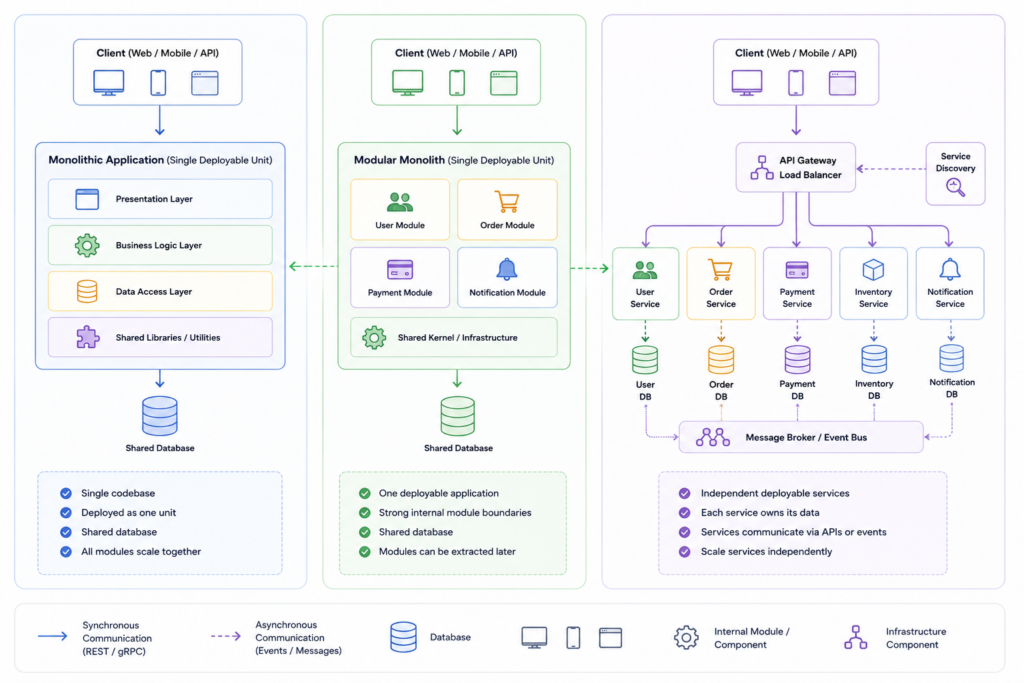
For example:
Single application
├── Customer module
├── Orders module
├── Payments module
└── Notifications module
The modules can have explicit interfaces and controlled dependencies.
This gives a startup or smaller team a simpler deployment model while creating boundaries that can support future changes.
When does a modular monolith architecture make sense?
It is a strong option when:
- The product is still finding product-market fit.
- The team is small.
- Business boundaries are not fully understood.
- Operational capacity is limited.
- Independent service deployment is not yet necessary.
A modular monolith also creates potential extraction points if the business later needs microservices.
Monolith vs microservices for startups – What to choose?
For most early-stage startups, the question should be:
What architecture lets us learn and ship without creating unnecessary operational work?
A monolith often wins when the team is small and requirements are changing quickly.
Choose a monolith or modular monolith when:
- You have a small engineering team.
- You are building an MVP.
- Your domain boundaries are still changing.
- You need to keep infrastructure simple.
- Deployments are still manageable.
When should a startup reconsider?
Look for signs such as:
- Several teams blocking each other during releases.
- One part of the system needs very different scaling.
- Releases require too much coordination.
- A failure in one area affects unrelated functions.
- The team already has strong CI/CD, monitoring and service ownership.
Don’t create microservices to solve problems you do not have yet.
If you’re unsure whether your startup needs a monolith, modular monolith or microservices, an architecture review can help identify the practical option before development costs increase.
Book a FREE architecture review with Evangelist Apps for a practical roadmap.
Monolithic vs microservices architecture for enterprises – What to choose?
Enterprise environments often have different pressures.
Microservices can be useful when:
- Multiple teams need independent ownership.
- Different workloads need independent scaling.
- Frequent releases are important.
- Fault isolation matters.
- The organisation has complex integrations.
- A legacy application needs incremental modernisation.
However, enterprise size alone is not a reason to adopt microservices.
A large application maintained by one team with manageable releases may still work well as a modular monolith.
The architecture should follow the business and team structure.
Monolith vs microservices: How to choose for your team?
Use this quick decision framework to choose between Monolithic, Microservices architecture based on different scenarios.
| Your situation | Consider |
| Small team + new product | Monolith |
| Small team + clear modules | Modular monolith |
| Multiple engineering teams | Microservices |
| Uneven workload across domains | Microservices |
| Releases are still simple | Monolith |
| Releases are tightly coupled | Consider microservices |
| Limited DevOps capacity | Monolith or modular monolith |
| Strong CI/CD and observability | Microservices becomes more practical |
| Legacy system with clear extraction candidates | Phased migration |
The key question is not “Which architecture is better?”
It is:
Which architecture solves the business problem without adding unnecessary complexity?
Microservices vs Monolith cost & total cost of ownership
Microservices can cost more to operate initially because the architecture introduces more components and operational requirements.
Consider these cost areas:
| Cost area | Monolith | Microservices |
| Development | Usually simpler initially | More design and integration work |
| Infrastructure | Fewer components | More services and infrastructure |
| DevOps | Lower initial overhead | Greater automation requirements |
| Testing | Simpler test environment | More integration and contract testing |
| Monitoring | Simpler | Distributed observability required |
| Security | Fewer interfaces | More service boundaries to secure |
| Migration | Not applicable initially | Can be significant when migrating |
| Scaling | Scale the application | Scale selected services |
Microservices can reduce waste where individual workloads need different resources or teams need independent delivery.
But those gains should be measured against the cost of running a distributed system.
There is no reliable universal percentage for how much cheaper or more expensive one architecture will be. Your workload, team structure and operational maturity matter more.
Microservices vs Monolith for performance, scalability & resilience
Microservices do not automatically make an application faster.
A simple monolith can be faster for operations that would otherwise require multiple network calls.
Microservices introduce “network latency” and the possibility of partial failure.
Their main scalability advantage is selective scaling.
For example, if search receives far more traffic than account management, a microservices architecture can scale the search service without scaling every other service.
For resilience, teams need mechanisms such as:
- Timeouts
- Retries
- Circuit breakers
- Health checks
- Graceful degradation
Performance decisions should be based on actual workloads and service-level objectives rather than architecture assumptions.
Microservices vs monolith for development, testing & deployment
Microservices work best when engineering practices support independent delivery.
A practical setup includes:
- Automated CI/CD
- Unit and integration tests
- Contract testing
- API versioning
- Feature flags
- Automated rollback
- Centralised logs and metrics
- Distributed tracing
The developer experience also matters. Ten services can be manageable. Hundreds can create significant local development and debugging overhead without good tooling and ownership.
Microservices vs monolith for data architecture
Data ownership is one of the most important differences between a monolith and microservices.
A monolith often uses one shared database. Microservices generally work better when each service owns its data.
That introduces new problems around transactions and consistency.
For example, an order service may need information from a payment service. The two services cannot always rely on one shared database transaction.
Teams may instead use patterns such as:
- Events
- Idempotency
- Outbox pattern
- Sagas
The goal is not to eliminate consistency issues. It is to design how the system handles them.
Warning: multiple “microservices” directly sharing the same tightly coupled database can remove much of the independence the architecture is supposed to provide.
How to migrate from monolith to microservices architecture
A successful monolith to microservices migration is usually incremental.
A practical path is:
- Assess the existing system – Map dependencies, data ownership, release bottlenecks and business capabilities.
- Define service boundaries – Start with a capability that has a clear boundary and limited dependency on the monolith.
- Create stable APIs – Give the new service a clear contract instead of exposing internal monolith logic.
- Move capability and data carefully – Avoid creating a new service while leaving all important data tightly coupled to the old database.
- Run both paths where needed – Use controlled transition patterns when the old and new systems need to coexist.
- Measure the result – Track release speed, reliability, scaling requirements and operational cost.
- Retire the old path – A migration is not complete just because a new service exists. Remove the old implementation when it is safe to do so.
Avoid a big-bang rewrite
Trying to rebuild an entire enterprise application as microservices at once increases delivery and migration risk.
A phased migration lets the business gain value from each completed step while keeping the existing application running where necessary.
How Evangelist Apps helps with microservices
Evangelist Apps provides microservices development services for UK and global businesses, covering strategy consulting, architecture design, development, integration and testing.
We also support legacy IT modernisation and phased migration from existing systems.
Our team of experts can help you with:
- Microservices architecture assessment
- Service and domain design
- Cloud-native architecture
- API and event-driven integration
- Containerisation
- CI/CD
- Testing
- Observability
- Monolith-to-microservices migration
The aim is to recommend the architecture that fits the business rather than force every project into microservices.
Planning a migration or new microservices-based application?
Explore Evangelist Apps’ microservices development services or speak with our team about your architecture and migration requirements.
Conclusion: choose the architecture that fits the business
The monolith vs microservices decision has no universal winner.
A monolith can be the better choice for a startup that needs to validate an idea quickly.
A modular monolith can provide stronger boundaries as the product grows.
Microservices can become the better option when multiple teams, independent releases, selective scaling or fault isolation create a clear business case.
Before choosing, ask:
- How large is the engineering team?
- Are business boundaries clear?
- Do different parts of the system need separate scaling?
- Are releases becoming tightly coupled?
- Does the organisation have the operational maturity to run distributed software?
If the answers point towards microservices, plan the move carefully.
Start with clear business capabilities, establish service ownership, protect data boundaries and migrate in measurable steps.
If you’re evaluating microservices architecture, modernisation or a monolith-to-microservices migration, Evangelist Apps can assess your existing system and recommend a practical architecture path for your business.
Talk to Evangelist Apps about your architecture assessment project & get a clear roadmap today.
Monolith vs microservices FAQs
Q. Is monolithic architecture outdated?
No. A well-structured monolith can still be a good choice for many applications, especially when the team and product are small.
Q. Which is better for startups, monolith or microservices?
A monolith or modular monolith is often a practical starting point for startups. Microservices become more useful when team size, release requirements, scaling needs or reliability requirements justify the added complexity.
Q. Which is better for enterprises?
Neither is automatically better. Enterprises with multiple teams, complex domains, independent scaling needs and frequent releases may benefit from microservices.
Q. Can a monolith scale?
Yes. A monolith can scale vertically or horizontally. Microservices mainly add the ability to scale individual services independently.
Q. Do microservices require Kubernetes?
No. Kubernetes is one orchestration option, not a requirement for microservices.
Q. Are microservices more expensive?
They can have higher initial infrastructure, DevOps, testing and monitoring costs. The additional cost may be justified when independent scaling and team delivery provide measurable value.
Q. What is a modular monolith?
A modular monolith is one deployable application with clearly separated internal business modules. It provides more structure than a tightly coupled monolith without the operational overhead of multiple services.
Q. When should a business move from monolith to microservices?
Consider migration when release coupling, team dependencies, uneven scaling or reliability requirements create measurable problems that a distributed architecture can solve.
Q. What should I look for in a microservices development company?
Look for experience in architecture design, APIs, data ownership, CI/CD, observability, security and phased migration, not just experience deploying containers.