

Many AI products never reach production.
Some fail because the problem was never worth solving with AI. Others struggle because the available data is poor, the model performs well in testing but not with real users, or the cost of running the model outweighs its value.
The common thread is rarely the AI model itself.
Successful AI products follow a disciplined product engineering process that combines product strategy, data, software engineering, experimentation, governance, and continuous improvement.
That process is known as the AI product development lifecycle.
Unlike traditional software, AI products continue learning long after launch. Models drift. User behaviour changes. New data becomes available.
What worked six months ago may no longer deliver the same results.
For CTOs, founders, and product leaders, understanding this lifecycle is essential before investing in AI development.
The right framework helps reduce technical risk, validate ideas earlier, and build products that create measurable business value instead of expensive prototypes.
In this guide, we’ll walk through a practical AI product development lifecycle used by experienced AI product engineering teams. We’ll also explain where companies commonly fail, how to avoid costly mistakes, and what separates production-ready AI products from proof-of-concept demos.
What is the AI product development lifecycle?
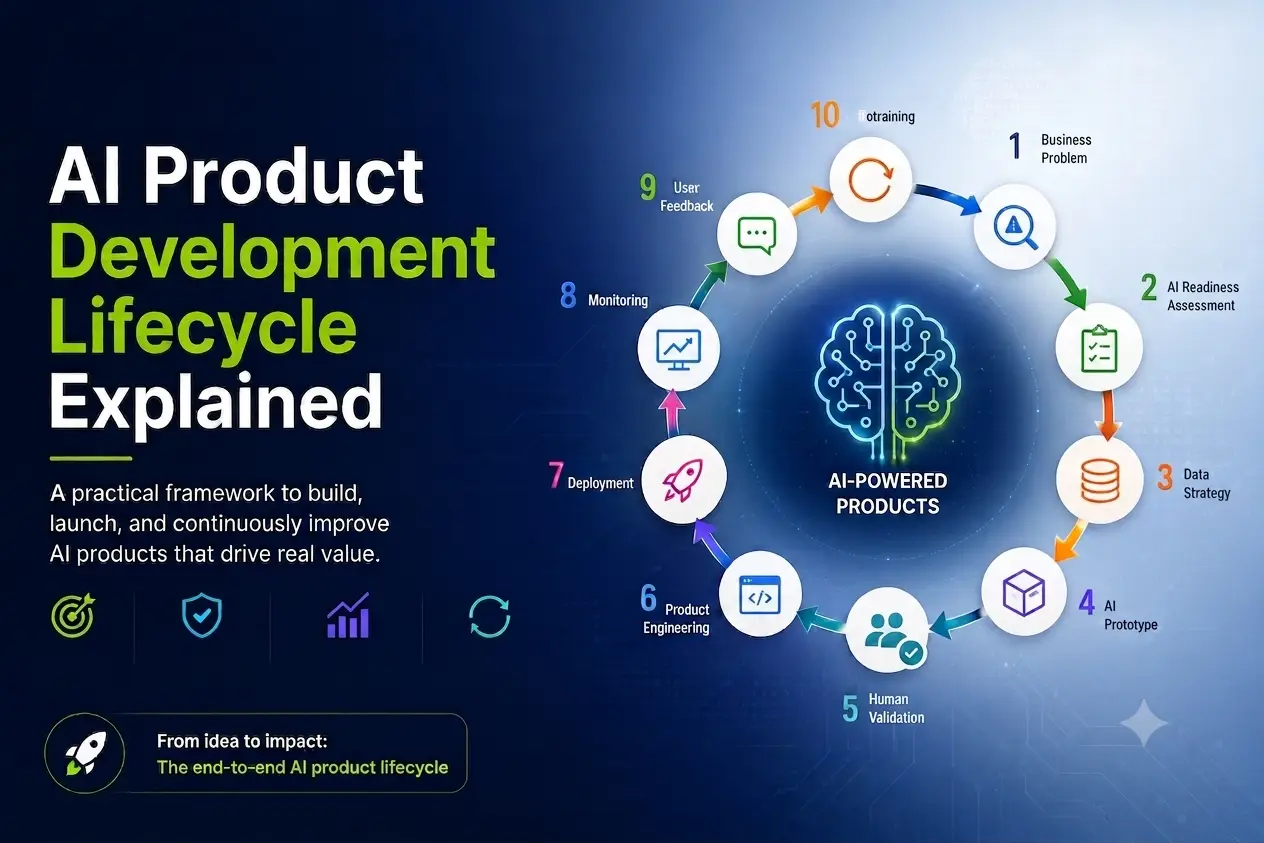
The AI product development lifecycle is the structured process of planning, designing, building, deploying, monitoring, and continuously improving AI-powered products.
A modern AI product lifecycle typically includes:
- Problem discovery and AI feasibility assessment
- Data strategy and preparation
- AI prototyping and model selection
- Product engineering and integration
- Testing and AI evaluation
- Production deployment
- Monitoring, retraining, and optimisation
Each stage influences the next. Skipping one often creates problems later in the project.
One mistake we regularly see is teams selecting an LLM before confirming whether AI is even necessary.
In many business cases, simpler automation, rules-based systems, or predictive analytics solve the problem more effectively and at a lower cost.
The objective should never be to build an AI product.
The objective is to solve a business problem in the most practical way possible.
Why is AI product development different from traditional software development?
Traditional software follows “deterministic logic”.
Given the same input, it produces the same output every time.
AI products work differently.
They generate probabilistic outputs based on patterns learned from data. The same prompt or input can produce different responses depending on the model, context, and training data.
That changes how products are designed, tested, and maintained.
The biggest shift is that software development is no longer only about writing code.It becomes an ongoing process of improving data quality, evaluating model performance, and measuring business outcomes.
According to McKinsey, generative AI could contribute between $2.6 trillion and $4.4 trillion annually to the global economy.
That opportunity comes with higher expectations around governance, reliability, and measurable ROI rather than simply adopting AI tools.
Research from McKinsey and Sonar also found that engineering teams redesigning workflows around AI achieved up to 2.2× higher pull request throughput, 3.4× faster pull request cycle times, and 50–80% self-reported productivity gains.
AI product lifecycle vs traditional SDLC: What’s the difference?
One of the biggest misconceptions is that AI projects simply replace the development phase with machine learning.
They don’t.
The entire lifecycle changes because data becomes a product asset rather than a project input.
| Stage | Traditional SDLC | AI product development lifecycle |
| Discovery | Business requirements | Business problem + AI feasibility |
| Design | UI/UX | UX + AI interactions + explainability |
| Development | Coding | Coding + model training + data pipelines |
| Testing | Functional & QA | Functional, model evaluation, bias, hallucination, latency |
| Deployment | Software release | Software + models + inference infrastructure |
| Maintenance | Bug fixes | Continuous monitoring, retraining, drift detection |
Planning to build an AI product or integrate AI into an existing product?
Many companies spend months building an MVP before discovering that the available data cannot support the expected outcomes.
A structured AI Product Roadmap Workshop can identify technical risks, validate commercial viability, assess data readiness, and recommend the fastest route to a production-ready MVP.
At Evangelist Apps, we help startups, SMEs, and enterprises evaluate AI opportunities before significant development investment.
Our AI product engineering team works with founders and CTOs to define the right architecture, technology stack, and delivery roadmap, helping teams avoid expensive rework later in the project.
Book a FREE 30-Min AI Roadmap Session with us today.
Now let’s understand the different stages of the AI product lifecycle.
Stage 1) Problem discovery & AI feasibility assessment
The most successful AI products don’t start with a model.
They start with a problem worth solving.
Many organisations approach AI with a preferred technology already in mind. They decide to build an LLM application or an AI assistant before understanding whether those technologies solve the underlying business challenge.
Experienced AI product teams reverse that process.
They begin with customer problems, operational bottlenecks, and measurable business outcomes.
Only then do they decide whether AI is the right solution.
Goal
Validate that AI is the best approach for solving a clearly defined business problem.
Key activities
- Interview customers and stakeholders.
- Map the existing workflow.
- Identify repetitive decisions suitable for AI.
- Estimate commercial value.
- Define measurable success metrics.
- Evaluate technical feasibility.
Questions every CTO/Founder should answer
Before approving an AI project, ask:
- Does this problem genuinely require AI?
- Can success be measured?
- Is there enough historical data?
- Will AI improve speed, quality, cost, or customer experience?
- Can humans verify AI outputs where necessary?
- What are the regulatory implications?
These questions often determine whether an AI initiative becomes a scalable product or an expensive experiment.
Deliverables
At the end of this stage, teams should have:
- Product vision
- AI opportunity assessment
- Business case
- Success metrics
- Technical feasibility report
- Initial product roadmap
5 Common mistakes in this stage
Many AI initiatives fail before development starts because teams:
- choose technology before defining the problem
- overestimate AI capabilities
- underestimate data requirements
- ignore compliance considerations
- measure technical success instead of business impact
Best practice
Treat AI as one possible solution, not the objective.
If conventional software solves the problem more reliably, choose that instead.
_______________
Stage 2) Data strategy before model strategy
A common mistake in the AI product development process is selecting a model before evaluating the available data.
In practice, the opposite approach produces better results.
Great data consistently outperforms sophisticated models trained on incomplete, inconsistent, or poorly labelled datasets.
For most production AI systems, data quality becomes the biggest competitive advantage.
Goal
Build a reliable data foundation before selecting or training AI models.
Why data matters more than models
Large language models continue to improve rapidly.
Your proprietary business data does not.
That makes your data one of the few sustainable competitive advantages your AI product can have.
For example, two customer support assistants may use the same foundation model. The one connected to accurate product documentation, clean historical tickets, and structured knowledge bases will usually deliver better answers.
The difference is rarely the model. It’s the data.
Key activities
- Audit existing data sources.
- Assess data quality.
- Identify missing datasets.
- Label training data where required.
- Build data governance policies.
- Define privacy controls.
- Create data pipelines.
Data readiness checklist
Before moving into development, verify that you have:
✔ Sufficient historical data
✔ High-quality labels
✔ Permission to use the data
✔ Minimal duplication
✔ Consistent formatting
✔ Defined ownership
✔ Security controls
✔ Compliance with regulations
Deliverables
- Data inventory
- Data quality report
- Data governance framework
- Feature engineering strategy
- Training dataset
- Evaluation dataset
5 Common mistakes people make in this stage
Teams often:
- assume more data automatically means better models
- ignore data bias
- overlook data privacy requirements
- mix production and testing datasets
- underestimate data cleaning effort
In many AI projects, preparing data takes significantly more time than model development.
Best practice
Choose your data strategy before choosing your AI model.
Foundation models evolve every few months. High-quality proprietary data remains valuable regardless of which model you adopt.
________________
Stage 3) AI prototyping & model selection
By this point, you’ve confirmed that AI is the right solution and that your data can support it.
Now comes a decision that many teams get wrong.
They spend weeks comparing models before validating whether users even want the AI capability they’re building.
The purpose of this stage isn’t to build the final product. It’s to reduce uncertainty as quickly as possible.
Your first AI prototype should answer questions like:
- Can the model solve the problem reliably?
- Do users trust the outputs?
- Is the response quality good enough?
- Can the business afford to run it at scale?
A prototype is successful when it helps you make better product decisions, even if the model never reaches production.
Goal
Validate technical feasibility and user value through rapid experimentation before investing in full-scale development.
Key activities
- Define the minimum viable AI feature (AI MVP).
- Compare suitable foundation models.
- Build proof-of-concept workflows.
- Test prompts and retrieval strategies.
- Evaluate response quality with real users.
- Measure latency and inference costs.
- Select the most appropriate architecture
Model selection: Choose based on business requirements
There’s no universal “best” AI model. Different products have different priorities.
| Requirement | Typical choice |
| High reasoning capability | GPT-4.1, Claude Opus |
| Cost-sensitive applications | GPT-4.1 Mini, Gemini Flash |
| Enterprise security | Azure OpenAI, private LLM deployment |
| Domain-specific knowledge | Fine-tuned or RAG-enabled models |
| On-device AI | Smaller open-source models |
| Multimodal applications | GPT-4o, Gemini, Claude |
The right decision depends on factors such as:
- Expected traffic
- Cost per request
- Accuracy requirements
- Regulatory obligations
- Deployment environment
- Existing technology stack
Many successful AI products combine multiple models rather than relying on one provider.
Build an AI MVP, not a full platform
Traditional MVPs focus on product functionality.
AI MVPs focus on learning.
Instead of launching dozens of AI features, start with one high-value workflow.
Examples include:
- AI meeting summaries
- Knowledge assistants
- Contract analysis
- Customer support copilots
- Document search
- Internal productivity tools
Launch early, gather feedback, and improve based on real usage.
Deliverables
By the end of this stage, your team should have:
- Working AI prototype
- Model evaluation report
- Prompt library
- Initial architecture
- Cost estimation
- User feedback report
- Technical recommendation
5 Common mistakes teams often make
Teams often:
- optimise prompts before validating the product idea
- benchmark models using synthetic data only
- ignore inference costs
- select the largest model unnecessarily
- build features users never requested
Best practice
Prototype quickly.
Validate with users.
Scale only after you’ve confirmed that the AI capability creates measurable value.
___________
Stage 4) Human-centred validation & AI evaluation
Traditional software testing asks one question:
Does the application work correctly?
AI products require a different question.
Does the application consistently produce useful, trustworthy, and cost-effective outputs?
This is why AI evaluation becomes one of the most important stages in the AI product development lifecycle.
Accuracy alone isn’t enough.
An AI chatbot can answer correctly 95% of the time but still frustrate users if responses take too long or hallucinations appear during critical tasks.
Successful AI teams evaluate technical performance and business outcomes together.
Goal
Ensure the AI product performs reliably in real-world scenarios before production deployment.
Key activities
- Functional testing
- AI response evaluation
- Hallucination testing
- Bias assessment
- Prompt optimisation
- Human review sessions
- User acceptance testing
- Security testing
Build an AI evaluation framework
A production-ready AI product should be evaluated across multiple dimensions.
| Evaluation area | Questions to answer |
| Accuracy | Are responses factually correct? |
| Latency | How quickly does the model respond? |
| Cost | What is the average inference cost? |
| Hallucination rate | How often does the model generate incorrect information? |
| User satisfaction | Do users trust and adopt the feature? |
| Business KPIs | Does AI improve measurable business outcomes? |
This framework creates a balanced view of product quality.
For example, a model that is 2% more accurate but costs three times more may not be the best business decision.
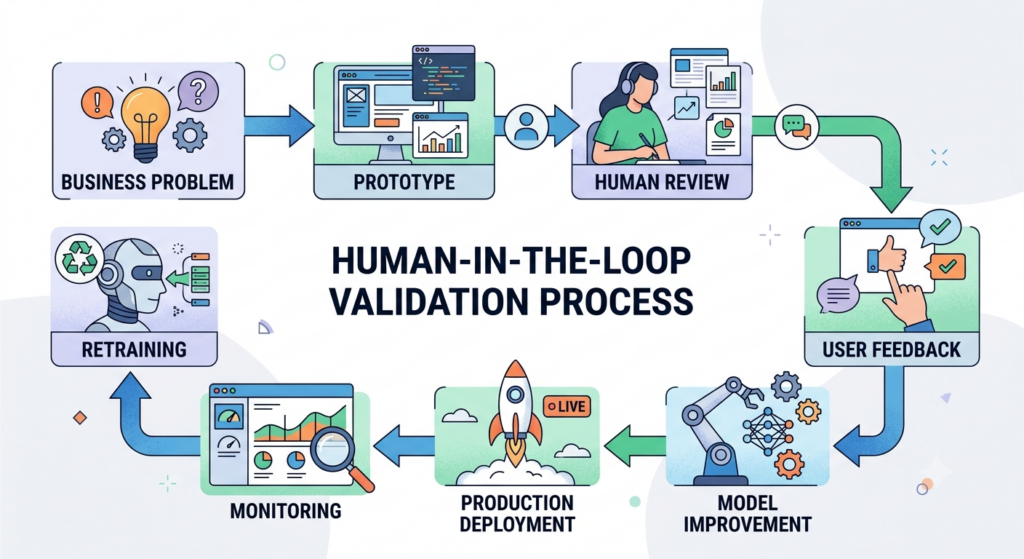
Human-in-the-loop validation
AI should rarely operate without oversight during the early stages of deployment.
Human reviewers help:
- verify AI outputs
- identify hallucinations
- improve prompts
- refine datasets
- detect edge cases
- provide feedback for retraining
A practical feedback loop looks like this:
Conduct A/B testing with users
Before rolling out AI features to every customer, compare them against existing workflows.
Questions worth measuring include:
- Does AI reduce task completion time?
- Are users completing more actions?
- Do support requests decrease?
- Are recommendations accepted more often?
- Does customer satisfaction improve?
Real user behaviour often reveals problems that technical testing misses.
Deliverables
By the end of this stage, you should have:
- AI evaluation scorecard
- Prompt evaluation report
- Human review feedback
- User testing results
- Go-live recommendation
- Risk assessment
5 Common mistakes organisations make
Many organisations:
- rely only on benchmark scores
- skip user validation
- ignore hallucinations
- optimise technical metrics instead of business outcomes
- launch AI features without human oversight
Best practice
Measure what matters to your users and your business, not just what matters to the model.
AI evaluation framework every AI product should use
Many organisations judge AI success using a single metric, usually accuracy.
Production AI requires a broader evaluation framework because success depends on user trust, operating costs, and business impact.
A practical framework should include the following metrics.
| Metric | Why it matters |
| Accuracy | Determines factual correctness |
| Precision & recall | Measures prediction quality |
| Latency | Affects user experience |
| Cost per request | Influences profitability |
| Hallucination rate | Indicates response reliability |
| User satisfaction | Measures adoption |
| Task completion rate | Shows productivity gains |
| Business KPIs | Connects AI to ROI |
Human-in-the-loop checkpoints across the lifecycle
Human expertise should remain part of every stage of AI product development.
| Lifecycle stage | Human contribution |
| Discovery | Define business objectives |
| Data preparation | Label and validate datasets |
| Prototyping | Review AI outputs |
| Testing | Evaluate quality and identify edge cases |
| Deployment | Approve production release |
| Monitoring | Analyse failures and retraining needs |
This collaborative approach produces more reliable AI products while maintaining accountability.
Need help validating your AI product idea?
Building AI products requires more than selecting the latest foundation model.
Success depends on choosing the right use case, preparing quality data, validating with users, and designing an architecture that can scale.
At Evangelist Apps, we work with founders, CTOs, and product teams to validate AI opportunities before significant engineering investment.
Our AI Product Engineering team helps organisations assess feasibility, build production-ready MVPs, integrate LLMs, and create AI products designed for long-term growth.
Book a FREE Consultation Call with us for an early technical assessment that can reduce delivery risk and accelerate your path to production.
______________
Stage 5) AI product engineering & deployment
Once your prototype proves its value, the next challenge is turning it into a secure, scalable product that people can rely on every day.
This stage goes far beyond connecting an LLM API to a user interface.
Production AI systems need resilient infrastructure, observability, security, governance, and the ability to evolve without disrupting users.
Many promising AI products fail here because they were designed as demonstrations rather than production systems.
Goal
Build and deploy a secure, scalable AI product that integrates seamlessly with your existing software ecosystem.
Key activities
- Build production-ready frontend and backend services
- Integrate AI models through secure APIs
- Develop RAG pipelines where appropriate
- Implement authentication and authorisation
- Configure monitoring and logging
- Optimise inference costs
- Establish CI/CD and MLOps pipelines
- Prepare production infrastructure
AI architecture considerations
Depending on your use case, a production architecture may include:
- Web or mobile application
- Backend APIs
- LLM orchestration layer
- Vector database
- Business databases
- Retrieval pipelines
- Prompt management
- Model gateway
- AI observability platform
- Analytics dashboard
Keeping these components loosely coupled makes it easier to update models or switch providers without rebuilding the application.
Don’t forget non-functional requirements
AI products are judged on more than response quality. They also need to perform well under real operating conditions.
Consider:
- Response time
- Scalability
- Availability
- Security
- Compliance
- Cost optimisation
- Explainability
- Disaster recovery
Ignoring these areas often leads to production issues that are far more expensive to fix after launch.
Deliverables
By the end of this stage, you should have:
- Production-ready application
- AI infrastructure
- Deployment pipelines
- Security controls
- Monitoring dashboards
- Technical documentation
- Operational runbooks
6 Common mistakes to be aware of in this stage
Teams frequently:
- deploy without monitoring
- tightly couple applications to one model provider
- ignore inference costs
- underestimate API rate limits
- skip security reviews
- delay observability until after launch
Best practice
Design your product so models can change without requiring the entire application to change.
Today’s best-performing model may not be the best choice six months from now.
__________
Stage 6) Monitoring, feedback loops and continuous learning
Launching an AI product is the beginning of the lifecycle, not the end.
Unlike traditional software, AI systems change over time.
Customer behaviour evolves.
Business rules change.
New data becomes available.
Foundation models improve.
Without continuous monitoring, model quality gradually declines.
This phenomenon is commonly known as model drift.
Production AI teams expect this to happen and build systems that detect it early.
Goal
Continuously improve model performance, reliability, and business outcomes after launch.
Key activities
- Monitor production performance
- Detect model drift
- Evaluate prompt quality
- Review user feedback
- Retrain models when required
- Update knowledge bases
- Optimise operating costs
- Measure business KPIs
Monitor more than model accuracy
Successful AI products track technical and commercial performance together.
Important metrics include:
- Accuracy
- Latency
- Cost per request
- Token usage
- Hallucination rate
- Customer satisfaction
- Feature adoption
- Revenue impact
- Task completion rate
- Infrastructure costs
This provides a complete picture of product health rather than relying on model benchmarks alone.
Introduce LLMOps and ModelOps
As AI systems mature, managing prompts, models, and evaluations becomes increasingly complex.
This is where LLMOps and ModelOps become essential.
Typical activities include:
- Prompt version control
- Automated evaluations
- Model versioning
- Deployment pipelines
- Drift detection
- AI observability
- Cost monitoring
- Compliance reporting
Treat these capabilities as part of your engineering process rather than operational add-ons.
Deliverables
- Monitoring dashboards
- Drift detection reports
- Updated prompts
- Retraining schedule
- Model performance reports
- Business KPI dashboard
5 Common mistakes people make in this stage
Many organisations:
- stop measuring performance after launch
- ignore user feedback
- postpone retraining
- fail to monitor AI costs
- overlook prompt degradation
Best practice
Create a continuous improvement process where product managers, engineers, and AI specialists regularly review performance together.
AI product development lifecycle diagram
Unlike traditional software, AI products rarely move through a straight sequence of stages. They improve through repeated learning cycles.
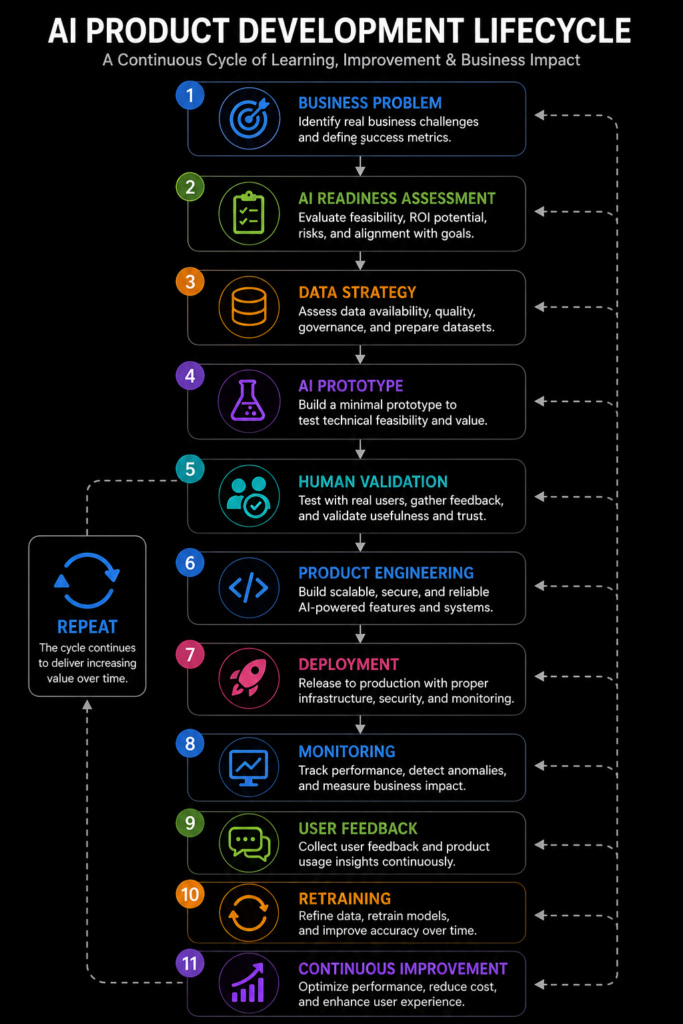
This flywheel helps teams improve product quality with every iteration while adapting to changing user needs and business priorities.
AI product lifecycle for LLM-based applications
Large Language Model (LLM) applications introduce additional considerations that aren’t present in traditional machine learning systems.
Alongside the standard lifecycle, teams should also manage:
- Prompt engineering
- Retrieval-Augmented Generation (RAG)
- Knowledge base updates
- Prompt versioning
- Guardrails
- Hallucination monitoring
- Token optimisation
- Context window management
These components should evolve continuously as models and business requirements change.
AI product lifecycle for SaaS products
Most SaaS companies integrate AI into existing products rather than building standalone AI applications. The lifecycle remains similar but requires closer alignment with existing engineering practices.
Typical workflow:
- Validate customer demand.
- Prioritise AI use cases.
- Assess existing product data.
- Prototype AI functionality.
- Test with a limited customer group.
- Roll out gradually using feature flags.
- Monitor usage and ROI.
- Expand based on adoption.
This incremental approach reduces risk while allowing customers to adapt to new AI capabilities.
AI product development checklist
Before moving into production, confirm that you’ve completed the following:
Discovery
- AI use case validated
- Business objectives defined
- Success metrics agreed
Data
- Data quality assessed
- Privacy reviewed
- Training datasets prepared
Prototyping
- AI MVP validated
- Model selected
- User feedback collected
Engineering
- Secure architecture implemented
- APIs integrated
- Infrastructure tested
Evaluation
- Hallucinations measured
- Human review completed
- Performance benchmarked
Deployment
- Monitoring enabled
- Security verified
- Rollback strategy prepared
Continuous improvement
- Drift detection configured
- Feedback loops established
- Retraining plan documented
10 Common mistakes that cause AI products to fail
Even well-funded AI initiatives can struggle if the fundamentals are overlooked.
The most common mistakes include:
- Building AI before validating the business problem.
- Choosing models before assessing data quality.
- Measuring accuracy instead of business outcomes.
- Ignoring human review during early deployment.
- Treating AI deployment as the end of the project.
- Failing to monitor production performance.
- Underestimating infrastructure and inference costs.
- Overlooking governance, privacy, and compliance requirements.
- Building tightly coupled architectures that are difficult to update.
- Expecting one model to solve every business problem.
Many of these issues can be avoided with structured planning and early technical validation.
Why work with an AI product engineering partner?
Building an AI product requires expertise across product strategy, software engineering, machine learning, cloud infrastructure, data engineering, UX, and AI governance.
Bringing these disciplines together can be challenging, especially for organisations building their first AI-powered product.
At Evangelist Apps, we help startups, scale-ups, SMEs, and enterprise teams move from an AI idea to a production-ready solution. Our AI Product Engineering services cover AI strategy, discovery workshops, MVP development, LLM integration, RAG implementation, enterprise software development, cloud deployment, and continuous optimisation.
Whether you’re building an AI-first SaaS platform, an enterprise copilot, an intelligent automation system, or adding AI capabilities to an existing product, our team helps reduce technical risk and accelerate delivery through a structured engineering approach.
Book a free AI roadmap session to validate your product idea, assess technical feasibility, and define the fastest path to a production-ready AI solution.
Conclusion
Building an AI product is no longer about selecting the latest model.
The products that succeed are built on a structured lifecycle that combines product thinking, high-quality data, disciplined engineering, continuous evaluation, and long-term optimisation.
Every stage influences the next. Decisions made during discovery affect model performance. Data quality shapes user experience. Monitoring determines whether an AI product continues delivering value months after launch.
For founders and CTOs, the biggest advantage isn’t adopting AI faster than competitors. It’s building AI products that solve genuine business problems, adapt over time, and deliver measurable outcomes in production.
Following a structured AI product development lifecycle gives your team a repeatable framework for achieving that goal.
Frequently asked questions
Q. What is the AI product development lifecycle?
The AI product development lifecycle is the end-to-end process of planning, designing, building, deploying, monitoring, and continuously improving AI-powered products using data, machine learning, and software engineering.
Q. How is the AI product development lifecycle different from the traditional product development life cycle?
AI products rely on data, probabilistic models, continuous evaluation, and ongoing retraining, whereas traditional software mainly follows deterministic logic and periodic software updates.
Q. Why is data strategy important before selecting an AI model?
High-quality data has a greater impact on AI performance than model selection. Clean, relevant, and well-governed data improves accuracy, reliability, and long-term product performance.
Q. What are the main stages of the AI product development process?
The process includes problem discovery, AI feasibility assessment, data preparation, prototyping, model selection, product engineering, testing, deployment, monitoring, and continuous improvement.
Q. What are ModelOps and LLMOps?
ModelOps manages the lifecycle of machine learning models, while LLMOps focuses on deploying, monitoring, evaluating, and improving large language model applications in production.
Q. How long does it take to build an AI MVP?
Most AI MVPs can be developed within 8 to 16 weeks, depending on data availability, technical complexity, integrations, and compliance requirements.
Q. What is the biggest reason AI products fail?
Many AI products fail because teams prioritise technology before validating the business problem, preparing quality data, and testing with real users.
Q. Should startups build custom AI models?
Not always. Many startups can launch faster by combining foundation models with Retrieval-Augmented Generation (RAG), proprietary data, and strong product engineering instead of training custom models from scratch.