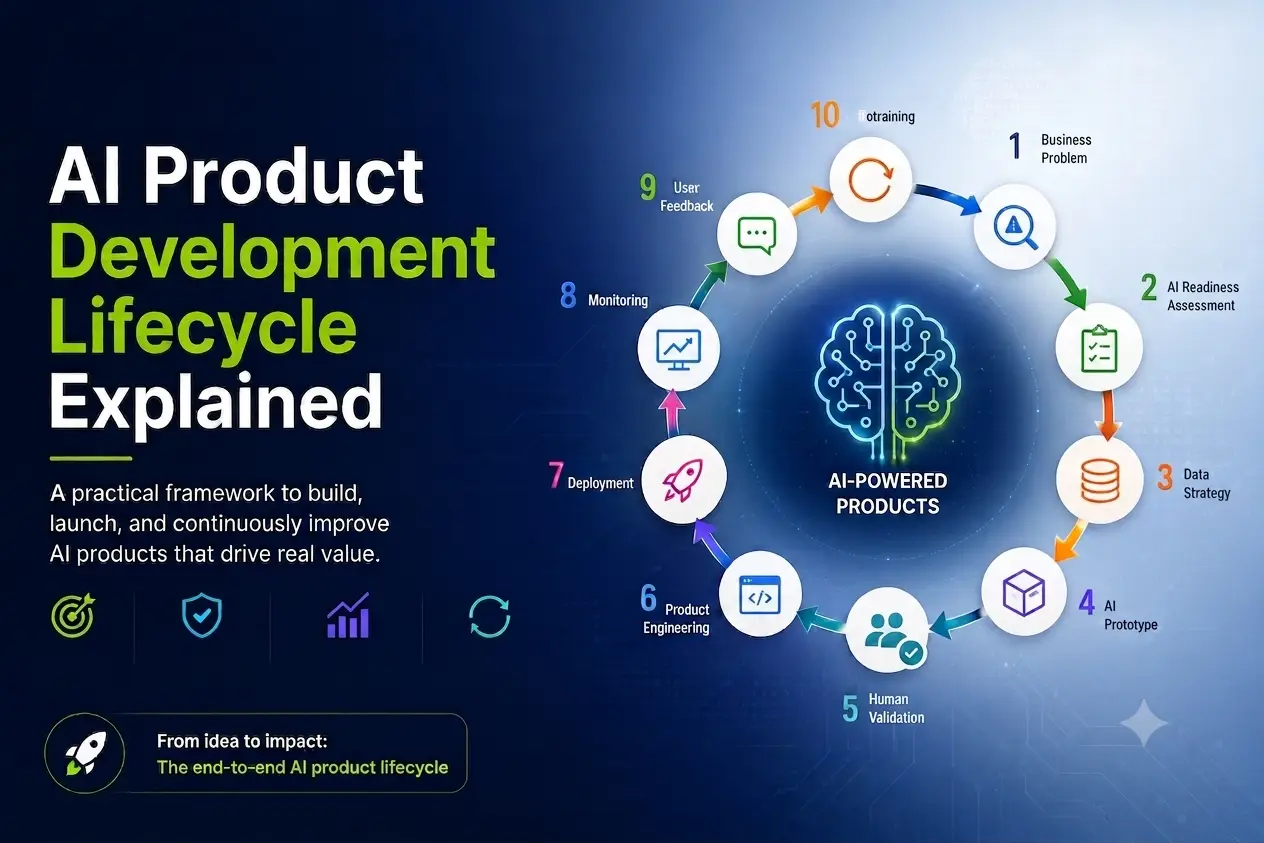
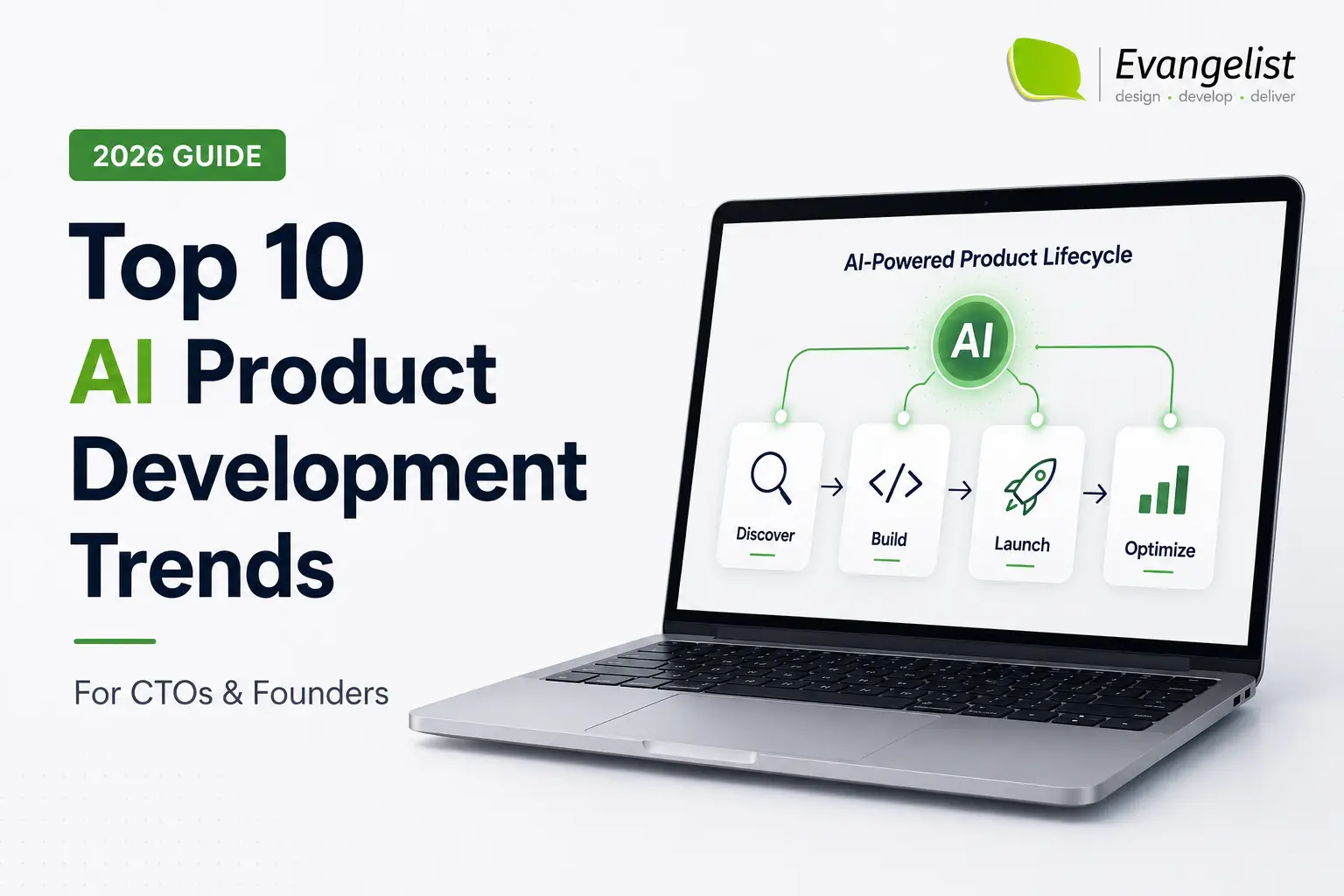


Artificial intelligence now totally influences how products are planned, designed, developed, tested, launched, and improved after release.
If you are a CTOs, product manager or a founder, this creates a different challenge for you now.
The question is no longer whether to adopt AI.
The question is where AI delivers measurable value across the product lifecycle.
Companies that integrate AI into product engineering are already seeing results.
According to Gartner, generative AI is expected to support around 80% of the product development lifecycle, particularly in software engineering and code generation.
And most importantly, the impact goes beyond writing code faster.
AI is helping teams validate ideas earlier, understand customer behaviour in real time, automate testing, predict software defects, improve release quality, and personalize user experiences at scale.
At the same time, expectations have changed.
Customers expect intelligent products. Investors expect faster innovation. Product teams must ship features quickly while maintaining quality, security, and compliance.
This shift is redefining modern product development trends in 2026 & beyond.
At Evangelist Apps, one of the UK’s leading AI & Software development companies, we’ve seen AI change how digital products are built for enterprises and fast-growing businesses.
Instead of treating AI as an add-on feature, successful organizations are embedding intelligence into every stage of product engineering, from discovery workshops to long-term optimization.
In this article, we’ll look at the most important digital product development trends shaping 2026 and beyond, what they mean for technology leaders, and how engineering teams can prepare.
(if you are looking for product engineering services and don’t know how to proceed, book a FREE 30-min consultation call with us. We’ll guide you!)
Why are product development trends changing so quickly?
Traditional software development followed a predictable cycle.
- Research.
- Planning.
- Development.
- Testing.
- Deployment.
Each phase depended heavily on manual work, making iterations expensive and slow.
AI changes this model.
> Instead of waiting weeks for customer feedback, teams can analyse thousands of customer interactions within hours.
> Instead of manually reviewing every pull request, AI assistants identify issues as developers write code. Product managers can evaluate market demand using AI-powered research before engineering begins.
This creates a continuous feedback loop rather than a linear development process.
Several industry factors are accelerating this shift:
- Generative AI has become accessible to development teams.
- Cloud infrastructure makes AI deployment easier.
- Enterprise data is more available than ever.
- Customers increasingly expect personalized digital experiences.
- Competition rewards faster product releases.
According to McKinsey, organizations adopting AI across product development have reduced development time by up to 50% while shortening time-to-market by 20% to 40%.
For technology leaders, AI is becoming an engineering capability rather than a standalone technology investment.
Now let’s talk about the AI trends that are shaping how digital products are built in 2026 & beyond.
#1. AI-native product discovery replaces assumption-based planning
The earliest stages of product development often determine whether a product succeeds.
Historically, product ideas relied on stakeholder opinions, customer interviews, competitor analysis, and market research.
These remain valuable, but AI significantly expands what product teams can learn before writing the first line of code.
Modern AI systems can analyse:
- Customer support conversations
- App Store reviews
- Sales call transcripts
- CRM data
- Community discussions
- Social media sentiment
- Competitor feature releases
Instead of manually reviewing thousands of data points, product teams receive structured insights within minutes.
For example, a SaaS company planning a new reporting module can combine customer support tickets, CRM feedback, and usage analytics to identify the reports customers actually need instead of relying on internal assumptions.
This reduces feature waste.
Research consistently shows that many new products fail because they solve the wrong problem rather than because of poor engineering.
AI helps product teams validate opportunities much earlier in the development process.
What CTOs/Founders/Product Managers should do ⬇️
- Build AI-assisted discovery into every major product initiative.
- Instead of beginning roadmap discussions with opinions, begin with customer evidence generated from AI-assisted analysis.This creates better alignment between product, engineering, marketing, and executive leadership.
#2. AI copilots are becoming standard development tools
One of the biggest AI product development trends is the widespread adoption of AI coding assistants.
Development teams are no longer using AI simply to autocomplete code.
Today’s AI copilots help developers:
- Generate boilerplate code
- Explain unfamiliar codebases
- Suggest architecture improvements
- Generate documentation
- Create unit tests
- Identify security vulnerabilities
- Recommend performance optimizations
The productivity gains are substantial, but the real advantage is consistency.
Experienced engineers also benefit because AI reduces context switching.
Rather than searching documentation across multiple websites, developers receive relevant answers inside their development environment.
This shortens onboarding for new engineers and improves overall engineering velocity.
Can AI replace engineers now?
AI still needs experienced engineers.
Despite rapid advances, AI does not replace software engineers.
Architecture decisions, security design, scalability planning, compliance requirements, and customer experience still require human judgment.
AI increases engineering capacity. It doesn’t replace engineering expertise.
#3. Multi-agent AI is changing how software gets built
Most organizations started their AI journey with individual tools.
One chatbot generated content.
Another created images.
A separate tool helped developers write code.
That model is changing.
The next generation of AI product development relies on multiple AI agents working together.
Instead of performing one isolated task, specialized AI agents collaborate across the software development lifecycle.
A product development workflow might include:
- A research agent analysing market demand.
- A planning agent creating user stories.
- A coding agent generating implementation suggestions.
- A testing agent creating automated test cases.
- A documentation agent updating technical documentation.
- A monitoring agent analysing production issues after release.
Each agent contributes to a connected workflow rather than operating independently.
This dramatically reduces repetitive work while keeping humans responsible for approvals, architecture, and strategic decisions.
For enterprise software teams managing hundreds of releases each year, these coordinated AI workflows can save thousands of engineering hours.
Evangelist Apps’ POV
Many organizations begin their AI journey by purchasing AI tools.
The companies seeing the strongest results start somewhere else.
They redesign their product development process first.
At Evangelist Apps, we’ve found that AI delivers the most value when it’s embedded throughout the engineering lifecycle instead of being added at the end of development.
Product discovery, architecture planning, software engineering, testing, deployment, and continuous improvement all benefit when AI supports the workflow from day one.
That approach reduces rework, shortens delivery cycles, and gives product teams better visibility into technical and business decisions.
We’d be happy to help you in AI integration adding AI into your existing products/processes etc. Share your requirements here
#4. Hyper-personalization is becoming the new product standard
Personalization is no longer a competitive advantage. Users expect it by default.
Whether it’s a banking app recommending financial products, a B2B SaaS platform surfacing relevant dashboards, or an eCommerce application suggesting products based on previous purchases, customers now expect software to understand their intent.
Traditional personalization relied on predefined rules.
For example:
- Show Product A if the customer belongs to Segment X.
- Display Dashboard B for Enterprise customers.
- Recommend Feature C after a specific event.
This approach works for simple scenarios but struggles when user behavior changes frequently.
AI changes the model completely.
Instead of following static rules, machine learning continuously learns from user interactions and adapts the experience in real time.
An AI-powered application can analyze hundreds of behavioral signals, including:
- Session duration
- Click patterns
- Purchase history
- Device preferences
- Feature usage
- Search behavior
- Customer support interactions
Rather than serving the same interface to every user, the product evolves based on individual behavior.
Streaming platforms, fintech companies, healthcare providers, and enterprise SaaS vendors already use this approach to improve engagement and customer retention.
According to MarketsandMarkets, the global hyper-personalization market is projected to exceed $42 billion by 2028, reflecting growing investment across industries.
What this means for product leaders
Product teams should think beyond recommendation engines.
Ask questions such as:
- Which workflows can adapt automatically?
- Which reports should change based on user roles?
- Which notifications should AI prioritize?
- Which onboarding steps should be personalized?
Products that adapt to users create better engagement than products that expect users to adapt to them.
#5. Predictive quality engineering is replacing reactive testing
Quality assurance has traditionally been one of the most time-consuming phases of software development.
- Developers complete implementation.
- QA teams execute manual tests.
- Defects are logged.
- Developers fix issues.
- The cycle repeats.
AI shortens this process by identifying problems before they reach QA.
Instead of simply finding bugs, AI predicts where bugs are likely to occur.
Modern AI-powered testing platforms can:
- Generate test cases automatically
- Prioritize regression tests
- Detect risky code changes
- Recommend additional test coverage
- Predict modules with the highest failure probability
- Identify duplicate defects
This changes testing from reactive validation to proactive risk management.
Industry research shows that nearly 68% of QA teams already use AI for at least one testing activity, including regression testing, smoke testing, and risk-based testing.
The biggest advantage is speed.
Rather than testing everything equally, engineering teams focus on the areas most likely to introduce production defects.
AI does not eliminate QA
Human testers remain essential.
Exploratory testing, usability evaluation, accessibility validation, and business workflow verification still require human judgment.
AI handles repetitive validation.
People evaluate customer experience.
The combination produces better software while reducing release delays.
Ready to build your AI-first digital product?
Whether you’re developing a new SaaS platform, modernizing enterprise software, or integrating AI into an existing application, Evangelist Apps can help you accelerate development while maintaining security, scalability, and long-term flexibility.
Talk to our AI Product Engineering team to discuss your product vision and discover how AI can create measurable business value across your software development lifecycle.
#6. AI-first architecture is becoming a competitive advantage
Many organizations have added AI features to products that were never designed to support AI.
The result is often disappointing.
- Performance suffers.
- Infrastructure costs increase.
- Data becomes difficult to manage.
- Scaling becomes expensive.
Successful organizations are taking a different approach.
Instead of adding AI later, they design products with AI in mind from the beginning.
This includes:
- API-first development
- Microservices architecture
- Event-driven systems
- Scalable data pipelines
- Vector databases
- Retrieval-Augmented Generation (RAG)
- Model orchestration layers
These architectural decisions make it easier to introduce new AI capabilities without rebuilding the entire platform.
Each capability evolves without affecting the rest of the application.
That flexibility becomes increasingly important as AI models continue to improve.
Think beyond today’s models
Large language models are evolving rapidly.
The model you deploy today may not be the best choice next year.
Building modular architecture allows organizations to switch models without redesigning the application.
Technology changes.
Good architecture should not.
#7. Responsible AI is moving from compliance to product strategy
As AI adoption grows, so do customer expectations around privacy, transparency, and governance.
Enterprise customers increasingly ask questions like:
- How is customer data processed?
- Which AI model generated this response?
- Can the output be explained?
- Is confidential information protected?
- Can the model be audited?
These are no longer questions for legal teams alone.
They directly influence product design.
Responsible AI includes several engineering practices such as secure model deployment, explainable AI where appropriate, human review for critical decisions etc.
Organizations that treat governance as a product feature will build greater customer confidence than those that view compliance as a final checklist.
This is particularly important in industries such as healthcare, finance, insurance, education, and government.
Governance should begin during product planning.
When governance becomes part of product engineering, compliance becomes easier to maintain as products grow.
#8. AI-powered experimentation will replace long product release cycles
AI now shortens this entire feedback loop.
Instead of waiting weeks or months for enough customer data, AI continuously evaluates how users interact with new features.
Product managers can identify adoption issues, usability bottlenecks, and feature abandonment almost immediately.
This allows product teams to make smaller, evidence-based improvements instead of relying on large quarterly releases.
For example, AI can automatically identify:
- Features with low adoption
- Steps where users abandon onboarding
- Workflows that generate the highest support requests
- Customer segments that require different experiences
- Features likely to increase retention
Rather than relying on static dashboards, AI surfaces recommendations proactively.
This changes product experimentation from a scheduled activity into a continuous process.
The best digital products improve every day.
Companies like Netflix, Spotify, Amazon, and leading SaaS platforms constantly refine their products using data collected after every interaction.
AI makes this approach accessible to organizations of every size.
#9. Product analytics is becoming predictive instead of descriptive
Traditional analytics answers questions about the past.
- How many users logged in?
- Which features were used?
- How many customers upgraded?
These reports explain what happened.
AI helps explain why it happened and what is likely to happen next.
This is one of the most valuable product development trends because it allows product teams to make decisions before problems become expensive.
Predictive product analytics can identify:
- Customers likely to churn
- Accounts ready for upselling
- Features that drive long-term engagement
- High-risk customer journeys
- Infrastructure bottlenecks before performance drops
- Usage patterns that indicate future demand
Instead of reacting to declining customer engagement, businesses can intervene before users leave.
For enterprise software vendors, this can directly improve customer retention and recurring revenue.
#10. Products are being designed for AI-first users
One of the biggest changes in digital product development trends isn’t happening inside engineering teams.
It’s happening with customers.
People have become comfortable interacting with AI.
- They expect conversational interfaces instead of complex navigation.
- They expect search instead of menus.
- They expect recommendations instead of manually filtering information.
This changes how digital products should be designed.
Instead of asking users to learn the software, modern applications increasingly adapt to the user.
Examples include:
- AI-powered enterprise search
- Natural language reporting
- Intelligent document summarization
- Voice-enabled workflows
- AI copilots embedded inside business applications
- Automated workflow suggestions
The interface is becoming simpler while the technology behind it becomes more sophisticated.
For founders, this creates an opportunity.
Products designed around AI-assisted workflows can often outperform competitors without adding unnecessary complexity.
The goal is not to add AI everywhere.
The goal is to remove unnecessary effort for the user.
What should CTOs, CIOs, and founders do next?
If you’re planning a new AI product or modernizing an existing platform, focus on these 5 priorities before investing in new AI tools.
- Start with an AI roadmap, not a technology stack. Identify the business problems AI should solve and the outcomes you want to measure.
- Build an AI-ready architecture. Use modular services, APIs, cloud infrastructure, and scalable data pipelines so your product can evolve as AI technology changes.
- Improve engineering productivity. Equip your teams with AI-assisted development, automated testing, and intelligent DevOps workflows to accelerate releases without compromising quality.
- Get your data foundation right. Reliable, well-governed data is essential for building trustworthy AI products.
- Measure business impact continuously. Track KPIs such as development speed, customer retention, operational efficiency, and revenue growth to ensure every AI investment delivers measurable value.
Need help defining your AI product roadmap?
Building a digital product requires making the right architectural and product decisions from day one.
At Evangelist Apps, we’ve helped global brands including British Airways, BBC, UBS, Virgin Money, KLM, Channel 4, Hästens, and Third Bridge build and scale digital products.
Our AI Product Engineering services cover the complete product lifecycle, from product discovery and UX design to AI application development, enterprise software engineering, cloud-native architecture, automation, & llong-term product support.
Whether you’re launching a new AI-native SaaS platform, modernizing an existing enterprise application, or integrating Generative AI into your software, our team works to deliver secure, scalable solutions that create measurable business value.
Explore our case studies to see how we’ve delivered enterprise-grade web, mobile, and AI solutions across industries.
Book a FREE discovery call with our AI Product Engineering team to get the practical roadmap for your product, identify high-impact AI opportunities, & avoid costly architectural mistakes before development begins.
Frequently asked questions
Q. What are the biggest product development trends in 2026?
The biggest product development trends include AI-assisted software engineering, multi-agent AI, predictive quality engineering, hyper-personalization, AI-powered analytics, responsible AI governance, and AI-first product architecture.
Q. How is AI changing digital product development?
AI improves every stage of digital product development by accelerating product discovery, generating code, automating testing, predicting customer behavior, personalizing user experiences, and helping teams make faster product decisions.
Q. What is AI product development?
AI product development is the process of designing, building, testing, and improving software products that use artificial intelligence to automate tasks, analyze data, support decision-making, or enhance customer experiences.
Q. Why should businesses invest in AI product development?
Businesses invest in AI product development to shorten development cycles, improve customer experiences, reduce operational costs, increase engineering productivity, and create competitive advantages through intelligent software.
Q. How do CTOs prepare for AI-driven product development?
CTOs should modernize software architecture, establish strong data governance, adopt AI-assisted engineering workflows, invest in cloud-native infrastructure, and measure AI initiatives against clear business outcomes.
Q. What industries benefit most from AI product development?
Healthcare, financial services, retail, manufacturing, logistics, education, telecommunications, and SaaS businesses are among the industries seeing significant value from AI-powered digital products.
Q. Why choose Evangelist Apps for AI product engineering?
Evangelist Apps combines over two decades of software engineering experience with AI expertise to help organizations design, build, modernize, and scale intelligent digital products for global markets.