


TL;DR: Computer Vision for UK Businesses
- Computer vision uses AI to analyse images and video, automating tasks like inspection, monitoring, and tracking
- Computer vision can process visual data up to 10x faster than human workflows
- Many businesses achieve ROI within 6–12 months, with faster returns in high-volume operations
- AI adoption is growing rapidly, with 70%+ of organisations using AI in at least one function
- Implementation requires high-quality data, system integration, and continuous model training
- Computer vision delivers the highest impact in repetitive, high-volume visual processes
Computer vision technology helps UK businesses automatically analyse images and video to detect objects, monitor processes, and make faster decisions without manual effort.
From retail shelf tracking to manufacturing quality inspection, it reduces errors, improves efficiency, and drives measurable cost savings.
In this guide, you’ll learn how computer vision works, where UK businesses are using it, and how to implement it successfully for real business outcomes.
So let’s get started.
What Is Computer Vision?
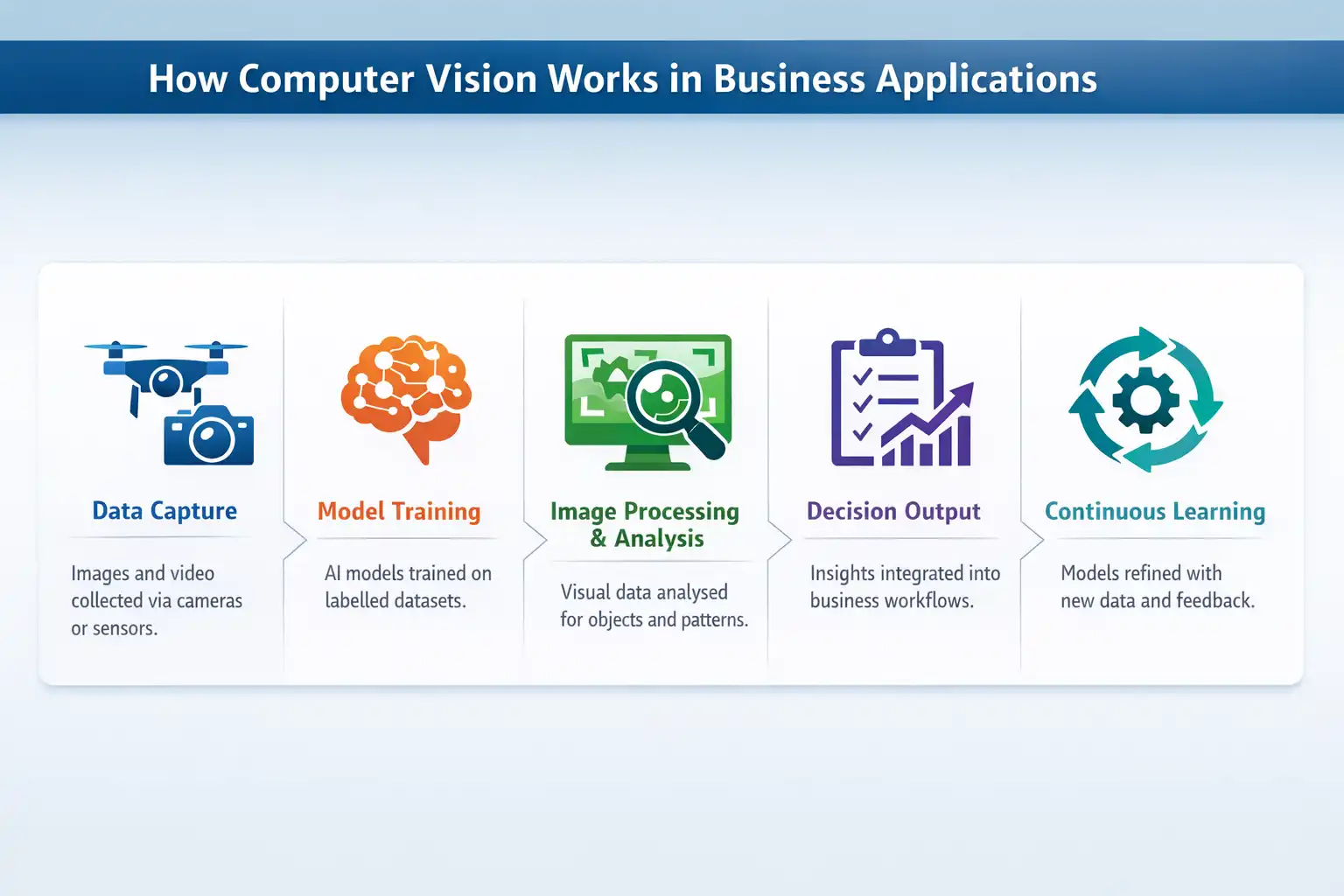
Computer vision is a field of Artificial Intelligence(AI) that enables systems to interpret and process visual data such as images and videos. It uses machine learning models to identify patterns, detect objects, and extract meaningful insights from visual inputs.
For businesses, this means automating tasks that traditionally require human vision such as inspection, monitoring, tracking, and analysis at a much larger scale and speed.
Unlike manual processes, computer vision systems operate continuously, reduce human error, and provide real-time insights that improve operational efficiency.
Key Capabilities of Computer Vision
- Object detection (identify items, people, defects)
- Image classification (categorise visual data)
- Facial recognition (identity verification & security)
- Motion tracking (monitor behaviour over time)
- Optical character recognition (extract text from images)

Why Computer Vision Matters for UK Businesses in 2026
Computer vision adoption is accelerating across UK industries as businesses look to automate operations, reduce costs, and improve accuracy in real-time decision-making.
Key drivers include:
-
Rising labour costs and need for automation
-
Demand for real-time operational visibility
-
Increased focus on quality control and compliance
-
Growth of AI adoption across UK enterprises
Businesses that implement computer vision early gain a competitive advantage through faster workflows, reduced operational errors, and improved customer experiences.
Key Benefits of Computer Vision for UK Based Businesses
Computer vision delivers measurable business outcomes across multiple functions:
- Improved Operational Efficiency – Automates repetitive visual tasks such as inspection and monitoring, reducing manual workload.
- Reduced Errors and Higher Accuracy – Detects defects and anomalies more consistently than human inspection.
- Cost Reduction – Lowers labour costs and minimizes losses due to errors, defects, or inefficiencies.
- Real-Time Decision Making – Provides instant insights from visual data to enable faster responses.
- Enhanced Customer Experience – Improves service delivery through automation and personalization.
How UK Businesses Are Using Computer Vision Technology Across the Industries
As digital transformation accelerates, UK companies are under pressure to improve efficiency, reduce costs, and innovate faster.
Computer vision solutions are helping them do just that.
From retail to manufacturing and logistics to healthcare, this new technology is giving businesses new possibilities to improve their workflows.
Retail
Computer vision helps retail businesses automate store operations and improve customer experience.
Popular use cases in retail include:
- Shelf monitoring to detect stock shortages
- Automated checkout and cashier-less systems
- Customer behaviour analysis for layout optimization
- Loss prevention and theft detection
Manufacturing
UK-based manufacturers are mainly computer vision for precision and efficiency.
Some of the popular use cases include:
- Automated defect detection in production lines
- Quality inspection at scale
- Equipment monitoring and predictive maintenance
- Worker safety compliance monitoring
Healthcare
Hospitals and clinics in UK are rapidly adopting computer vision services to support diagnostics, improve patient monitoring, and streamline workflows.
In healthcare, computer vision also enhances diagnosis and patient care.
Most healthcare related use of cases include:
- Medical image analysis (X-rays, scans)
- Early disease detection
- Patient monitoring systems
- Workflow automation in hospitals
Logistics
Logistics firms in UK mainly use computer vision to enhance efficiency and accuracy in supply chains.
Popular logistical cases include:
- Parcel tracking and verification
- Warehouse automation and inventory monitoring
- Route optimization through visual data
- Safety monitoring in warehouses
Security & Facilities Management
Computer vision enhances security and facility operations by enabling real-time monitoring, threat detection, and automated access control systems.
- Surveillance and threat detection
- Access control systems
- Crowd monitoring and safety compliance
What Are the Challenges and Considerations in Implementing Computer Vision?
While computer vision offers significant business advantages, successful implementation requires careful planning and alignment with operational needs.
1. Data Quality and Availability
Computer vision models rely heavily on high-quality, well-labelled datasets. Poor image quality, inconsistent data, or limited datasets can reduce accuracy and impact performance. Businesses must ensure access to relevant and diverse visual data.
2. Integration with Existing Systems
Integrating computer vision into current workflows, software systems, and infrastructure can be complex. Seamless integration is essential to ensure that insights generated by the system are actionable and aligned with business processes.
3. Privacy and Compliance (UK GDPR)
Using cameras and visual data introduces privacy concerns. UK businesses must ensure compliance with data protection regulations, including UK GDPR, especially when handling personal or sensitive visual information.
4. Initial Setup and Infrastructure Costs
Deploying computer vision systems may require investment in hardware (cameras, edge devices), cloud infrastructure, and development resources. However, these upfront costs are typically offset by long-term efficiency gains.
5. Model Accuracy and Continuous Training
Computer vision models are not static. They require continuous monitoring, retraining, and optimization to maintain accuracy as environments, lighting conditions, and business scenarios evolve.
6. Change Management and Adoption
Introducing AI-driven automation can require operational changes and employee training. Ensuring team adoption and aligning stakeholders is critical for long-term success.
Addressing these challenges early ensures successful implementation and long-term ROI.
ROI and Business Impact of Computer Vision
Businesses adopting computer vision report 20–50% cost reduction, 30–45% productivity gains, and up to 90–99% accuracy in defect detection, especially in manufacturing and retail.
Many organisations achieve ROI within 6–12 months, with early efficiency gains appearing even sooner.
AI adoption is rapidly scaling, with 78% of companies already using AI in at least one business function and 77% actively exploring or deploying AI solutions. (Source: McKinsey & Company “State of AI in 2025” report)
AI-driven transformation is also expected to boost global productivity by up to 40% and increase economic output by up to 15% over the next decade, reinforcing its long-term business value
Companies that partner with a computer vision company or seek computer vision consulting gain access to tailored solutions that align with their goals.
Whether through custom development or integration with existing systems, a strategic approach can lead to significant ROI.
Computer Vision Development Services for UK Businesses
At Evangelist Apps, we help UK businesses design and implement custom computer vision solutions that automate visual processes and deliver real-time insights from images and video.
What We Offer
- Computer Vision Strategy & Consulting – Identify high-impact use cases, assess data readiness, and define a clear roadmap aligned with your business goals and ROI expectations.
- Custom Computer Vision Development – Build end-to-end solutions using advanced AI models for image analysis, object detection, tracking, and automation tailored to your industry.
- System Integration & Workflow Automation – Seamlessly integrate computer vision systems with your existing tools, APIs, and infrastructure to ensure smooth operations and real-time decision-making.
- Model Optimization & Performance Scaling – Enhance model accuracy, reduce latency, and ensure stable performance in real-world environments through continuous optimization.
- Data Preparation & AI Training Support – Manage data collection, annotation, and validation to build highly accurate and reliable computer vision models.
Core Capabilities Evangelist Apps Deliver
- Image and video analysis
- Real-time monitoring and anomaly detection
- OCR and visual data extraction
- Scalable cloud and edge deployment
These solutions help businesses reduce costs, improve accuracy, and make faster data-driven decision
Why Businesses Choose Evangelist Apps for Computer Vision Solutions
- End-to-end execution from strategy to deployment
- Custom-built solutions tailored to specific business needs
- Scalable systems designed for long-term growth
- Strong focus on measurable ROI and operational efficiency
Evangelist Apps combines technical expertise with practical business understanding to deliver computer vision solutions that are not just innovative, but commercially impactful.
Whether you’re exploring automation or scaling AI adoption, our team of experts helps you implement computer vision solutions that drive efficiency, accuracy, and long-term business growth.
Book a FREE 30-min Call with us to explore how computer vision can transform your operations.
Frequently Asked Questions (F.A.Qs)
Q. What is computer vision used for in businesses?
Computer vision is used to automate visual tasks such as inspection, monitoring, tracking, and quality control across industries.
Q. How does computer vision help UK businesses?
It reduces operational costs, improves accuracy, and enables real-time decision-making.
Q. Is computer vision expensive to implement?
Costs vary by use case, but many businesses see ROI within months through efficiency gains.
Q. Which industries benefit most from computer vision?
Retail, manufacturing, healthcare, logistics, and security sectors benefit the most.
Q. Do small businesses use computer vision?
Yes, scalable solutions make computer vision accessible to small and mid-sized businesses.