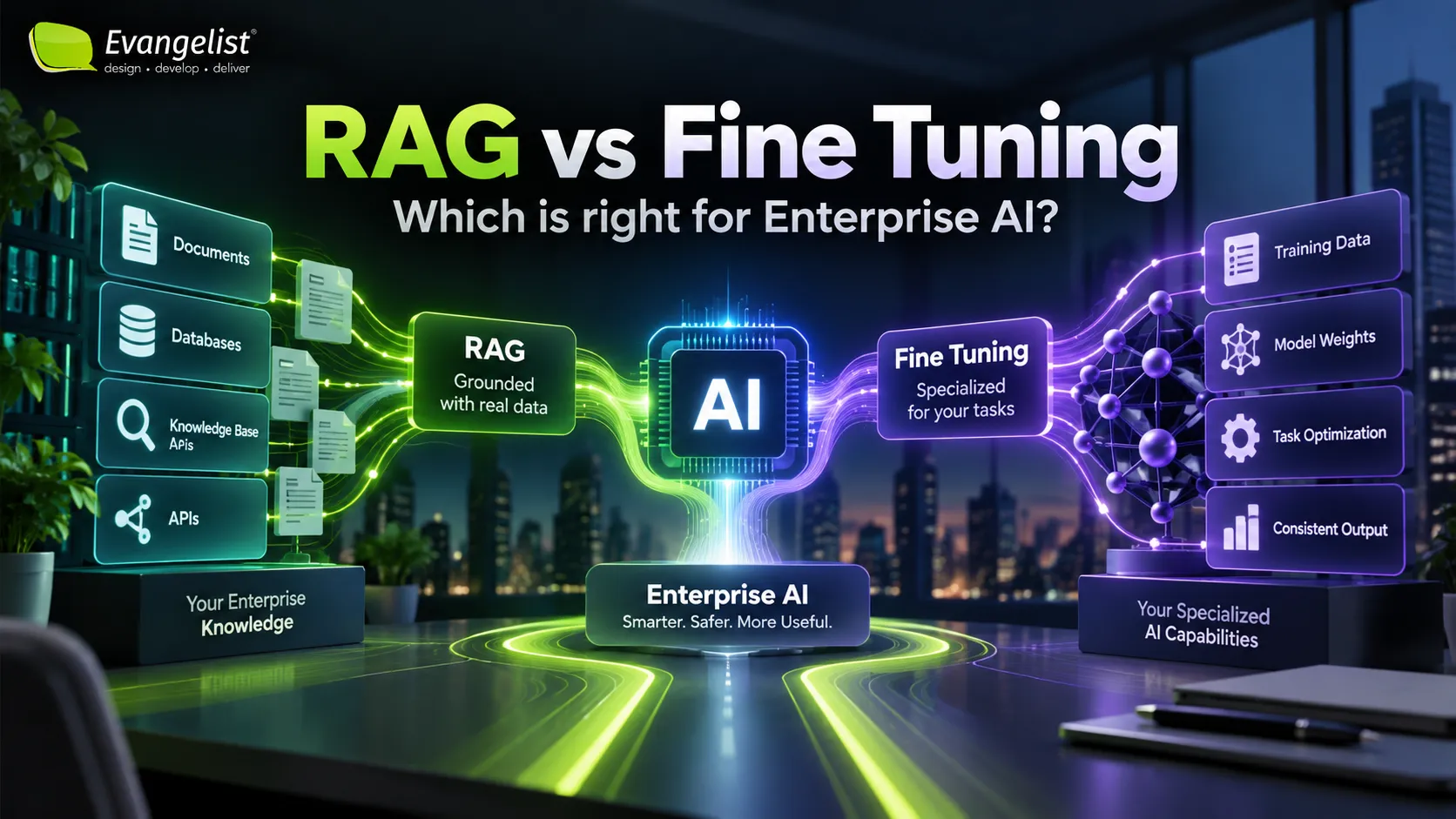


Enterprise AI projects often reach the same question after the first prototype works: should the model use RAG or fine tuning?
The answer depends on what the system needs to improve.
RAG gives an LLM access to external information at runtime. It is a strong fit for private, changing or source based enterprise knowledge.
Fine tuning changes model behavior through additional training. It is better suited to narrow tasks, consistent formats and specialized behavior.
Some applications need both.
This decision is becoming more practical as companies move from AI experiments to production systems.
This guide explains RAG vs fine tuning for enterprise AI, when each approach makes sense, where they can fail and when a hybrid architecture is worth considering.
TL;DR
- Choose RAG when your AI needs access to private, changing, or source based enterprise information.
- Choose fine tuning when the main problem is model behavior, such as classification, extraction, formatting, or specialized task performance.
- RAG keeps knowledge in external sources, while fine tuning changes the model through additional training.
- Use RAG when you need current information, source citations, access controls, or traceability.
- Use RAG and fine tuning together when you need both current enterprise knowledge and specialized model behavior.
RAG vs fine tuning at a glance
The simplest way to understand RAG vs fine tuning is to ask where the capability should live.
| Requirements | Best starting point |
| Current company information | RAG |
| Private documents and knowledge | RAG |
| Source citations | RAG |
| Knowledge spread across systems | RAG |
| Narrow classification task | Fine tuning |
| Consistent output format | Fine tuning |
| Specialized task behavior | Fine tuning |
| Current knowledge plus specialized behavior | Fine tuning + RAG |
RAG keeps knowledge in external sources and retrieves it when needed.
Fine tuning changes the model through additional training.
So, if the problem is knowledge access, start with RAG. If the problem is repeatable model behavior, evaluate fine tuning. If both problems exist, test a hybrid approach.
Why the choice matters in enterprise AI
A model can perform well in a controlled demo and still fail in production.
An enterprise application may need to work with confidential documents, enforce user permissions, connect to CRM or ERP systems, provide citations and meet strict response time or cost targets.
The model is only one layer.
A knowledge assistant, for example, depends on the quality of its source documents, document processing, retrieval, ranking and access controls. If the wrong document is retrieved, a more capable model may still produce the wrong answer.
The architecture also affects maintenance.
Fine tuning a model with information that changes every week creates a recurring training problem. Adding retrieval to a simple classification workflow can create unnecessary latency and infrastructure.
The goal is to use the simplest architecture that meets the actual business requirement.
What is RAG?
RAG stands for Retrieval Augmented Generation.
It allows an LLM to use external information when generating a response. The information can come from documents, databases, knowledge bases, APIs or other approved enterprise sources.
A production RAG pipeline typically follows this path:
Enterprise data → ingestion → processing → indexing → retrieval → reranking → permission checks → LLM → response
How enterprise RAG works
1. Ingest enterprise data – Data may come from PDFs, websites, databases, CRM systems, ERP systems, internal wikis or product documentation.
2. Process and chunk the data – Large documents are divided into useful sections. Metadata such as department, date, product, document type and permission level can improve retrieval.
3. Create searchable indexes – Embeddings support semantic search. Keyword search can also matter when exact product codes, policy numbers or error codes are important.
4. Retrieve relevant information – The system searches for content related to the user’s request. Complex questions may require query transformation, decomposition or multi step retrieval.
5. Rerank and filter – A reranker can improve the ordering of retrieved content. Filters can remove information that does not meet the query or business rules.
6. Apply access controls – Authorization should be checked before restricted information reaches the model.
7. Generate the response – The LLM receives selected context and generates an answer. Source citations can be included when traceability is required.
8. Evaluate and monitor – Teams should measure retrieval quality, answer quality, groundedness, citation correctness, latency, cost and failure rates.
Where RAG works well in enterprise AI
RAG is a strong option for:
- Internal knowledge assistants
- Enterprise search
- Customer support
- Product documentation
- Research systems
- Policy and compliance workflows
- Document based applications
It is particularly useful when the source of truth changes regularly.
Where RAG can fail
- RAG quality depends on the complete retrieval pipeline.
- Poor source data can produce poor answers.
- Bad chunking can hide useful context.
- Weak retrieval can select irrelevant information.
- Too much context can increase cost and reduce response quality.
- Poorly designed permissions can expose restricted information.
- RAG can improve grounding, but it does not guarantee factual answers.
What is fine tuning?
Fine tuning adapts an existing model using a curated training dataset.
It changes how the model performs a task or follows a desired behavior.
This is different from giving the model additional information during an individual request.
Fine tuning is useful when the model already has the information it needs but does not consistently perform the task in the required way.
Fine tuning vs pretraining – are they same?
Pretraining creates the foundation model.
Fine tuning starts with an existing model and adapts it to a narrower task or behavior.
Parameter efficient approaches can reduce the amount of model parameters that need to be updated.
The appropriate method depends on the model, dataset, task and production requirements.
What fine tuning is good at
Fine tuning can help with:
- Classification
- Data extraction
- Routing
- Structured outputs
- Specialized terminology
- Consistent response formats
- Narrow domain tasks
- Repeatable workflows
For example, a support operation may need every ticket classified into a fixed set of categories. If prompting does not provide the required consistency, fine tuning may be worth testing.
Fine tuning can also make sense when a smaller customized model can handle a high volume task at a lower inference cost.
What fine tuning is not good at
Fine tuning is usually a poor solution for fast changing factual information.
If product prices, policies or inventory change frequently, those values are better managed through an external source.
Fine tuning also does not guarantee factuality. It changes model behavior. It does not turn model parameters into a governed company database.
RAG vs fine tuning comparison for enterprise AI
| Factor | RAG | Fine tuning |
| Primary purpose | External knowledge access | Model behavior and task performance |
| Knowledge location | External data source | Model parameters |
| Data freshness | High when the source is updated | Usually requires retraining |
| Traceability | Can provide citations | Not inherent |
| Security | Can enforce source permissions | Information may be embedded in model weights |
| Best fit | Q&A, search, research, support | Classification, extraction, formatting |
| Upfront effort | Data and retrieval architecture | Dataset preparation and training |
| Ongoing effort | Data sync, retrieval tuning and evaluation | Retraining, versioning and evaluation |
| Latency | Adds retrieval steps | Can be lower when retrieval is unnecessary |
| Portability | Often easier at application level | More tied to the tuned model |
There is no universal winner in the RAG vs fine tuning debate.
The right choice depends on the workload.
When should an enterprise choose RAG?
Choose RAG when the application needs information that lives outside the model and may change over time.
Typical signals include:
1. Your knowledge changes frequently
Product documentation, pricing, policies, procedures and operational information can change without notice.
Keeping these sources external allows the AI system to retrieve the current version.
2. You need answers grounded in proprietary sources
RAG can connect an LLM to internal information without treating the model itself as the company’s knowledge repository.
3. You need citations or auditability
If users need to verify where an answer came from, retrieved source references can be included in the response.
This is particularly useful for regulated workflows, research and internal knowledge systems.
4. Data lives across multiple systems
Enterprise information is often spread across databases, documents, applications and APIs.
A retrieval layer can bring relevant information from those sources into the AI workflow.
5. Permissions matter
Different employees may have access to different information.
RAG can enforce those boundaries at retrieval time when the architecture is designed correctly.
When should an enterprise choose fine tuning?
Fine tuning is worth evaluating when the core problem is model behavior.
1. The task is narrow and repeatable
Classification, extraction, routing and structured generation are common examples.
2. Output format must be highly consistent
If the model repeatedly fails to follow a required format despite strong instructions, fine tuning may improve consistency.
3. You have high quality examples
Fine tuning needs representative training and evaluation data.
If the organization does not have enough quality examples, building the evaluation set should come first.
4. Inference efficiency justifies customization
A smaller customized model may make economic sense for a high volume task.
The decision should consider training, deployment and inference costs together.
5. Prompting is not enough
Fine tuning becomes more relevant when the model has the right information but still fails to perform the required task consistently.
When should RAG and fine tuning be used together?
A hybrid architecture can separate knowledge access from model behavior.
Consider an enterprise customer support assistant.
RAG can retrieve the latest troubleshooting guide, product documentation and warranty policy.
Fine tuning can help the model follow a specific support workflow or response format if prompting does not provide sufficient consistency.
The same pattern can work for regulated document workflows.
RAG can retrieve the current policy or procedure. A tuned model can classify the document or extract required fields.
The key is to justify each component through evaluation. A hybrid system adds operational complexity, so both parts should have a measurable purpose.
The enterprise decision framework
Before choosing RAG, fine tuning or both, ask:
- Does knowledge change frequently?
- Do answers need to reference approved sources?
- Is the problem knowledge, behavior or both?
- Who is allowed to access the data?
- Where does the required information live?
- What latency does the workflow require?
- What is the acceptable cost per successful task?
- Do you have representative evaluation data?
- What security and governance controls are required?
- Who will operate the system after launch?
If these questions cannot be answered, the project may need an architecture and data assessment before model customization.
A practical enterprise RAG architecture
A production RAG system needs more than a vector database.
Data sources and ingestion
Connect approved enterprise sources and account for document versions, updates and source failures.
Document processing and enrichment
Extract useful content and preserve important structure. Add metadata that supports retrieval and access control.
Hybrid search and reranking
Semantic search can find conceptually related information. Keyword search can handle exact terms. Reranking can improve the final context selection.
Model routing
Different tasks may need different models.
A simple extraction task may not require the same model used for a complex reasoning workflow. Routing can help manage latency and cost.
Guardrails and access control
Security rules should be enforced before sensitive information reaches the model.
Evaluation and observability
Log useful information such as search queries, retrieved documents, model versions, latency, token usage, errors and user feedback.
This allows teams to investigate why a response failed.
How to evaluate RAG vs fine tuning
Build an evaluation set from real enterprise tasks before making a major architecture decision.
For RAG, evaluate retrieval separately from generation.
If the answer is wrong, first ask whether the correct information was retrieved.
Then measure:
- Groundedness
- Citation correctness
- Task success
- Refusal behavior
- Latency
- Cost
- Permission boundary failures
For fine tuning, compare the tuned model with a strongly prompted baseline.
Measure whether the improvement in the target task justifies the training and operating cost.
Start with a baseline before optimizing.
This prevents teams from adding retrieval, reranking or fine tuning without evidence that the additional component solves a real problem.
Common enterprise mistakes for enterprise AI
Mistake #1) Fine tuning changing documents into model knowledge
Documents that frequently change should usually remain in an external knowledge system.
Mistake #2) Treating vector search as the whole RAG system
A vector database is only one part of retrieval.
Data preparation, chunking, metadata, ranking, permissions and evaluation also matter.
Mistake #3) Ignoring source data quality
If the source material is incomplete or outdated, the AI system inherits that problem.
Mistake #4) Choosing a model before defining the workload
Define the task, quality target, latency, security requirements and cost before choosing a model.
Mistake #5) Skipping access controls
Sensitive enterprise information should reach the model only when the user and workflow are authorized to access it.
Mistake #6) Treating a prototype as production
A production system needs monitoring, evaluation, failure handling and processes for data and model updates.
RAG vs fine tuning: cost and operational trade offs
Neither approach is automatically cheaper.
RAG can involve costs for ingestion, parsing, embeddings, storage, retrieval, reranking, inference and monitoring.
Fine tuning can involve dataset preparation, training, evaluation, hosting, model versioning and retraining.
Engineering time also matters.
A RAG system needs data and retrieval maintenance. A fine tuned model needs a dataset and model lifecycle management.
IBM’s 2025 CEO Study found that only 25% of surveyed CEOs said their AI initiatives had delivered the expected ROI over the previous few years.
That makes architecture discipline important. The question should be whether the chosen approach improves the business outcome enough to justify its full operating cost.
What the right choice looks like in 2026
RAG is often a practical starting point for enterprise applications that need current or private knowledge.
Fine tuning is a targeted option for specialized behavior and narrow tasks.
Hybrid architectures make sense when both requirements are measurable.
More advanced applications can also combine retrieval with tools, model routing and agentic workflows.
The same principle applies: every component should have a clear job.
As IBM Chairman and CEO Arvind Krishna recently remarked:
“The enterprises pulling ahead are not deploying more AI; they’re redesigning how their business operates.”
For enterprise AI teams, that means looking beyond the model and designing the complete workflow around the business requirement.
How Evangelist Apps helps in your enterprise AI strategy
Choosing RAG or fine tuning is only one part of an enterprise AI project.
The implementation may require data integration, retrieval, model selection, security, evaluation, deployment and MLOps.
Evangelist Apps is one of the UK’s leading AI engineering teams, delivering AI development and integration services to businesses worldwide.
With experience building secure, scalable AI solutions for ambitious brands, our team helps enterprises turn complex AI strategies into production-ready systems.
Over the years we have helped some of the biggest brands develop & integrate AI into their production processes. (Check out portfolio for more information)
Evangelist Apps can support these areas through:
- RAG development
- AI consulting and implementation
- AI integration
- Custom AI development
- AI product engineering
- Machine learning development and MLOps
- AI chatbot development
For organizations building AI applications around proprietary data, the focus can be on selecting the right architecture first and then building the required production components.
Free 30 minute enterprise AI architecture consultation
Not sure whether your use case needs RAG, fine tuning or both?
Bring your use case, data sources and constraints to a free 30 minute consultation with our Evangelist Apps AI team.
Useful inputs include your current AI workflow, data sources, update frequency, expected users, security requirements, latency targets and known model failures.
The goal is to identify an architecture that fits the actual workload.
Book your FREE 30 min consultation here (Click on the link)
F.A.Q on RAG vs fine tuning
Q. Is RAG better than fine tuning?
Neither is universally better. RAG fits knowledge access. Fine tuning fits specialized behavior and narrow tasks.
Q. Can RAG replace fine tuning?
RAG can solve many knowledge access problems that teams initially think require fine tuning. It does not replace fine tuning for every behavioral requirement.
Q. Can you use RAG and fine tuning together?
Yes. RAG can provide current information while fine tuning can improve specialized behavior.
Q. Is fine tuning good for adding company knowledge?
It can help with company terminology and task behavior. Frequently changing factual knowledge is generally better handled through retrieval.
Q. Is RAG cheaper than fine tuning?
Not always. Compare the total cost of ownership for the specific workload.
Q. Does RAG eliminate hallucinations?
No. RAG can improve grounding when retrieval and generation are designed and evaluated properly.
Q. How do you evaluate an enterprise RAG system?
Test retrieval and generation separately. Measure groundedness, citation accuracy, task success, latency, cost and permission boundary failures.
Q. When should an enterprise fine tune a model?
Consider it when the task is narrow, repeatable and measurable, and prompting does not provide the required consistency.