A Large Language Model (LLM) is an advanced artificial intelligence model trained on vast amounts of text to understand language, recognise patterns, and generate human-like responses. It enables AI applications to read, write, summarise, analyse, and converse using natural language.
Why LLMs Matter for Businesses
The way businesses interact with information is changing rapidly.
Employees spend hours searching through documents, writing reports, responding to customer queries, and analysing large volumes of data.
Large Language Models help automate many of these knowledge-intensive tasks while improving productivity and consistency.
Unlike traditional software, which follows predefined rules, an LLM understands context, intent, and relationships between words. This allows it to answer questions, generate content, summarise documents, write code, analyse customer feedback, translate languages, and assist with decision-making.
Today, LLMs power some of the world’s most widely used AI assistants, including Microsoft Copilot, ChatGPT, GitHub Copilot, and many enterprise AI platforms.
Businesses are increasingly using them to improve customer support, accelerate software development, streamline internal operations, and unlock insights hidden within their data.
However, an LLM is only one part of an effective AI solution.
To deliver reliable business outcomes, it often works alongside technologies such as Retrieval-Augmented Generation (RAG), vector databases, APIs, and enterprise knowledge systems.
How a Large Language Model Works
A Large Language Model learns language by analysing enormous collections of books, articles, websites, research papers, technical documentation, and other publicly available text.
During training, the model identifies relationships between words, phrases, and concepts rather than memorising individual sentences.
When someone asks a question, the LLM predicts the most likely sequence of words that forms a useful response based on the context provided.
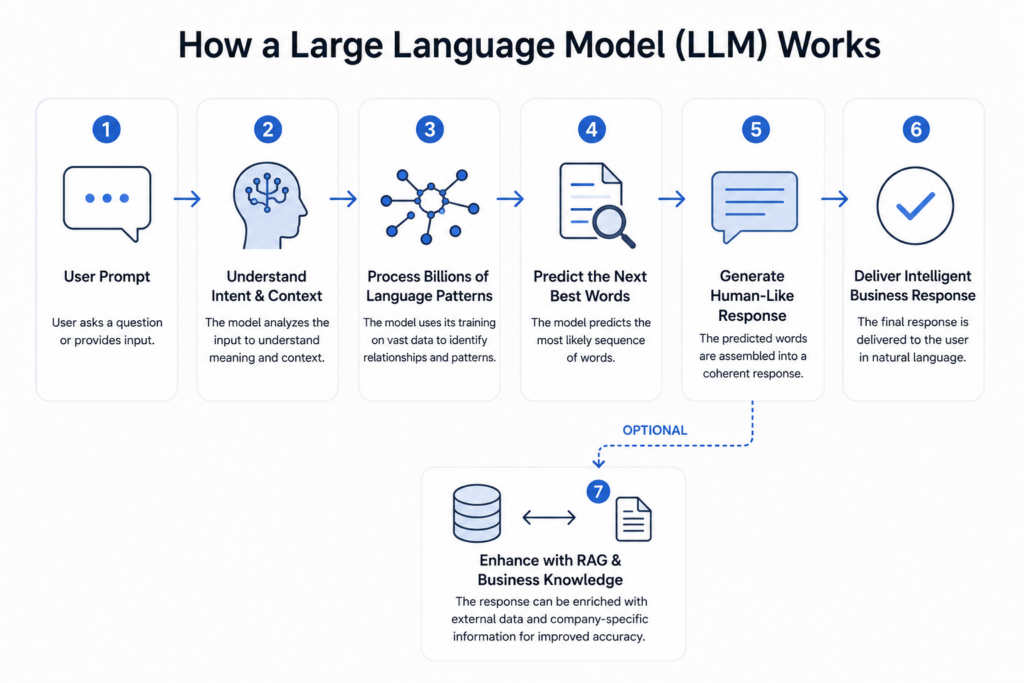
Although this process happens in milliseconds, several stages occur behind the scenes:
Step 1: Understanding the Prompt
The model first analyses the user’s question to understand its intent, context, and key topics.
Step 2: Processing Language Patterns
Using billions of learned parameters, the model identifies relationships between words and concepts to determine the most appropriate response.
Step 3: Generating a Response
Instead of retrieving a predefined answer, the model generates new text one word at a time based on statistical probabilities and contextual understanding.
Step 4: Refining the Output
Depending on the application, the generated response may be enhanced using external knowledge sources, business rules, or Retrieval-Augmented Generation (RAGRetrieval-Augmented Generation (RAG) is an AI architecture that combines a large language model (LLM) with an external knowledge source, allowing AI systems to retrieve relevant information before generating a response. This approach helps deliver answers that are more accurate, up-to-date, and grounded in trusted business data. More) to improve accuracy.
This ability to understand and generate natural language makes LLMs significantly more flexible than traditional chatbot systems or keyword-based search engines.
What Are the Benefits of LLMs
Natural Conversations
LLMs understand questions phrased in everyday language, making AI interactions feel intuitive and human-like.
Improved Productivity
Businesses can automate repetitive writing tasks such as drafting emails, creating reports, summarising meetings, and generating documentation.
Knowledge Discovery
Employees can quickly find information across large collections of documents without manually searching through multiple systems.
Content Generation
LLMs can assist in creating blogs, product descriptions, technical documentation, marketing copy, and customer communications while maintaining consistent quality.
Software Development Support
Developers use LLMs to generate code snippets, explain existing code, suggest improvements, and accelerate software delivery.
Multilingual Communication
Modern language models can translate content, support international customers, and enable organisations to operate across multiple languages.
Real-World Business Example of LLM Usage
Consider a financial services company where relationship managers frequently answer client questions about investment products, compliance policies, and internal procedures.
Without an LLM, employees may need to search multiple systems, review lengthy documents, or contact specialists before responding to clients.
By integrating an LLM with the company’s knowledge base, employees can ask questions in plain English such as:
“What documents are required for opening a corporate investment account?”
The AI understands the request, retrieves relevant internal guidance, and provides a concise, easy-to-understand answer within seconds.
This reduces response times, improves consistency, and allows employees to focus on delivering better customer experiences.
How Evangelist Apps Uses Large Language Models
At Evangelist Apps, we help organisations move beyond experimental AI and build practical, business-focused solutions powered by Large Language Models.
Our team of AI experts has developed applications that combine LLMs with secure enterprise data, modern cloud platforms, APIs, and Microsoft technologies to solve real business challenges.
Whether it’s an AI-powered customer support assistant, document intelligence platform, internal knowledge portal, or workflow automation solution, we design AI systems that are scalable, secure, and aligned with business objectives.
Rather than relying solely on an LLM’s pre-trained knowledge, we often combine language models with Retrieval-Augmented Generation (RAGRetrieval-Augmented Generation (RAG) is an AI architecture that combines a large language model (LLM) with an external knowledge source, allowing AI systems to retrieve relevant information before generating a response. This approach helps deliver answers that are more accurate, up-to-date, and grounded in trusted business data. More), semantic searchSemantic Search understands the meaning and intent behind a query to find relevant results, even when the exact words do not match. More, and vector databases to ensure responses are grounded in accurate, up-to-date business information.
By integrating AI into existing business processes, organisations can improve productivity, enhance customer experiences, and make better use of their organisational knowledge.
Large Language Models are transforming the way organisations work across industries. Common applications include:
AI-powered customer support and virtual assistants
Intelligent document search and knowledge management
Meeting summaries and action item generation
Content creation and marketing assistance
Software development and code generation
HR policy assistants and employee self-service portals
Sales proposal drafting and CRM support
Enterprise search across SharePoint, Dynamics 365, and cloud storage
Related Glossary Terms
Retrieval-Augmented Generation (RAGRetrieval-Augmented Generation (RAG) is an AI architecture that combines a large language model (LLM) with an external knowledge source, allowing AI systems to retrieve relevant information before generating a response. This approach helps deliver answers that are more accurate, up-to-date, and grounded in trusted business data. More)
AI AgentWhat is an AI Agent? One-Line Definition An AI Agent is an intelligent software system that can understand goals, make decisions, interact with tools and data, and complete tasks with minimal human intervention. Unlike traditional AI chatbots that primarily answer questions, AI agents can reason, plan, take actions, and continuously adapt to achieve specific business objectives. Why AI Agents Matter... More
Prompt EngineeringPrompt engineering is the practice of writing and refining instructions to help AI produce more accurate, useful results. More
Generative AI
Vector Embeddings
Semantic SearchSemantic Search understands the meaning and intent behind a query to find relevant results, even when the exact words do not match. More
Fine-Tuning
Summarize with AI
Share:
Transform your
business! Build a
powerful mobile app
now!
Why Over 500 Clients Choose Evangelist Apps
Why Organizations Trust Us
25+ Years of Expertise. |
Global Reach |
Agile. Transparent. Fast
Our Recognized Certifications & Partnerships
About to leave?
Share your requirements with us, and we’ll provide you with a detailed estimate on cost and timeline