Semantic Search is a search technique that understands the meaning and intent behind a user’s query instead of matching exact keywords. It delivers more relevant results by analysing context, relationships between words, and the overall meaning of both the search query and the available content.
Why Semantic Search Matters for Businesses
Finding information should be quick, but traditional keyword search often makes people work harder than necessary.
Employees may search for the correct document using different words than the document author used.
Customers may describe a product or problem in everyday language while the website expects specific keywords. In both situations, valuable information remains difficult to find.
Semantic Search addresses this challenge by focusing on meaning rather than exact wording. It recognises that different phrases can express the same idea and ranks results based on relevance instead of simple keyword matches.
For businesses, this creates a better experience across customer portals, internal knowledge bases, document libraries, e-commerce platforms, and AI assistants.
Employees spend less time searching for information, customers receive more accurate answers, and organisations make better use of the knowledge they already own.
As AI-powered search continues to replace traditional search experiences, Semantic Search has become a key technology behind enterprise knowledge management, intelligent chatbots, and Retrieval-Augmented Generation (RAG) systems.
Semantic Search vs Keyword Search
Although both approaches help users find information, they work differently.
Keyword Search looks for exact words or phrases within documents. It performs well when users know the precise terminology but may miss relevant content written differently.
Semantic Search focuses on meaning. It understands relationships between concepts, interprets natural language, and retrieves content that answers the user’s intent even when the wording differs.
For organisations managing large knowledge repositories, Semantic Search generally produces more useful and relevant results while reducing the effort required to locate information.
How Semantic Search Works
Unlike a conventional search engine that looks for identical words, Semantic Search tries to understand what the user actually wants to find.
When someone enters a query, the search system first analyses the intent behind the request. It considers synonyms, related concepts, context, and the relationships between different words.
Both the search query and the available documents are converted into mathematical representations, often called embeddings, which capture their meaning instead of their exact wording.
The system then compares these representations to identify documents that are conceptually similar, even when they use different vocabulary.
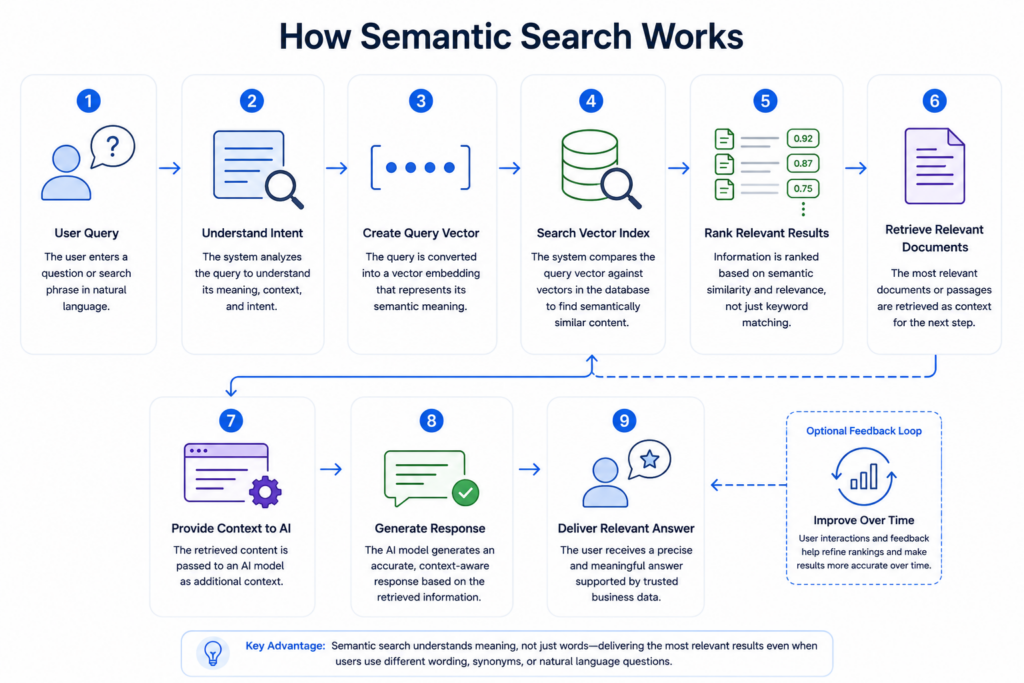
A typical Semantic Search process looks like this:
A user enters a question or search phrase.
The query is analysed to understand its meaning.
The query is converted into a semantic representation.
Documents stored in the knowledge base are compared based on similarity.
The most relevant content is ranked and returned.
If combined with an AI model, the retrieved information can be used to generate a natural language response.
Because the search is based on meaning, users often receive useful results even if they misspell words, use different terminology, or ask complete questions instead of typing short keyword phrases.
What Are the Benefits of Semantic Search
Finds Information More Accurately
Users receive results that match what they mean instead of only what they type, reducing unsuccessful searches.
Understands Natural Language
People can search using complete questions or everyday language without needing to know the exact terminology used in the documents.
Improves Enterprise Knowledge Discovery
Employees can locate policies, manuals, project documents, and technical information much faster across large knowledge repositories.
Delivers Better Customer Experiences
Customers receive more relevant search results, making it easier to find products, support articles, FAQs, and documentation.
Supports Modern AI Applications
Semantic Search provides the relevant business context needed for AI assistants, enterprise chatbots, and Retrieval-Augmented Generation (RAGRetrieval-Augmented Generation (RAG) is an AI architecture that combines a large language model (LLM) with an external knowledge source, allowing AI systems to retrieve relevant information before generating a response. This approach helps deliver answers that are more accurate, up-to-date, and grounded in trusted business data. More) solutions.
Scales Across Large Content Libraries
Whether an organisation stores hundreds or millions of documents, Semantic Search continues to organise and retrieve information based on meaning instead of manual tagging alone.
Real-World Business Example of Semantic Search
Imagine a healthcare provider with thousands of clinical guidelines, treatment protocols, insurance documents, and patient education resources.
A clinician searches for:
“How should diabetes medication be adjusted before surgery?”
The relevant guidance may not contain that exact sentence. One document might use the phrase “pre-operative medication management for diabetic patients,” while another discusses insulin adjustments before procedures.
A keyword-based search may overlook important documents because the wording differs.
Semantic Search recognises that these phrases describe the same topic.
It returns the most relevant guidance regardless of the exact wording, allowing clinicians to find trusted information more quickly and spend less time searching through multiple documents.
How Evangelist Apps Uses Semantic Search
At Evangelist Apps, we use Semantic Search to help organisations make better use of their business knowledge.
We integrate it into AI assistants, enterprise search platforms, document intelligence solutions, and customer support systems where finding the right information quickly is essential.
Rather than relying only on keyword matching, our solutions understand the intent behind user questions and retrieve information from trusted business sources.
We commonly combine Semantic Search with Large Language Models (LLMs), Retrieval-Augmented Generation (RAGRetrieval-Augmented Generation (RAG) is an AI architecture that combines a large language model (LLM) with an external knowledge source, allowing AI systems to retrieve relevant information before generating a response. This approach helps deliver answers that are more accurate, up-to-date, and grounded in trusted business data. More), Microsoft technologies, APIs, SharePoint, Dynamics 365, cloud storage, and custom knowledge repositories.
This approach helps organisations build AI systems that respond with relevant, context-aware information drawn from their own business data.
Whether the goal is improving internal knowledge access, enhancing customer self-service, or powering enterprise AI assistants, Semantic Search provides the foundation for more intelligent information retrieval.
Book a FREE 30-Min Consultation Call to discuss how Semantic Search can improve your AI applications, enterprise search, and knowledge management solutions.
Common Business Use Cases of Semantic Search
Semantic Search is widely used across modern digital platforms, including:
Enterprise knowledge management
AI-powered customer support
Internal employee search portals
Product and catalogue search
Legal and compliance document retrieval
Healthcare knowledge systems
Financial document discovery
Technical documentation search
Learning management platforms
Intelligent document management
Retrieval-Augmented Generation (RAGRetrieval-Augmented Generation (RAG) is an AI architecture that combines a large language model (LLM) with an external knowledge source, allowing AI systems to retrieve relevant information before generating a response. This approach helps deliver answers that are more accurate, up-to-date, and grounded in trusted business data. More)
AI knowledge assistants
Related Glossary Terms
Retrieval-Augmented Generation (RAGRetrieval-Augmented Generation (RAG) is an AI architecture that combines a large language model (LLM) with an external knowledge source, allowing AI systems to retrieve relevant information before generating a response. This approach helps deliver answers that are more accurate, up-to-date, and grounded in trusted business data. More)
Prompt EngineeringPrompt engineering is the practice of writing and refining instructions to help AI produce more accurate, useful results. More
AI AgentWhat is an AI Agent? One-Line Definition An AI Agent is an intelligent software system that can understand goals, make decisions, interact with tools and data, and complete tasks with minimal human intervention. Unlike traditional AI chatbots that primarily answer questions, AI agents can reason, plan, take actions, and continuously adapt to achieve specific business objectives. Why AI Agents Matter... More
Summarize with AI
Share:
Transform your
business! Build a
powerful mobile app
now!
Why Over 500 Clients Choose Evangelist Apps
Why Organizations Trust Us
25+ Years of Expertise. |
Global Reach |
Agile. Transparent. Fast
Our Recognized Certifications & Partnerships
About to leave?
Share your requirements with us, and we’ll provide you with a detailed estimate on cost and timeline