An AI Agent is an intelligent software system that can understand goals, make decisions, interact with tools and data, and complete tasks with minimal human intervention. Unlike traditional AI chatbots that primarily answer questions, AI agents can reason, plan, take actions, and continuously adapt to achieve specific business objectives.
Why AI Agents Matter for Businesses
Artificial Intelligence is moving beyond simply generating answers. Businesses now expect AI to complete work, automate processes, and make intelligent decisions rather than acting as a passive assistant.
This is where AI Agents come in.
An AI Agent doesn’t just respond to prompts. It can understand a business goal, decide the sequence of actions required, connect to multiple systems, retrieve information, execute tasks, and deliver meaningful outcomes.
For example, instead of answering “How do I schedule a meeting?”, an AI Agent could:
Check everyone’s calendars.
Find an available slot.
Send meeting invitations.
Book a meeting room.
Share relevant documents.
Notify participants automatically.
This shift from conversational AI to action-oriented AI is transforming how organisations operate.
AI Agents are increasingly becoming digital coworkers that support employees, automate repetitive work, improve customer experiences, and streamline business operations.
As enterprise AI matures, AI Agents are expected to become a core component of modern digital workplaces.
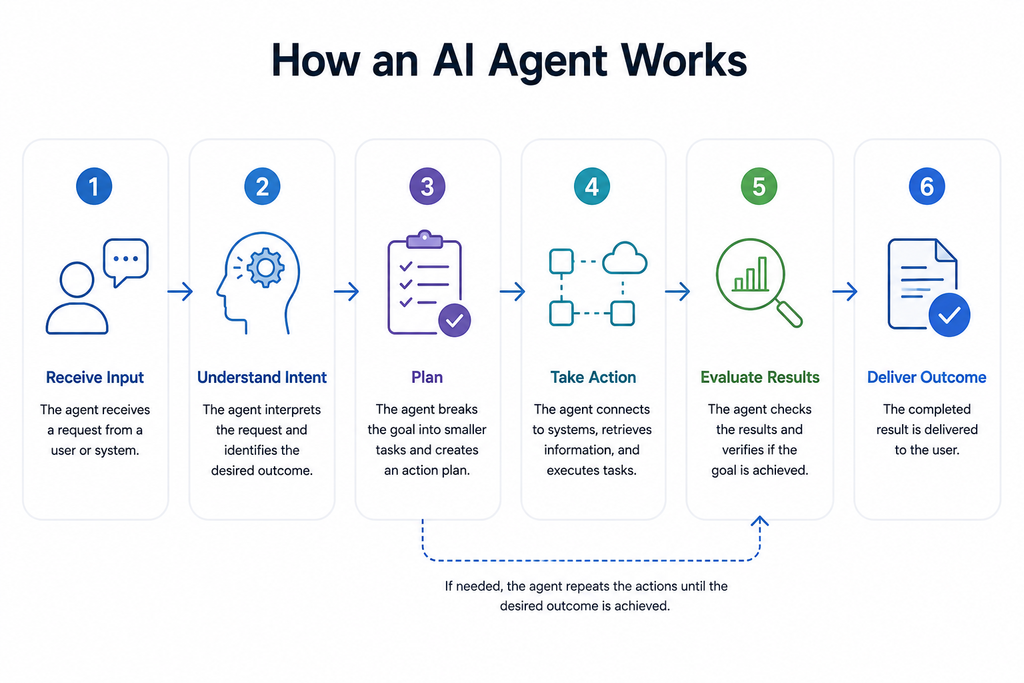
How an AI Agent Works
An AI Agent combines several AI technologies to understand objectives and complete tasks autonomously.
Rather than simply generating text, an AI Agent follows a reasoning process similar to how a human approaches a problem.
Step 1 – Receive Input
The agent receives a request from a user, another application, or an automated workflow.
Example:
“Generate this month’s sales report and email it to the management team.”
Step 2 – Understand Intent
Using a Large Language Model (LLM)Large Language Models (LLMs) are AI systems trained on vast amounts of text to understand and generate human-like language for tasks such as answering questions, creating content, and automating workflows. More, the agent interprets the user’s request and identifies the desired outcome.
Rather than focusing on keywords, it understands context, objectives, and business intent.
Step 3 – Plan
The agent breaks the objective into smaller tasks.
For example:
Retrieve sales data
Analyse performance
Generate charts
Create a report
Send an email
This planning stage allows the AI to solve multi-step business problems rather than answering a single question.
Step 4 – Take Action
The AI Agent connects to business systems such as:
CRM platforms
ERP systems
Microsoft 365
Dynamics 365
SharePoint
APIs
Databases
Cloud applications
It retrieves information, updates records, executes workflows, or triggers external systems depending on the task.
Step 5 – Evaluate Results
Before completing the task, the agent checks whether the objective has been achieved successfully.
If necessary, it may refine the output, request additional information, or repeat certain actions until the desired result is reached.
Step 6 – Deliver the Outcome
Finally, the completed result is delivered to the user.
Depending on the task, this may include:
A generated report
A completed workflow
A customer response
An updated database
A scheduled meeting
A business recommendation
The user receives the completed outcome rather than simply receiving instructions on how to perform the work.
Key Benefits of AI Agents
Intelligent Task Automation
AI Agents automate complete business processes rather than isolated activities, reducing manual effort and increasing operational efficiency.
Improved Productivity
Employees spend less time on repetitive administrative work and more time focusing on strategic initiatives that require human expertise.
Better Decision Support
AI Agents analyse information from multiple sources before recommending or taking action, helping organisations make more informed decisions.
Always Available
Unlike human teams, AI Agents can operate 24/7, supporting customers and employees across different time zones.
Connects Multiple Systems
AI Agents integrate seamlessly with business applications, cloud platforms, APIs, and enterprise software, eliminating information silos.
Learns and Improves
Modern AI Agents can refine their performance over time using user feedback, updated knowledge sources, and improved reasoning strategies.
Real-World Business Example of AI Agents
Imagine a recruitment company receiving hundreds of job applications every day.
Traditionally, recruiters manually review CVs, compare candidate skills, schedule interviews, send emails, and update the Applicant Tracking System (ATS).
An AI Agent can automate much of this workflow.
When a new application arrives, the agent reviews the CV, compares the candidate’s skills against the job description, ranks applicants based on predefined criteria, schedules interviews using integrated calendars, sends personalised email invitations, and updates the recruitment system automatically.
Recruiters remain in control of hiring decisions while the AI handles repetitive administrative work, allowing the team to focus on engaging with the best candidates.
How Evangelist Apps Builds AI Agents
At Evangelist Apps, we design and develop AI Agents that solve real business challenges rather than acting as simple conversational assistants.
Our AI solutions combine Large Language Models, Retrieval-Augmented Generation (RAGRetrieval-Augmented Generation (RAG) is an AI architecture that combines a large language model (LLM) with an external knowledge source, allowing AI systems to retrieve relevant information before generating a response. This approach helps deliver answers that are more accurate, up-to-date, and grounded in trusted business data. More), APIs, Microsoft technologies, cloud platforms, and enterprise systems to build intelligent digital assistants capable of understanding context, planning tasks, and executing business workflows.
Whether it’s automating customer service, streamlining internal operations, improving document management, or integrating AI into Microsoft Dynamics 365 and Microsoft Copilot, we build AI Agents that align with existing business processes while maintaining enterprise-grade security, scalability, and governance.
Our focus is on creating AI that delivers measurable business outcomes—not just impressive demonstrations.
AI Agents are transforming organisations across multiple industries.
Some of the most common applications include:
Customer support automation
Employee knowledge assistants
HR onboarding and recruitment
Sales qualification and CRM updates
Marketing campaign automation
Software development assistance
IT service desk support
Invoice processing
Workflow automation
Business intelligence reporting
Meeting scheduling
Document generation
Enterprise search
Supply chain coordination
Project management assistance
Related Glossary Terms
Large Language Model (LLM)Large Language Models (LLMs) are AI systems trained on vast amounts of text to understand and generate human-like language for tasks such as answering questions, creating content, and automating workflows. More
Retrieval-Augmented Generation (RAGRetrieval-Augmented Generation (RAG) is an AI architecture that combines a large language model (LLM) with an external knowledge source, allowing AI systems to retrieve relevant information before generating a response. This approach helps deliver answers that are more accurate, up-to-date, and grounded in trusted business data. More)
Prompt EngineeringPrompt engineering is the practice of writing and refining instructions to help AI produce more accurate, useful results. More
Generative AI
Fine-Tuning
Semantic SearchSemantic Search understands the meaning and intent behind a query to find relevant results, even when the exact words do not match. More
Vector Embeddings
Summarize with AI
Share:
Transform your
business! Build a
powerful mobile app
now!
Why Over 500 Clients Choose Evangelist Apps
Why Organizations Trust Us
25+ Years of Expertise. |
Global Reach |
Agile. Transparent. Fast
Our Recognized Certifications & Partnerships
About to leave?
Share your requirements with us, and we’ll provide you with a detailed estimate on cost and timeline