Natural Language Processing (NLP) is a branch of Artificial Intelligence (AI) that enables computers to understand, interpret, analyse, and generate human language. It allows software to work with written text and spoken language in a way that feels natural to people, powering applications such as chatbots, search engines, virtual assistants, translation tools, and document analysis platforms.
Why NLP Matters for Businesses
Businesses generate enormous volumes of unstructured information every day.
Emails, customer support tickets, contracts, meeting notes, social media conversations, product reviews, and internal documents all contain valuable business insights, but manually analysing this information is time-consuming and expensive.
Natural Language Processing enables organisations to automatically understand and process human language at scale.
Rather than treating text as simple words, NLP identifies meaning, context, relationships, sentiment, and intent, allowing businesses to extract actionable insights from large collections of data.
Modern AI assistants, enterprise search platforms, and conversational AI solutions rely heavily on NLP. It helps organisations improve customer experiences, automate repetitive work, accelerate decision-making, and make better use of their knowledge assets.
As Generative AI and Large Language Models continue to evolve, NLP remains one of the foundational technologies that enables AI to communicate naturally with people.
How Natural Language Processing Works
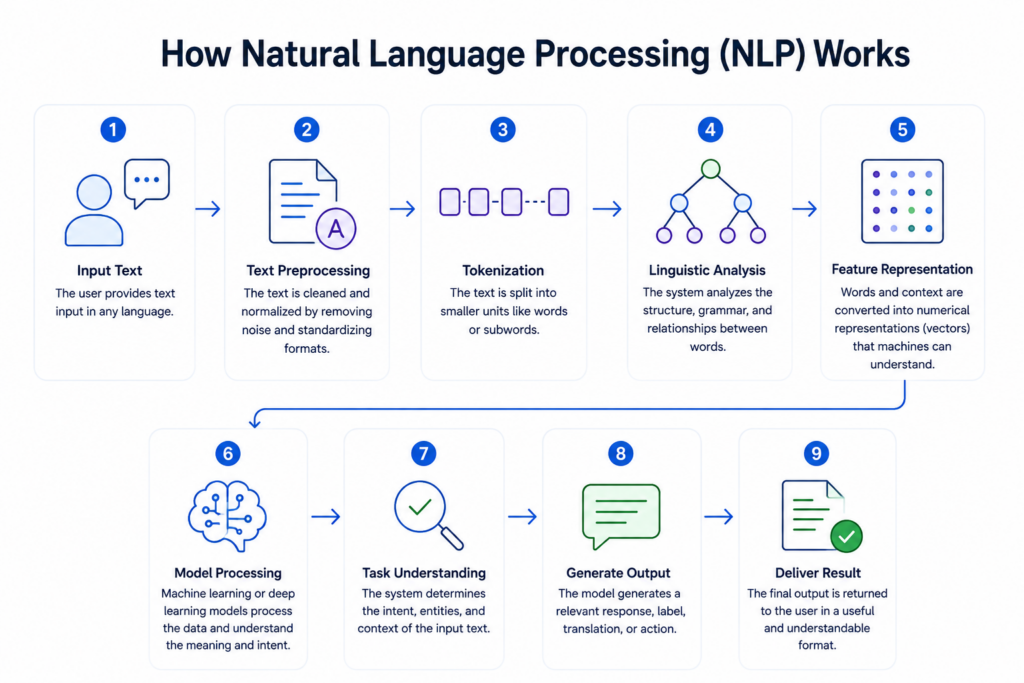
Natural Language Processing combines computational linguistics with machine learning and deep learning techniques to help computers understand language in a way that resembles human communication.
A typical NLP workflow involves several stages.
Step 1 – Receive Language Input
The system receives text or speech from a user.
Examples include:
Customer questions
Emails
Chat conversations
Voice commands
Business documents
Step 2 – Understand the Language
The NLP system breaks the content into words, sentences, and grammatical structures while identifying relationships between them.
It determines:
Keywords
Entities
Intent
Context
Sentiment
Rather than matching exact keywords, modern NLP understands how words relate to one another within a sentence.
Step 3 – Process the Meaning
Using machine learning models, the system interprets the meaning of the input.
For example, if a customer writes:
“My order hasn’t arrived yet and I’m disappointed.”
The NLP engine identifies:
Topic → Order Delivery
Intent → Customer Support
Sentiment → Negative
Entity → Order
This enables downstream systems to take appropriate action automatically.
Step 4 – Generate a Response
Once the information has been understood, the AI generates an appropriate response.
This could include:
Answering a question
Retrieving business information
Translating text
Summarising documents
Recommending actions
Triggering automated workflows
Modern enterprise AI combines NLP with Large Language Models (LLMs) and Retrieval-Augmented Generation (RAG) to generate responses that are conversational, context-aware, and based on trusted business knowledge.
What Are the Key Benefits of NLP
Makes Human Language Understandable to Computers
NLP allows software to understand everyday language instead of relying on rigid commands or keyword matching.
Improves Customer Experiences
Businesses can provide faster, more accurate responses through AI-powered chatbots, virtual assistants, and customer service platforms.
Automates Document Processing
NLP can analyse contracts, invoices, reports, policies, emails, and other business documents in seconds.
Extracts Business Insights
By analysing customer feedback, surveys, reviews, and conversations, NLP helps organisations identify trends, recurring issues, and opportunities for improvement.
Powers Enterprise Search
Rather than searching for exact keywords, NLP understands user intent and returns more relevant search results across business knowledge bases.
Supports Multilingual Communication
Modern NLP solutions can translate content, understand multiple languages, and enable organisations to communicate effectively with global customers.
Common NLP Applications in Business
Natural Language Processing powers many AI applications used every day, including:
AI-powered customer support
Virtual assistants
Enterprise search
Document summarisation
Sentiment analysis
Language translation
Speech recognition
Text classification
Intelligent email routing
Contract analysis
Meeting transcription
Knowledge management
Content moderation
Voice assistants
These applications help organisations automate knowledge-intensive tasks while improving efficiency and accuracy.
Real-World Business Example of NLP Usage
Imagine an insurance company receiving thousands of customer emails every week.
Without NLP, support teams would need to manually read each email, identify the issue, categorise the request, and assign it to the appropriate department.
With Natural Language Processing, the system automatically analyses each email, recognises the customer’s intent, detects urgency, identifies policy numbers or claim references, and routes the request to the correct team.
If the enquiry is straightforward, an AI assistant can even generate a personalised response instantly, reducing response times from hours to seconds while improving customer satisfaction.
How Evangelist Apps Uses NLP to Build AI-Powered Solutions
At Evangelist Apps, we use Natural Language Processing as a core capability within our enterprise AI solutions.
We build intelligent applications that understand business language, interpret customer queries, analyse documents, and automate knowledge-intensive workflows.
Our NLP-powered solutions are integrated with Large Language Models (LLMs), Retrieval-Augmented Generation (RAGRetrieval-Augmented Generation (RAG) is an AI architecture that combines a large language model (LLM) with an external knowledge source, allowing AI systems to retrieve relevant information before generating a response. This approach helps deliver answers that are more accurate, up-to-date, and grounded in trusted business data. More), Microsoft Copilot, Dynamics 365, APIs, and enterprise knowledge repositories to deliver accurate, context-aware AI experiences.
Whether it’s developing AI-powered customer support assistants, intelligent document search platforms, enterprise knowledge portals, or workflow automation solutions, we use NLP to help organisations unlock the value hidden within their business data.
Our focus is on creating AI solutions that improve productivity, enhance decision-making, and deliver measurable business outcomes.
Although often used together, NLP and LLMs are not the same thing.
Natural Language Processing is the broader field of AI that enables computers to understand and work with human language.
Large Language Models are advanced AI models trained on massive amounts of text that perform many NLP tasks, such as answering questions, generating content, summarising documents, and translating languages.
In simple terms:
NLP is the discipline.
LLMs are one of the most powerful technologies within that discipline.
Related Glossary Terms
Large Language Model (LLM)Large Language Models (LLMs) are AI systems trained on vast amounts of text to understand and generate human-like language for tasks such as answering questions, creating content, and automating workflows. More
Retrieval-Augmented Generation (RAGRetrieval-Augmented Generation (RAG) is an AI architecture that combines a large language model (LLM) with an external knowledge source, allowing AI systems to retrieve relevant information before generating a response. This approach helps deliver answers that are more accurate, up-to-date, and grounded in trusted business data. More)
Semantic SearchSemantic Search understands the meaning and intent behind a query to find relevant results, even when the exact words do not match. More
Vector Embeddings
AI AgentWhat is an AI Agent? One-Line Definition An AI Agent is an intelligent software system that can understand goals, make decisions, interact with tools and data, and complete tasks with minimal human intervention. Unlike traditional AI chatbots that primarily answer questions, AI agents can reason, plan, take actions, and continuously adapt to achieve specific business objectives. Why AI Agents Matter... More
Generative AI
Summarize with AI
Share:
Transform your
business! Build a
powerful mobile app
now!
Why Over 500 Clients Choose Evangelist Apps
Why Organizations Trust Us
25+ Years of Expertise. |
Global Reach |
Agile. Transparent. Fast
Our Recognized Certifications & Partnerships
About to leave?
Share your requirements with us, and we’ll provide you with a detailed estimate on cost and timeline