Fine-Tuning is the process of further training a pre-trained AI model on a smaller, specialised dataset so it performs better for a specific task, industry, behaviour, or type of output.
Why Fine Tuning Matters for Businesses
A general AI model can handle many types of requests, but businesses often need more specific behaviour.
For example, a company may want an AI system to classify support tickets according to its own categories, generate responses in a particular format, understand industry-specific terminology, or follow a consistent communication style.
Fine tuning adapts an existing model for these requirements by training it with examples that represent the task the business needs it to perform.
This can be useful when an organisation needs consistent model behaviour across a large number of similar requests. Instead of repeatedly explaining the expected format or behaviour through prompts, the desired patterns can be incorporated into the model through additional training.
Fine-Tuning is especially relevant for specialised classification, structured output, domain-specific language, and tasks where consistent behaviour matters.
It is also important to understand what Fine-Tuning does not solve.
If the main requirement is giving an AI model access to frequently changing company information, Fine-Tuning may not be the right approach.
A Retrieval-Augmented Generation (RAGRetrieval-Augmented Generation (RAG) is an AI architecture that combines a large language model (LLM) with an external knowledge source, allowing AI systems to retrieve relevant information before generating a response. This approach helps deliver answers that are more accurate, up-to-date, and grounded in trusted business data. More) system can provide the model with current information from an external knowledge source without retraining the model every time the underlying information changes.
How Fine Tuning Works
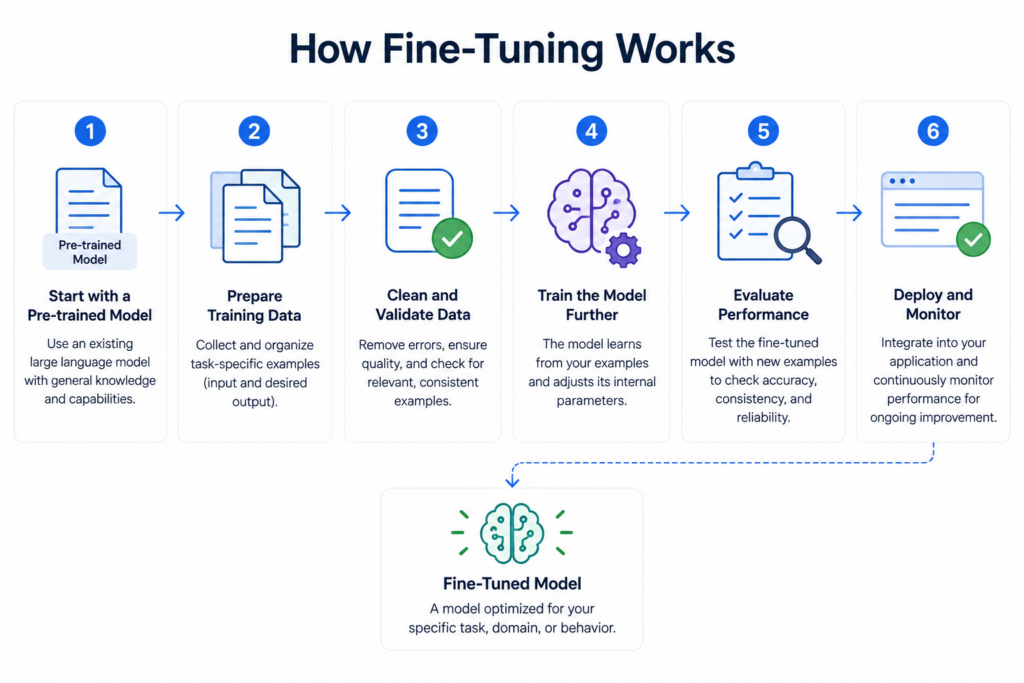
Fine-Tuning starts with an existing pre-trained AI model. Instead of training a model from the beginning, developers provide additional examples that represent the task or behaviour the model needs to learn.
The process usually involves the following steps:
Step 1 – Define the Task
The first step is to identify exactly what the model needs to do.
For example:
Classify customer support requests
Generate structured product descriptions
Extract information from documents
Follow a specific response format
Understand specialised industry terminology
A clearly defined task makes it easier to create useful training examples.
Step 2 – Prepare the Training Data
The business prepares examples that demonstrate the desired input and output.
For a customer support application, a dataset might contain customer messages paired with the correct category.
For example:
“How can I reset my account password?”
→ Account Access
“Where can I download my previous invoices?”
→ Billing
The dataset should represent the types of requests the model will encounter in the actual application.
Step 3 – Clean and Review the Dataset
Training data needs to be checked before it is used.
Incorrect labels, duplicate examples, irrelevant information, inconsistent formatting, and sensitive data can affect the quality of the resulting model.
The examples should also cover enough variations of the task so the model learns the intended pattern instead of simply memorising a small set of examples.
Step 4 – Train the Model Further
The prepared dataset is used to continue training the pre-trained model.
During this stage, the model adjusts some of its internal parameters based on the training examples. The goal is to make the model more likely to produce the desired type of output when it encounters similar inputs.
Fine-Tuning does not normally involve rebuilding the entire AI model from scratch. It starts with capabilities the model has already learned and adapts them for the target task.
Step 5 – Evaluate the Fine-Tuned Model
The resulting model is tested using examples that were not included in its training data.
Developers compare its performance against the original model and check whether it follows the required behaviour consistently.
Testing can include accuracy, formatting, classification quality, response consistency, and performance on unfamiliar examples.
Step 6 – Deploy and Monitor
Once the model meets the required performance level, it can be integrated into the business application.
Its performance should continue to be monitored because real-world data can differ from the examples used during training. New examples can also reveal cases where the model needs further improvement.
What Are the Benefits of Fine Tuning
More Consistent Outputs
Fine-Tuning can help a model follow a specific response pattern or classification system more consistently across repeated tasks.
Better Performance on Specialised Tasks
A general-purpose model can be adapted to perform a narrower task using examples from the business domain.
Reduced Dependence on Long Prompts
When specific behaviour has been learned through Fine-Tuning, applications may require fewer detailed instructions in every request.
Better Understanding of Domain Language
Training with relevant examples can help a model handle specialised terminology, abbreviations, and language patterns used within a particular industry or organisation.
Improved Structured Output
Fine-Tuning can be useful when an application requires predictable output formats, such as predefined categories, fields, labels, or response structures.
Reusable Model Behaviour
Once a model has been fine-tuned for a particular task, the adapted model can be used across multiple requests without rebuilding the desired behaviour through prompts each time.
Real-World Business Example of Fine-Tuning
Consider a company that operates a large customer support center.
Its support team receives thousands of messages covering account access, billing, technical problems, cancellations, product questions, and other requests.
A general-purpose AI model may understand these messages but could produce inconsistent categories or classify similar requests differently.
The company can create a training dataset containing real support messages paired with the correct internal categories. The model is then fine-tuned using these examples.
After Fine-Tuning, a new message such as:
“Why was I charged twice for my subscription?”
can be classified according to the company’s own support taxonomy.
The resulting classification can then be passed to the appropriate workflow or support team. This can reduce manual ticket sorting and provide a consistent starting point for downstream automation.
How Evangelist Apps Uses Fine Tuning
At Evangelist Apps, Fine-Tuning is used when an AI application requires specialised model behaviour that cannot be achieved reliably through prompting and external knowledge retrieval alone.
For example, fine-tuning can fit applications that need consistent classification, structured outputs, domain-specific language handling, or a particular response behaviour across a high volume of interactions.
We can combine Fine-Tuning with other components of an enterprise AI architecture, including Large Language Models (LLMs), Retrieval-Augmented Generation (RAG), Semantic SearchSemantic Search understands the meaning and intent behind a query to find relevant results, even when the exact words do not match. More, APIs, Microsoft technologies, cloud services, and custom business applications.
The choice depends on the actual problem.
If an AI system needs access to changing company information, RAGRetrieval-Augmented Generation (RAG) is an AI architecture that combines a large language model (LLM) with an external knowledge source, allowing AI systems to retrieve relevant information before generating a response. This approach helps deliver answers that are more accurate, up-to-date, and grounded in trusted business data. More may be more appropriate. If the system needs to learn a repeatable behaviour or specialised task from examples, Fine-Tuning can be considered.
For businesses developing customer support assistants, document processing systems, internal AI tools, or specialised automation workflows, we can assess where Fine-Tuning fits within the wider application architecture.
Fine-Tuning and Retrieval-Augmented Generation solve different problems.
Fine-Tuning changes how a model behaves by training it on specialised examples. It is useful when the model needs to learn a particular task, output style, classification system, or domain-specific behaviour.
RAG gives an AI model access to external information at the time of a request. It is useful when the model needs to answer questions using business documents, databases, knowledge bases, or other information that can change over time.
A simple way to decide between them is:
Requirement
Better fit
Teach the model a specific behaviour
Fine-tuning
Improve consistent classification
Fine-tuning
Produce a particular output structure
Fine-tuning
Answer using current company documents
RAGRetrieval-Augmented Generation (RAG) is an AI architecture that combines a large language model (LLM) with an external knowledge source, allowing AI systems to retrieve relevant information before generating a response. This approach helps deliver answers that are more accurate, up-to-date, and grounded in trusted business data. More
Search an internal knowledge base
RAGRetrieval-Augmented Generation (RAG) is an AI architecture that combines a large language model (LLM) with an external knowledge source, allowing AI systems to retrieve relevant information before generating a response. This approach helps deliver answers that are more accurate, up-to-date, and grounded in trusted business data. More
Provide information that changes frequently
RAGRetrieval-Augmented Generation (RAG) is an AI architecture that combines a large language model (LLM) with an external knowledge source, allowing AI systems to retrieve relevant information before generating a response. This approach helps deliver answers that are more accurate, up-to-date, and grounded in trusted business data. More
Need specialised behaviour plus current business data
RAGRetrieval-Augmented Generation (RAG) is an AI architecture that combines a large language model (LLM) with an external knowledge source, allowing AI systems to retrieve relevant information before generating a response. This approach helps deliver answers that are more accurate, up-to-date, and grounded in trusted business data. More + Fine-tuning
Fine-Tuning and RAGRetrieval-Augmented Generation (RAG) is an AI architecture that combines a large language model (LLM) with an external knowledge source, allowing AI systems to retrieve relevant information before generating a response. This approach helps deliver answers that are more accurate, up-to-date, and grounded in trusted business data. More can also be used together.
Fine-Tuning can adapt model behaviour while RAGRetrieval-Augmented Generation (RAG) is an AI architecture that combines a large language model (LLM) with an external knowledge source, allowing AI systems to retrieve relevant information before generating a response. This approach helps deliver answers that are more accurate, up-to-date, and grounded in trusted business data. More supplies the information required for a particular request.
You can learn more about it in our detailed guide:
Fine-Tuning is worth considering when the same specialised task is performed repeatedly and the desired behaviour can be represented through a suitable set of training examples.
Common signs that Fine-Tuning may be appropriate include:
The model needs to follow a specific classification system.
Outputs need to follow a consistent structure.
The application uses specialised terminology.
Prompt-based instructions are becoming lengthy or difficult to maintain.
The task is repeated at high volume.
The business has enough high-quality examples to represent the desired behaviour.
Fine-Tuning may be unnecessary when the main problem is simply that the model lacks access to the latest business information. In that situation, connecting the model to an appropriate knowledge source through RAGRetrieval-Augmented Generation (RAG) is an AI architecture that combines a large language model (LLM) with an external knowledge source, allowing AI systems to retrieve relevant information before generating a response. This approach helps deliver answers that are more accurate, up-to-date, and grounded in trusted business data. More may be a better architectural choice.
Common Business Use Cases of Fine Tuning
Fine-Tuning can be applied to specialised AI tasks such as:
Retrieval-Augmented Generation (RAGRetrieval-Augmented Generation (RAG) is an AI architecture that combines a large language model (LLM) with an external knowledge source, allowing AI systems to retrieve relevant information before generating a response. This approach helps deliver answers that are more accurate, up-to-date, and grounded in trusted business data. More)
Semantic SearchSemantic Search understands the meaning and intent behind a query to find relevant results, even when the exact words do not match. More
AI AgentWhat is an AI Agent? One-Line Definition An AI Agent is an intelligent software system that can understand goals, make decisions, interact with tools and data, and complete tasks with minimal human intervention. Unlike traditional AI chatbots that primarily answer questions, AI agents can reason, plan, take actions, and continuously adapt to achieve specific business objectives. Why AI Agents Matter... More
Summarize with AI
Share:
Transform your
business! Build a
powerful mobile app
now!
Why Over 500 Clients Choose Evangelist Apps
Why Organizations Trust Us
25+ Years of Expertise. |
Global Reach |
Agile. Transparent. Fast
Our Recognized Certifications & Partnerships
About to leave?
Share your requirements with us, and we’ll provide you with a detailed estimate on cost and timeline