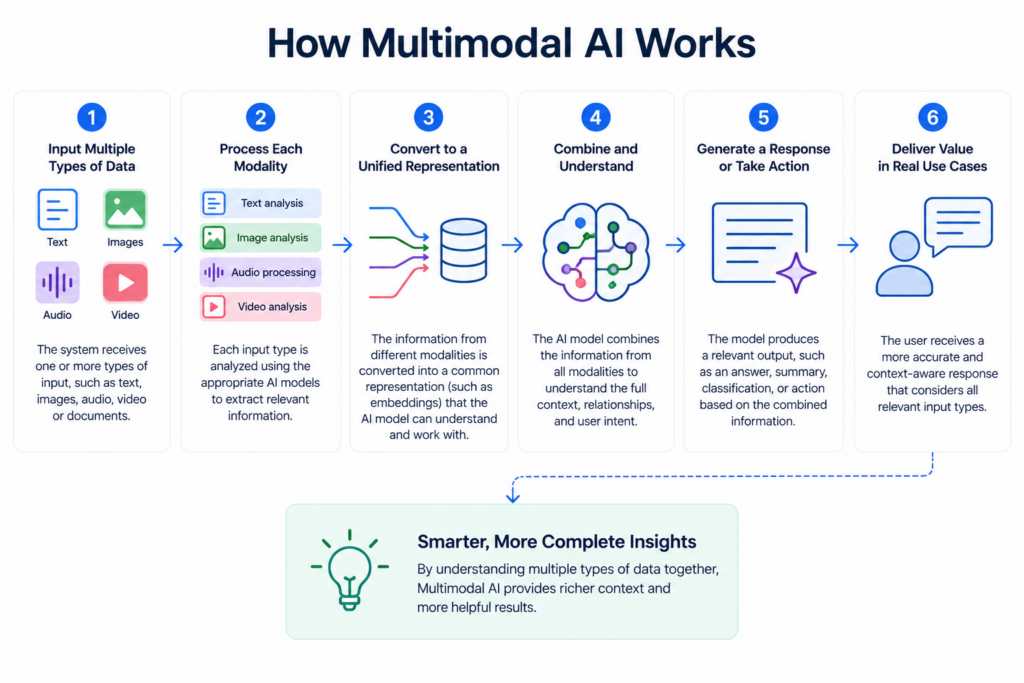
Multimodal AI is an artificial intelligence system that can process and understand more than one type of data, such as text, images, audio, video, or documents. It combines information from different formats to understand a situation and produce an appropriate response or action.
Why Multimodal AI Matters for Businesses
Business information rarely exists in one format.
A customer may send a written message with a photograph.
An employee may upload a PDF containing text, tables, and images.
A technician may record a video of a machine problem and add a voice description.
A financial team may need AI to interpret documents alongside numerical data.
Traditional AI applications often handle these inputs separately.
A text-based system may understand written information but have limited ability to interpret an image.
A speech system may convert audio into text before another system processes it.
Multimodal AI can work with different types of information within the same AI workflow. This gives an application more context when a task depends on information contained across multiple formats.
For businesses, this can support applications such as visual inspection, document processing, customer support, voice assistants, medical image analysis, product search, and field-service automation.
The practical value depends on the task.
If the required information exists only as text, a text-based AI system may be sufficient. Multimodal AI becomes useful when important information is spread across different data types.
Key Components Used in Multimodal AI Systems
A production Multimodal AI application can contain several components depending on its requirements:
Multimodal AI model – The model processes multiple types of information and determines relationships between them.
Large Language Model – An LLM can interpret language-based instructions and generate natural-language responses. Some modern models also support visual and other modalities directly.
Computer vision –Computer vision models can analyse visual information such as photographs, scans, screenshots, and video frames.
Speech processing – Speech technologies can convert spoken language into machine-readable information and, where required, generate spoken responses.
Retrieval-Augmented Generation –RAGRetrieval-Augmented Generation (RAG) is an AI architecture that combines a large language model (LLM) with an external knowledge source, allowing AI systems to retrieve relevant information before generating a response. This approach helps deliver answers that are more accurate, up-to-date, and grounded in trusted business data. More can provide the AI model with relevant information from company documents, databases, or knowledge repositories when the application needs external business knowledge.
6. APIs and business systems – APIs connect the AI workflow to applications such as CRM, ERP, service management, document management, and other enterprise systems.
How Multimodal AI Works in Practice
Multimodal AI processes different forms of input and combines the information into a representation that an AI model can use to understand the request.
The exact architecture varies between AI systems.
Some models can process multiple modalities directly, while other applications use separate models for individual data types and combine their outputs.
A typical multimodal AI workflow includes the following steps:
Step 1 – Receive multimodal input
The system receives one or more types of input.
For example, a customer might submit:
A written description of a damaged product
A photograph showing the damage
A voice message explaining what happened
Step 2 – Process each data type
The system analyses the incoming information according to its format.
Text can be processed for meaning and intent. Images can be analysed for objects, visual characteristics, or patterns. Audio can be processed for spoken words and other relevant signals. Video can provide information across a sequence of frames.
Step 3 – Convert information into a usable representation
The different inputs are transformed into representations that allow the AI system to work with the information.
For example, an image may be represented through visual features while text is represented through language features.
Step 4 – Combine the information
The system brings the information from different modalities together.
This is where the AI can connect information that would be difficult to understand from one input alone.
For example, the photograph may show a cracked component while the customer’s text explains that the crack appeared after installation.
Step 5 – Understand the task
The AI model uses the combined information to determine what the user is asking and what information is relevant to the task.
The system may need to answer a question, classify an object, extract information, identify a problem, or recommend an action.
Step 6 – Generate the result
The system produces an output based on the available information.
Depending on the application, the result could be:
A written answer
A classification
A summary
Extracted information
A recommendation
A generated image or other media
An action within a connected business system
This allows a single AI workflow to work with information that comes from several sources and formats.
How Multimodal AI Differs from Traditional AI
Traditional AI applications are often designed around a specific type of input.
For example:
A text classification system processes written text.
A speech recognition system processes audio.
A computer vision system processes images.
A video analysis system processes video.
Multimodal AI can combine two or more of these information types within the same task.
For example, an AI customer support application could receive a customer’s written question and an uploaded product photograph. The text provides the customer’s explanation, while the image provides visual evidence. The AI can use both when determining the appropriate response.
The distinction is therefore about how information is handled within the AI workflow. A multimodal system can reason over multiple input types when the application requires them.
Multimodal AI vs Generative AI: Are They Same?
Multimodal AI and Generative AI describe different aspects of an AI system.
Multimodal AI refers to the types of information an AI system can process or work with, such as text, images, audio, and video.
Generative AI refers to AI systems that can create new content based on their inputs, such as text, images, audio, code, or other media.
The two can overlap.
A Multimodal AI system can use Generative AI to produce a response after processing information from several modalities.
For example, an application could analyse a product photograph and a written customer complaint, then generate a text response explaining the next steps.
What Are the Benefits of Multimodal AI for Businesses
1. Understands More Complete Information
When relevant information is distributed across text, images, audio, or video, Multimodal AI can consider those inputs together.
2. Reduces Manual Data Conversion
Businesses may not need to manually convert every image, recording, or document into text before an AI system can process it.
3. Improves Document Processing
Multimodal AI can analyse documents where meaning depends on both written content and visual elements such as tables, diagrams, forms, or scanned pages.
4. Supports Natural User Interactions
Users can communicate with an AI system through combinations of text, voice, images, and other inputs instead of relying on a single input format.
5. Enables Visual Understanding
AI applications can analyse photographs, product images, equipment images, screenshots, and other visual information as part of a larger workflow.
6. Supports More Practical Automation
When an AI system can interpret multiple types of business data, more complex workflows can be automated from the initial input through to the final action.
Real-World Business Example of Multimodal AI
Consider an equipment manufacturer that provides field-service support.
A technician working at a customer site discovers a damaged component. Instead of typing a detailed description, the technician uploads a photograph of the component and records a short voice message describing the problem.
A Multimodal AI system can analyse the photograph alongside the technician’s description. It can identify the visible component, understand the reported issue, compare the information with relevant service documentation, and return troubleshooting guidance.
If connected to the company’s service system, the workflow could also extract the equipment details, identify the relevant service procedure, and prepare information for a support ticket.
The technician gets assistance from the information already available at the work site without having to manually convert every piece of information into a text-based request.
Common Business Use Cases of Multimodal AI
Multimodal AI can be used in applications where information comes in different formats.
Common use cases include:
Intelligent document processing
Visual quality inspection
Customer support with image uploads
Voice-enabled AI assistants
Medical image and document analysis
Product image search
Field-service assistance
Manufacturing inspection
Insurance claim assessment
Retail product analysis
Video content analysis
Accessibility applications
Education and training systems
Security and compliance monitoring
AI-powered enterprise assistants
How Evangelist Apps Uses Multimodal AI
At Evangelist Apps, we use Multimodal AI into business applications when a workflow depends on more than one type of information.
For example, an enterprise application may need to understand customer messages alongside uploaded images, process documents containing text and visual elements, or allow employees to interact with an AI assistant through voice and text.
Our AI development work usually combines multimodal AI capabilities with Large Language Models (LLMs), Retrieval-Augmented Generation (RAG), Semantic SearchSemantic Search understands the meaning and intent behind a query to find relevant results, even when the exact words do not match. More, APIs, cloud services and custom software applications.
This is particularly useful when an organisation has existing business data in different formats and wants a single application to process that information within a defined workflow.
For example, a field-service application could accept a technician’s photograph and written description, retrieve the relevant service documentation, and use AI to help identify the appropriate troubleshooting procedure.
The right architecture depends on the business task, available data, security requirements, and the type of AI model being used.
Multimodal AI is worth considering when a business process depends on information that cannot be fully represented through one data type.
It can be a good fit when:
Customers regularly submit images with support requests.
Employees work with documents containing text, tables, and diagrams.
Field workers need to share photographs, voice notes, or video.
Visual information affects a business decision.
Users need to interact with an AI system through voice and text.
Information from different formats needs to be considered together.
If the application only needs to process text, adding multimodal capabilities may add unnecessary complexity. The technology should match the actual information requirements of the workflow.
Retrieval-Augmented Generation (RAGRetrieval-Augmented Generation (RAG) is an AI architecture that combines a large language model (LLM) with an external knowledge source, allowing AI systems to retrieve relevant information before generating a response. This approach helps deliver answers that are more accurate, up-to-date, and grounded in trusted business data. More)
Semantic SearchSemantic Search understands the meaning and intent behind a query to find relevant results, even when the exact words do not match. More